Time in Mumbai is not measured in hours.
It is measured in train timings.
“9:14 Fast.”
“7:32 Slow.”
“Churchgate side window seat.”
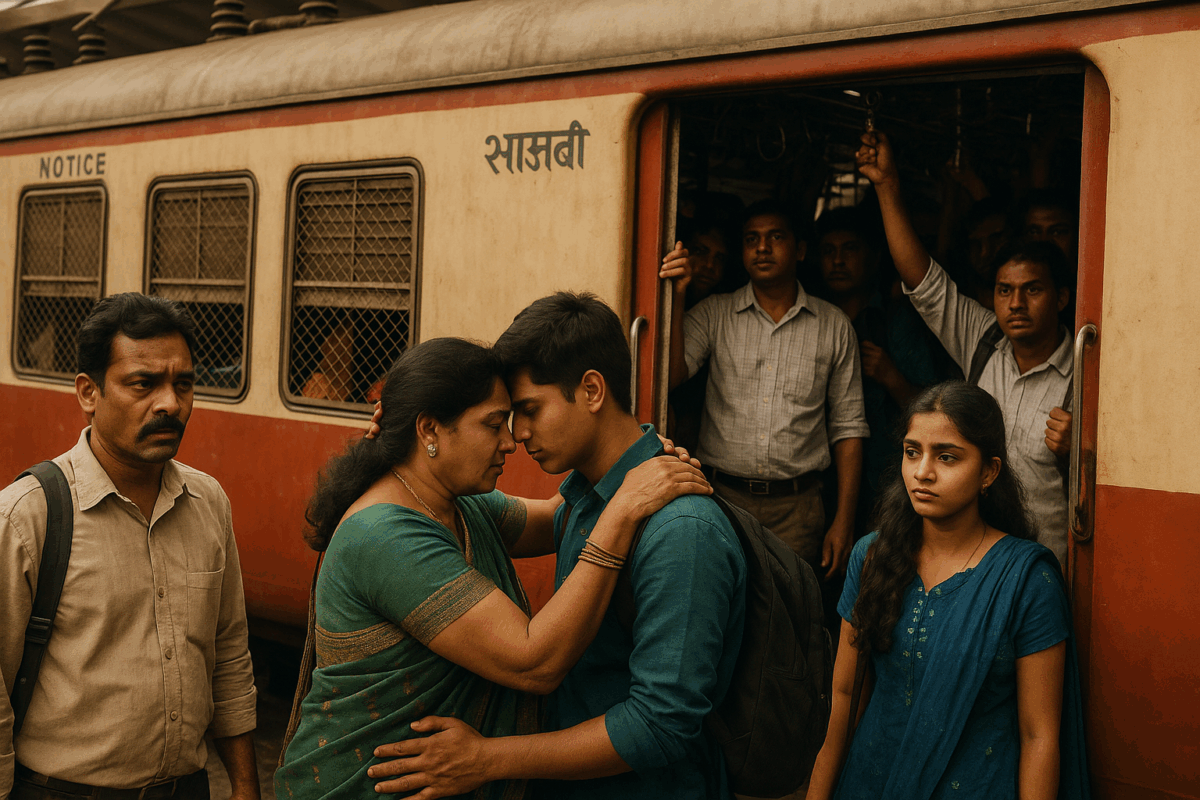
For millions, the Mumbai Local is not just a train — it is routine, identity, culture, survival, emotion, and connection compressed into metal coaches running on rail tracks.
Most cities grow around transport.
Mumbai grew because of its trains.
A City That Starts Moving Before It Wakes
It is 8:47 AM at Borivali station.
The platform vibrates before the train arrives.
You don’t need an announcement — your body knows.
- The pushing.
- The rhythm of footsteps.
- The synchronized boarding.
- The unspoken agreements.
- The occasional smile in the chaos.
Mumbai does not wake up slowly.
It rushes into life with the arrival of the first train.
Here, movement is survival. Stillness is luxury.
The First Breath of the Lifeline
The story begins on 16 April 1853, with India’s first passenger train:
Bombay to Thane, 34 km.
What started as a colonial infrastructure project slowly became the arterial system of an entire city.
Today:
| Route | Line | Passengers/Day |
|---|---|---|
| Churchgate ↔ Virar | Western | ~3.5 million |
| Chhatrapati Shivaji Maharaj Terminus ↔ Kalyan | Central | ~3.3 million |
| CSMT ↔ Panvel & Andheri ↔ Panvel | Harbour | ~1+ million |
Total: Over 8 million people travel daily — more than the entire population of some countries.
On these tracks, Mumbai breathes.
The Invisible Order Inside Chaos
To outsiders, the Mumbai Local looks like madness.
To those inside, it is mathematical precision.
There are rules — not written, not spoken — but universally followed:
- Three stations seat-sharing system
- “4th aage, 2nd badme.”
- Window seat protocol:
Ask once, wait your turn. No arguments. - Ladies compartment communication runs like radio waves — faster than the internet.
- If someone falls, the train does not move until they stand back up.
- The moment someone coughs — five people offer Vicks, water, or home remedies.
In the most crowded space, humanity breathes the loudest.
Stories That Live Inside Coaches
You will never remember the faces.
But you will remember:
- The uncle who told stock market tips daily.
- The student group studying for MPSC exams together.
- The girl from Andheri who shared songs via Bluetooth in 2011.
- The man who ate poha every day like a ritual.
- The grandmother who distributed prasad on Ekadashi.
And sometimes…
A train journey becomes a chapter in someone’s life.
People have:
- Made friends here.
- Started businesses together.
- Found soulmates.
- Lost love.
- Met again after years.
- And shared silence without needing words.
Every compartment is a moving storybook.
When the City Stops Moving
Ask any Mumbaikar:
- Rains can flood roads.
- Strikes can shut markets.
- Power can go out.
But when the local trains stop,
Mumbai freezes.
Because:
- Offices cannot function.
- Markets cannot open.
- Dabbawalas cannot deliver.
- Students cannot reach exams.
- The city’s heartbeat pauses.
In 2005 floods, people walked on tracks — not to go home — but to keep hope moving.
Tradition Meets Technology
The system is old, but the innovation is constant.
- UTS Mobile Tickets
- QR Code Scanning – UTS QR Code Scan via doableyo
- App-based route maps – Station via doableyo
- Digital displays & GPS tracking
- Station escalators, CCTV, panic assistance
Yet…
The most important things are still:
- The guard’s whistle.
- The motorman’s judgment.
- The crowd’s collective discipline.
Technology helps movement.
But trust keeps the system alive.
The Mumbai Local Is a Teacher
If you have traveled in Mumbai locals long enough, they teach you:
| Lesson | Meaning |
|---|---|
| Adjust | Life is shared space. Make room. |
| Time is everything | One missed minute changes everything. |
| Strangers are not enemies | Help comes from unexpected places. |
| Chaos can have harmony | Life does not need to be perfect to work. |
The people of Mumbai are not strong by choice.
The city trains them to be.
Literally.
Conclusion: The Heartbeat Never Stops
A Mumbai Local is more than compartments and engines.
It is:
- Thousands of stories moving side by side.
- Millions of lives synchronized in motion.
- A reminder that we rise by moving together.
The Mumbai Local is not a train.
It is the shared heartbeat of a city that never stops.