🚆 Local Train Services in Jammu & Kashmir: Timings, Route Map & Travel Tips

Jammu and Kashmir, known for its breathtaking landscapes, is now becoming more accessible thanks to expanding rail connectivity. While the state doesn’t have Mumbai-style EMU local trains, the Banihal–Baramulla DEMU (Diesel Electric Multiple Unit) service acts as a lifeline for the people of the Kashmir Valley. If you’re a traveler, student, or just a curious local explorer, here’s your complete guide to local train services in Jammu & Kashmir.


🕒 Local Train Timetable: Banihal to Baramulla

Currently, Northern Railways operates multiple DEMU trains daily between Banihal and Baramulla, covering a distance of ~135 km with 17 halts in about 3 hours.

🚉 Sample Daily Train Timings:

Train No. From → To Departure Arrival Duration

74625 Banihal → Baramulla 07:00 10:10 3h 10m
74627 Banihal → Baramulla 14:05 16:55 2h 50m
74637 Banihal → Baramulla 09:10 12:30 3h 20m
74630 Baramulla → Banihal 11:30 14:40 3h 10m

🟢 Frequency: 5–6 DEMU pairs operate daily.

🔁 Tickets: Available at stations and via IRCTC.


🗺️ Route Map: Stations Covered

Here’s a quick overview of the local train journey from south to north:

Banihal → Qazigund → Anantnag → Srinagar → Budgam → Sopore → Baramulla

📍 Notable Stations:

Banihal (BAHL) – Gateway to Jammu region through the Pir Panjal Tunnel (India’s longest railway tunnel).

Qazigund (QG) – Often called the “Gateway to Kashmir”.

Anantnag (ANT) – A cultural and economic hub of South Kashmir.

Srinagar (SINA) – Station for the capital city, close to Dal Lake and major tourist sites.

Budgam (BDGM) – Known for saffron fields (in season).

Baramulla (BRML) – Northernmost railway station in India.


🧳 Travel & Tourism Tips

If you’re planning to explore Kashmir affordably, these DEMU trains are a hidden gem:

🌄 Scenic Value

Enjoy a panoramic view of the valley, especially while passing through the Pir Panjal range and lush meadows.

The Pir Panjal Railway Tunnel adds to the excitement of the journey.

🧭 Things to Do at Stops

Srinagar: Visit Dal Lake, Nishat Bagh, Shankaracharya Temple

Anantnag: Taste local wazwan cuisine; visit Martand Sun Temple nearby

Budgam/Sopore: Experience the charm of apple orchards and traditional Kashmiri village life

Baramulla: A base for visiting Gulmarg (approx. 1.5 hours away)

✅ Helpful Tips

Tickets: Mostly unreserved; arrive early for a seat.

Weather: Services may be delayed in harsh winters due to snow.

Local Transport: Autos, sumos, and taxis available at most stations.


🚧 What About Jammu Region?

Currently, there are no suburban or MEMU local trains in the Jammu–Udhampur–Katra region. Only long-distance express trains operate there. However, once the Udhampur–Banihal rail link is fully completed (as part of the USBRL project), a continuous Jammu–Baramulla corridor will allow more local train operations.


📌 Summary

Feature Details

Train Type DEMU (Local Passenger)
Route Banihal to Baramulla
Distance ~135 km
Duration ~3 hours
Best Time to Travel Spring, Autumn
Ticket Cost Very affordable (general class)
Tourist Friendly? Yes ✅


Whether you’re commuting, sightseeing, or just looking to explore the Kashmir Valley like a local, the Banihal–Baramulla DEMU trains offer a beautiful, budget-friendly, and scenic ride that reveals the soul of the region.

🌸 Understanding Ancient Chinese Art: A Timeless Heritage for Educators

Ancient Chinese Art is one of the oldest continuous artistic traditions in the world, offering deep insights into China’s rich culture, philosophy, religion, and daily life. For school teachers and education professionals, learning about this art form is not only essential for cultural education but also for enriching interdisciplinary lessons in history, literature, philosophy, and visual arts.


🏺 What is Ancient Chinese Art?

Ancient Chinese Art spans thousands of years, from the Neolithic era (around 5000 BCE) to the final imperial Qing Dynasty (ending in 1912). Each dynasty introduced new styles, techniques, and ideas — all deeply influenced by Confucianism, Daoism (Taoism), and Buddhism.

✨ Key Themes:

Harmony with nature

Balance and symmetry

Spiritual expression over realism

Respect for tradition and ancestors


🎨 Major Forms of Ancient Chinese Art (and Their Modern Relevance)

Below are the most influential types of Chinese art and how they can still be seen or used today.


🖌️ Calligraphy (书法 – Shūfǎ)

What it is:
Calligraphy is the art of beautiful writing using brush and ink. In China, it’s considered one of the highest forms of art.

Cultural Value:

Used by scholars and poets

Connected to self-discipline and moral integrity

Reflects the artist’s personality and energy

Modern Usage:

Still taught in Chinese schools

Used in branding, interior design, art therapy

Practiced as a meditative art

In the classroom:

Great for combining language learning with artistic practice

Introduces students to Chinese characters and symbolism


🖼️ Ink and Wash Painting (水墨画 – Shuǐmòhuà)

What it is:
Traditional Chinese landscape or flower-bird painting using ink on rice paper or silk. It focuses on expression, emotion, and simplicity.

Cultural Value:

Philosophical — rooted in Daoist ideals of nature and flow

Often features mountains, rivers, bamboo, birds

Modern Usage:

Still widely practiced

Influences contemporary art, stationery, digital wallpapers

In the classroom:

A creative way to connect with Chinese philosophy and environment

Encourage students to express nature in their own ink-based style


🍵 Ceramics and Porcelain (瓷器 – Cíqì)

    What it is:
    China revolutionized ceramic art, especially during the Tang and Ming dynasties. “China” even became a term for porcelain globally.

    Cultural Value:

    Used in royal courts, trade, tea culture

    Iconic blue-and-white patterns

    Modern Usage:

    Contemporary homeware and collectible art

    Porcelain-making is still a thriving industry in Jingdezhen, China

    In the classroom:

    Introduce students to world trade history via the Silk Road

    Hands-on clay or paper plate painting activities


    🧵 Silk Art and Embroidery (刺绣 – Cìxiù)

      What it is:
      Embroidery on silk fabric, often depicting flowers, birds, or dragons.

      Cultural Value:

      Symbol of wealth and artistic skill

      Integral part of imperial fashion and festivals

      Modern Usage:

      Luxury fashion and home décor

      Continues in traditional Chinese wedding garments and festivals

      In the classroom:

      Use images or fabric samples to explore texture, pattern, and storytelling

      Connect with textile art projects in craft classes


      🟩 Jade Carving (玉雕 – Yùdiāo)

        What it is:
        Jade was considered more valuable than gold. It was used for jewelry, spiritual amulets, and burial items.

        Cultural Value:

        Symbolizes purity, protection, and virtue

        Often shaped into dragons, phoenixes, and Buddha figures

        Modern Usage:

        Worn as lucky charms and wedding gifts

        Still gifted during Chinese New Year or important events

        In the classroom:

        Explore symbolism and story behind each carving

        Create clay or soap carvings as a class project


        ⚱️ Bronze Work

          What it is:
          Mainly used during the Shang and Zhou dynasties, bronze was cast into vessels, bells, and weapons for rituals.

          Cultural Value:

          Used for ancestor worship and royal ceremonies

          Marked with inscriptions and patterns

          Modern Usage:

          Museum exhibits

          Inspires modern sculpture and design

          In the classroom:

          Link to early metallurgy and civilizations

          Let students create faux “bronze” using papier-mâché or metallic paints


          🏯 Ancient Architecture

            What it is:
            Pagodas, temples, palaces, and bridges built with wood and stone in distinct sweeping roof styles.

            Cultural Value:

            Represents cosmic harmony and feng shui

            Reflects social order and spiritual beliefs

            Modern Usage:

            Preserved in heritage sites

            Influences East Asian architecture globally

            In the classroom:

            Use 3D models, drawing exercises, or VR tours

            Discuss structure, symmetry, and symbolism


            📚 Cross-Disciplinary Learning Opportunities

            Subject Integration Idea

            History Use ancient art to explore dynasties and societal structure
            Art Practice brush painting, calligraphy, and design motifs
            Geography Connect Silk Road trade and export of porcelain/jade
            Philosophy Teach Confucian, Taoist, and Buddhist values in art
            Language Learn Chinese characters and their meanings through art


            🧠 Why Should Teachers Learn and Teach Chinese Art?

            ✅ Promotes cultural empathy and global awareness

            ✅ Supports creativity and visual learning

            ✅ Connects art to deeper values and traditions

            ✅ Makes history more tangible and relatable

            ✅ Encourages appreciation of craftsmanship and patience


            🔖 Suggested Teaching Resources

            1. Books:

            The Arts of China by Michael Sullivan

            Chinese Calligraphy: An Introduction to Its Aesthetic and Technique by Edoardo Fazzioli

            1. Videos/Documentaries:

            China: A Century of Revolution (PBS)

            Treasures of Chinese Art (YouTube, National Palace Museum Taiwan)

            1. Virtual Museum Tours:

            The Palace Museum (Forbidden City)

            The British Museum: Chinese Art Collection

            1. Classroom Activities:

            DIY ink brush painting

            Clay “jade” sculpture project

            Chinese fan painting or scroll art

            Paper cutting with traditional Chinese motifs


            🧧 Conclusion

            Ancient Chinese Art is not just about visual beauty—it carries centuries of wisdom, philosophy, and innovation. For educators, it’s a powerful tool to help students understand a major world civilization and develop respect for diverse cultures.

            By integrating Chinese art into your curriculum, you don’t just teach history or craft—you bring ancient wisdom into modern learning.

            📜 Disclaimer for Students and Educators

            This article is intended for educational purposes only. Students and teachers are welcome to use the information in personal school projects, class presentations, and cultural activities. Content may be adapted or quoted with proper acknowledgment. Commercial use or redistribution of the material for profit is not permitted without prior permission.Please ensure that any project work based on this article maintains respect for cultural heritage and historical accuracy.
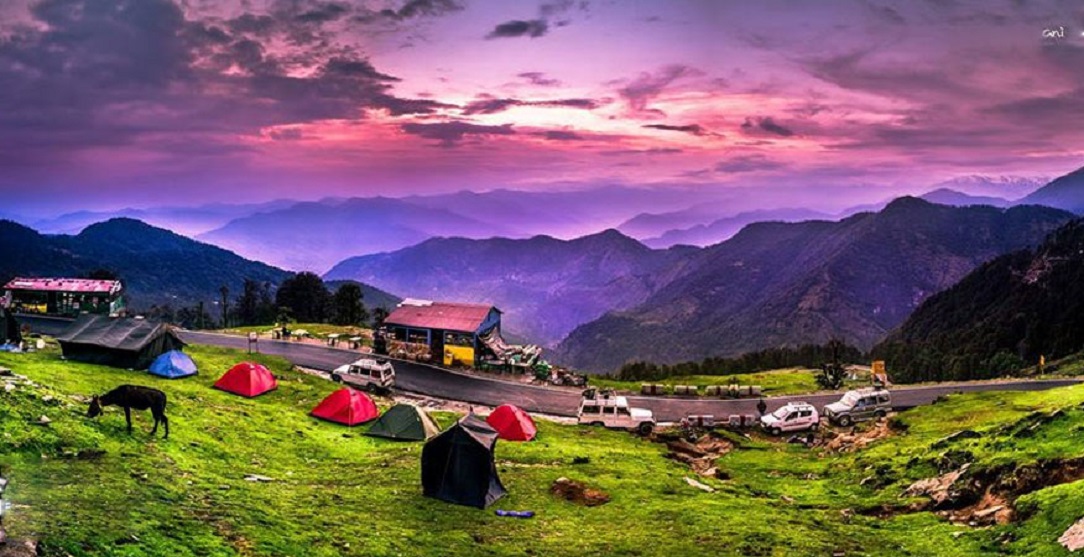
            🧭 15 Unknown Places in India (Bharat) That Will Take Your Breath Away

            Discover the soul of India through its quietest, most underrated gems.

            🌲 1. Chopta – Mini Switzerland of India, Uttarakhand

            A pristine hamlet in the Garhwal Himalayas, Chopta is surrounded by deodar forests and is the base for the world’s highest Shiva temple at Tungnath.

            Fun Fact: Chandrashila peak offers a view of Himalayan peaks including Nanda Devi and Trishul.

            📍 How to Reach:

            • Nearest Airport: Jolly Grant Airport, Dehradun (~225 km)
            • Railhead: Haridwar (~210 km)
            • By Road: Cabs from Rishikesh or Rudraprayag; winter months may need 4×4.

            ✅ What to Do Next:

            • Trek to Tungnath & Chandrashila
            • Camp at Deoria Tal
            • Birdwatching in Kedarnath Wildlife Sanctuary

            🔒 Safety:

            • Safe to travel year-round with proper gear
            • Solo travelers welcome, but avoid night treks
            • Signal loss is common; inform someone before trek

            🎒 Must-Carry:

            • Warm clothes, trekking shoes
            • Water bottle, snacks, offline maps
            • Torchlight, power bank

            🏞️ 2. Ziro Valley – The Tribal Paradise, Arunachal Pradesh

            A sustainable farming model, folk culture, and pine-clad hills make Ziro a timeless retreat.

            Cultural Insight: Apatani women once tattooed faces to deter tribal raids—now a fading tradition.

            📍 How to Reach:

            • Airport: Lilabari, Assam (~100 km)
            • Railhead: Naharlagun (~90 km)
            • Permit: ILP (Inner Line Permit) required for Indian citizens

            ✅ What to Do Next:

            • Explore Hong Village
            • Visit Talley Valley Sanctuary
            • Attend Ziro Music Festival

            🔒 Safety:

            • Very safe, peaceful tribal communities
            • Roads may be rough; keep buffer time
            • Monsoon landslides possible (June–August)

            🎒 Must-Carry:

            • ILP, mosquito repellent
            • Rain gear, comfortable shoes
            • Local SIM (Airtel, Jio work best)

            🐪 3. Guda Bishnoi Village – Eco Guardians, Rajasthan

            This desert village is a lesson in environmental conservation, led by the Bishnoi tribe.

            Did You Know? Bishnois sacrificed lives in 1730 to save trees—centuries before modern movements.

            📍 How to Reach:

            • Airport & Railhead: Jodhpur (~25 km)
            • By Road: Auto, taxi, or pre-arranged eco tour

            ✅ What to Do Next:

            • Jeep safari to spot blackbucks
            • Try pottery, weaving workshops
            • Watch sunset at Guda Lake

            🔒 Safety:

            • Extremely safe; friendly villagers
            • Day trips recommended
            • Follow eco-tourism guidelines

            🎒 Must-Carry:

            • Sunglasses, hat, sunscreen
            • Camera, binoculars
            • Water and local guide contact

            🏔️ 4. Phawngpui – Blue Mountain, Mizoram

            This sacred hill in Mizoram offers cloud forests and rare Himalayan species.

            Myth: Locals believe it’s home to mountain spirits; offerings are still made.

            📍 How to Reach:

            • Airport: Lengpui, Aizawl (~300 km)
            • By Road: Jeep/taxi from Aizawl

            ✅ What to Do Next:

            • Trek to Thaltlang village
            • Camp at Phawngpui National Park
            • Birdwatch rare butterflies & hornbills

            🔒 Safety:

            • Safe with guide, but fog can reduce visibility
            • Always trek during daylight
            • Solo travel not advised off-trail

            🎒 Must-Carry:

            • Trekking permits, raincoat
            • Compass, food, emergency whistle
            • Torch, insect spray

            🏞️ 5. Gandikota – Grand Canyon of India, Andhra Pradesh

            A gorge carved by the Pennar River, surrounded by red rock and history.

            Trivia: Gandikota Fort once housed a thriving market during the Vijayanagar empire.

            📍 How to Reach:

            • Railhead: Jammalamadugu (~18 km)
            • By Road: 4–5 hrs from Bengaluru or Tirupati

            ✅ What to Do Next:

            • Explore Gandikota Fort
            • Kayak in the Pennar River
            • Camp under the stars

            🔒 Safety:

            • Camping safe but isolated; group trips better
            • Fort walls can be steep; no rails

            🎒 Must-Carry:

            • Sunscreen, first-aid kit
            • Tent & torch if camping
            • Cash (no ATMs nearby)

            🌿 6. Agumbe – Cherrapunji of South India

            The king cobra’s rainforest home with unforgettable sunsets.

            Film Note: Many scenes from Malgudi Days were shot here.

            📍 How to Reach:

            • Airport: Mangalore (~100 km)
            • By Road: Buses/taxis from Udupi or Shivamogga

            ✅ What to Do Next:

            • Visit Barkana & Onake Abbi Falls
            • Sunset Point for views
            • Agumbe Rainforest Research Station

            🔒 Safety:

            • Safe in dry season (Oct–March)
            • Avoid night treks; cobra sightings common

            🎒 Must-Carry:

            • Poncho, anti-leech socks
            • Trekking shoes, whistle
            • Camera with rain protection

            🌿 7. Majuli Island – World’s Largest River Island, Assam

            A serene, spiritual, and ecologically significant river island on the Brahmaputra. Home to Neo-Vaishnavite culture.

            Cultural Insight: More than 20 Satras (monasteries) still practice ancient dance-drama arts like Sattriya.

            📍 How to Reach:

            • Airport: Jorhat (~20 km to ferry point)
            • By Road + Ferry: From Jorhat to Nimati Ghat, then 1-hour ferry to Majuli

            ✅ What to Do Next:

            • Visit Auniati & Kamalabari Satra
            • Watch mask-making at Samaguri
            • Cycle through paddy fields

            🔒 Safety:

            • Extremely safe; peaceful environment
            • Limited ATMs; carry cash
            • Seasonal flooding (July–Aug) may affect plans

            🏹 Must-Carry:

            • Sunhat, shades, raincoat
            • Insect repellent, torch, ID proof

            ⛺️ 8. Tawang – The Land of Monasteries, Arunachal Pradesh

            A high-altitude town with Buddhist spiritual energy, waterfalls, and Indo-China history.

            Did You Know? Tawang Monastery is the 2nd largest in the world after Lhasa.

            📍 How to Reach:

            • Airport: Tezpur or Guwahati (long drive after)
            • By Road: From Guwahati via Bomdila (~14 hrs)

            ✅ What to Do Next:

            • Visit Tawang Monastery & War Memorial
            • Day trip to Sela Pass & Madhuri Lake

            🔒 Safety:

            • Road safety depends on weather; avoid peak winter
            • Permit (ILP) required
            • Military zone; follow rules strictly

            🏹 Must-Carry:

            • Warm thermals, snow boots
            • Oxygen can (optional), medicine

            🏜️ 9. Patan – The Hidden Heritage Town, Gujarat

            Once a capital of Gujarat, now a forgotten marvel of Solanki architecture and Patola weaving.

            Fact: Rani Ki Vav, a stepwell, is a UNESCO World Heritage Site.

            📍 How to Reach:

            • Railhead: Mehsana (~50 km)
            • By Road: 2 hrs from Ahmedabad

            ✅ What to Do Next:

            • Explore Rani Ki Vav
            • Watch Patola saree weaving
            • Visit Sahasralinga Talav

            🔒 Safety:

            • Very safe, less crowded
            • Women travelers welcome

            🏹 Must-Carry:

            • Water bottle, camera
            • Sunblock, local guidebook

            ⛰️ 10. Kanatal – Quiet Himalayan Escape, Uttarakhand

            A calm hill station ideal for camping, valley views, and soul-soothing air.

            Note: Less crowded than nearby Mussoorie or Dhanaulti.

            📍 How to Reach:

            • Railhead: Dehradun
            • By Road: 3.5 hrs drive from Dehradun

            ✅ What to Do Next:

            • Camp under stars
            • Ziplining and jungle trails
            • Day trip to Tehri Lake

            🔒 Safety:

            • Safe for solo/couple travelers
            • Cold nights; pack accordingly

            🏹 Must-Carry:

            • Jacket, power bank, gloves
            • Snacks, camera tripod

            🐿️ 11. Daringbadi – Kashmir of Odisha

            A pine forest hill station with coffee gardens, tribal culture, and snowfall in Odisha!

            Surprise: It’s one of the few places in Eastern India to get snow.

            📍 How to Reach:

            • Nearest Airport: Bhubaneswar (~250 km)
            • By Road: Drive from Berhampur or Phulbani

            ✅ What to Do Next:

            • Visit coffee gardens & waterfalls
            • Tribal museum and markets

            🔒 Safety:

            • Safe with good roads
            • Less mobile connectivity in hills

            🏹 Must-Carry:

            • Sweaters, warm hat
            • Snacks, travel offline map

            ✨ 12. Chettinad – Mansions and Flavours, Tamil Nadu

            Not just food! Explore heritage homes, tile factories, and temples in this forgotten palace region.

            Fact: Chettinad mansions used Burma teak, Italian marble, and Belgian mirrors.

            📍 How to Reach:

            • Railhead: Karaikudi
            • By Road: 1.5 hrs from Madurai

            ✅ What to Do Next:

            • Explore Athangudi tile making
            • Stay in a Chettiar mansion
            • Eat authentic Chettinad thali

            🔒 Safety:

            • Very safe, peaceful
            • Best with a guide to unlock stories

            🏹 Must-Carry:

            • Light cotton wear
            • Notebook for architecture sketching

            ⛺️ 13. Halebidu – Temple Town of Forgotten Glory, Karnataka

            The Hoysaleswara temple carvings rival even Khajuraho in detail.

            Archaeological Insight: Each wall panel tells mythological stories frame-by-frame.

            📍 How to Reach:

            • Railhead: Hassan (~30 km)
            • By Road: 3.5 hrs from Bengaluru

            ✅ What to Do Next:

            • Visit Hoysaleswara & Kedareswara temples
            • Day trip to Belur

            🔒 Safety:

            • Daytime trips best
            • Watch footing; steps worn out

            🏹 Must-Carry:

            • Sunglasses, hat
            • Notebook for carvings study

            🌴 14. Maravanthe Beach – Road Meets Sea, Karnataka

            A scenic drive where the Arabian Sea kisses your left and a river flows on your right!

            Unique View: This is India’s version of California’s Pacific Coast Highway.

            📍 How to Reach:

            • Railhead: Kundapura
            • By Road: 2 hrs from Mangalore

            ✅ What to Do Next:

            • Boat ride in Souparnika river
            • Watch sunrise & sunset same day

            🔒 Safety:

            • Very safe; strong tides in monsoon
            • Carry cash; limited shops

            🏹 Must-Carry:

            • Beachwear, towel
            • Flip flops, sunscreen

            ⛺️ 15. Gurez Valley – Kashmir’s Best Kept Secret

            A postcard-perfect valley with log huts, walnut trees, and breathtaking views of the Habba Khatoon peak.

            Secret: Earlier restricted due to military reasons; now open to tourists.

            📍 How to Reach:

            • Airport: Srinagar
            • By Road: 6–7 hrs from Srinagar (via Bandipora)

            ✅ What to Do Next:

            • Stay in wooden homestays
            • Trek to Habba Khatoon springs
            • Interact with Dard-Shina people

            🔒 Safety:

            • Now safe with army support
            • Travel only May–Oct
            • Border zone; ID checks common

            🏹 Must-Carry:

            • Warm layers, torch
            • Permit, ID, cash

            📝 Summary

            These 15 lesser-known destinations across India promise raw beauty, cultural depth, and unforgettable adventures—away from the tourist crowds. Whether it’s cycling through the world’s largest river island, sipping coffee amidst Odisha’s pine forests, or watching the sea hug the highway in Karnataka—each place offers something truly special.

            Choose your adventure, respect the local culture, and always travel responsibly. ✨

            ⚠️ Disclaimer
            The travel information provided in this article is accurate to the best of our research as of the date of writing. However, conditions such as accessibility, safety, weather, and permit requirements can change. Readers are advised to verify local travel advisories, check with tourism departments, and take appropriate precautions while planning their journey.

            We do not take responsibility for any travel disruptions or issues. Always prioritize safety and sustainable tourism.

            Why India Is Behind (And How It’s Poised for a Massive Leap Forward)

            Introduction

            India is a paradox. It builds satellites that orbit the moon on a frugal budget, yet millions lack clean drinking water. It produces some of the world’s best tech minds, but also struggles with basic education outcomes in rural schools. These contradictions often raise the question:
            “Why is India behind compared to other developed nations?”

            Let’s dive deep—not to criticize, but to understand the historical, structural, and policy-driven challenges that have shaped India’s present—and the real signs of a powerful transformation underway.


            🧱 1. Colonial Legacy: 200 Years of Economic Drain

            The British Raj wasn’t just about governance—it was an extractive regime.

            • From 1757 to 1947, India’s economic output declined from 23% of world GDP (in 1700) to less than 4% at independence.
            • Industries like textiles were deliberately dismantled. Famines occurred not due to food shortages, but due to colonial policies (e.g., Bengal Famine, 1943).
            • Post-independence India started with near-zero foreign reserves, weak institutions, and fractured political unity.

            India’s lag isn’t rooted in failure—it’s the residue of centuries-long resource and knowledge extraction.


            👥 2. Overpopulation Meets Underprepared Infrastructure

            India has over 1.4 billion citizens, but the per capita investment in infrastructure is still catching up:

            • Public transportation is improving, but daily rail travel for millions is still uncomfortable and unsafe.
            • Rural areas lag in piped water, sanitation, and waste management. As of 2023, only about 45% of rural households had tap water connections under Jal Jeevan Mission.
            • Health infrastructure is severely underfunded—India spends just 2.1% of its GDP on healthcare, far below the global average.

            Why it matters: Economic development requires strong physical and social infrastructure. India’s current growth rate (6–7%) often outpaces its capacity to serve its population efficiently.


            📚 3. Education System: Quantity Over Quality

            India produces millions of graduates annually, yet many are not job-ready.
            Why?

            • Curriculum is often outdated and theory-heavy.
            • Innovation, creativity, and collaboration are rarely rewarded.
            • The ASER Report (Annual Status of Education Report) routinely shows poor reading and math skills among rural students—even at Grade 5.
            • Public education is underfunded, and private coaching has become a parallel economy—further deepening inequality.

            While elite institutions like IITs and IIMs are world-class, they serve a fraction of students and often feed global brain drain.


            🏢 4. Bureaucracy and Red Tape: The Invisible Barrier

            India ranked 63rd out of 190 in the World Bank’s 2020 Ease of Doing Business report—an improvement, but still far from ideal.

            Issues include:

            • Complex tax compliance (even post-GST simplification).
            • Delayed land clearances, environmental approvals.
            • Arbitrary policy reversals, political interference in contracts.
            • Judicial delays: India has 40 million+ pending cases, and average dispute resolution can take over 4 years.

            Impact: Investors hesitate, startups struggle, and small businesses are buried under paperwork.


            💰 5. Unequal Development: Economic Growth Without Inclusion

            India is the 5th largest economy by GDP—but ranks 132nd by per capita income.

            • The top 1% owns over 40% of the country’s wealth (Oxfam Report).
            • Urban elites access world-class healthcare, education, and internet—but rural, tribal, and marginalized communities lag behind.
            • Welfare schemes often suffer from leakages, ghost beneficiaries, and lack of targeting.

            Without inclusive growth, the majority remains disconnected from national progress.


            🧪 6. Underinvestment in Innovation and Deep Tech

            India spends just 0.64% of its GDP on R&D—compared to:

            • 2.4% in China
            • 3.5% in South Korea
            • 2.8% in the U.S.

            There’s a talent pool, but no strong bridge between academia, startups, and public R&D.
            In critical areas like semiconductors, AI, quantum computing, and renewable storage, India relies heavily on imports or foreign firms.

            Boosting indigenous innovation is key to future global relevance.


            🧠 7. Brain Drain: Exporting Excellence

            India produces over 1 million engineers per year, yet some of the best minds leave:

            • Nearly 60,000 Indians renounced their citizenship in 2022.
            • Indian-origin CEOs (Google, Microsoft, Adobe, etc.) are global leaders, but often had to leave to thrive.
            • Lack of institutional support, funding, and professional freedom pushes youth abroad.

            Solution isn’t to stop brain drain—but to create conditions where talent can stay and lead from within.


            🧕 8. Gender and Social Disparities: A Silent Crisis

            • India ranks 127th in the Global Gender Gap Report (2023).
            • Women’s labor participation is just 25%, among the lowest in the world.
            • Social bias, safety issues, and unpaid care work keep women out of formal roles.
            • Caste discrimination, despite legal protections, still impacts education, employment, and dignity for millions.

            India cannot progress if large parts of its population are held back.


            🌱 But India Is Rising — And Fast

            Despite all the above, India is not standing still. The last decade shows strong signals of a transformation:

            • 🛰 ISRO’s Achievements: Low-cost Mars and Moon missions.
            • 📱 UPI Revolution: Over 10 billion monthly transactions—outpacing global digital payments.
            • 🚄 Infrastructure Boom: Bullet trains, highways, smart cities, and digital villages are in motion.
            • 💻 Startup Growth: India is now the 3rd-largest startup ecosystem in the world.
            • 🇮🇳 National Confidence: A new generation is more vocal, connected, and global-minded.

            India is no longer content with being seen as “developing.” It’s redefining its trajectory—one policy, one innovation, and one generation at a time.


            Conclusion: From Lagging to Leading—It’s Our Choice

            India isn’t inherently behind—it started from a disadvantaged position and is playing catch-up with the world’s largest democracy and one of the most diverse societies.

            The bigger question is not “Why are we behind?”
            It’s “How do we take responsibility, innovate, and push forward?”

            With the right mix of policy reform, youth empowerment, gender inclusion, and infrastructure investment—India isn’t just catching up. It can lead.

            📖 For those who want to dive deeper into the data, check out our companion article: [The Truth Behind India’s Challenges – Backed by Data]

            The Truth Behind India’s Developmental Challenges: Data, Reports, and Reality

            🔹 Intro Paragraph:

            Many readers of our main article [“Why India Is Behind (And How It’s Poised for a Leap Forward)“] asked for the factual sources behind each insight. This companion article lists the key claims and backs them with credible reports, statistics, and data from global and Indian institutions.

            🔹 Content Outline:

            1. Colonial Impact

            • GDP fall from ~23% (1700) to <4% (1947): Source – Angus Maddison (OECD)
            • Drain of wealth studies: Utsa Patnaik

            2. Infrastructure Lag

            • Rural tap water: Jal Jeevan Mission Dashboard
            • Sanitation: NITI Aayog SDG Index

            3. Education

            • Low math and reading outcomes: ASER 2023 Report
            • Enrollment vs. learning gap: UNESCO & NCERT

            4. Bureaucracy & Legal System

            • Ease of Doing Business Rank: World Bank 2020
            • 40M+ court cases: National Judicial Data Grid

            5. Economic Inequality

            • Top 1% owns 40%+ wealth: Oxfam India 2023
            • Urban-rural income gaps: NSSO, World Bank

            6. R&D Investment

            • 0.64% of GDP on R&D: DST & UNESCO UIS
            • China, US, Korea comparisons: OECD Science Indicators

            7. Brain Drain

            • Skilled emigration trends: OECD Migration Outlook
            • Students abroad: MEA India Report

            8. Gender and Caste Disparity

            • Female workforce ~25%: World Bank
            • Gender Gap Rank 127: WEF Global Gender Gap 2023

            🔹 Conclusion Paragraph:

            Numbers don’t lie. These facts don’t just support the arguments—they urge action. Read our main piece to explore the full picture of India’s journey.

            🥃 V M: The Great Indian Getaway – Now Playing in Slow Motion Since 2016 🎬

            Written by: The Frustrated Cartoonist 🖋️


            Scene 1: The Takeoff 🛫

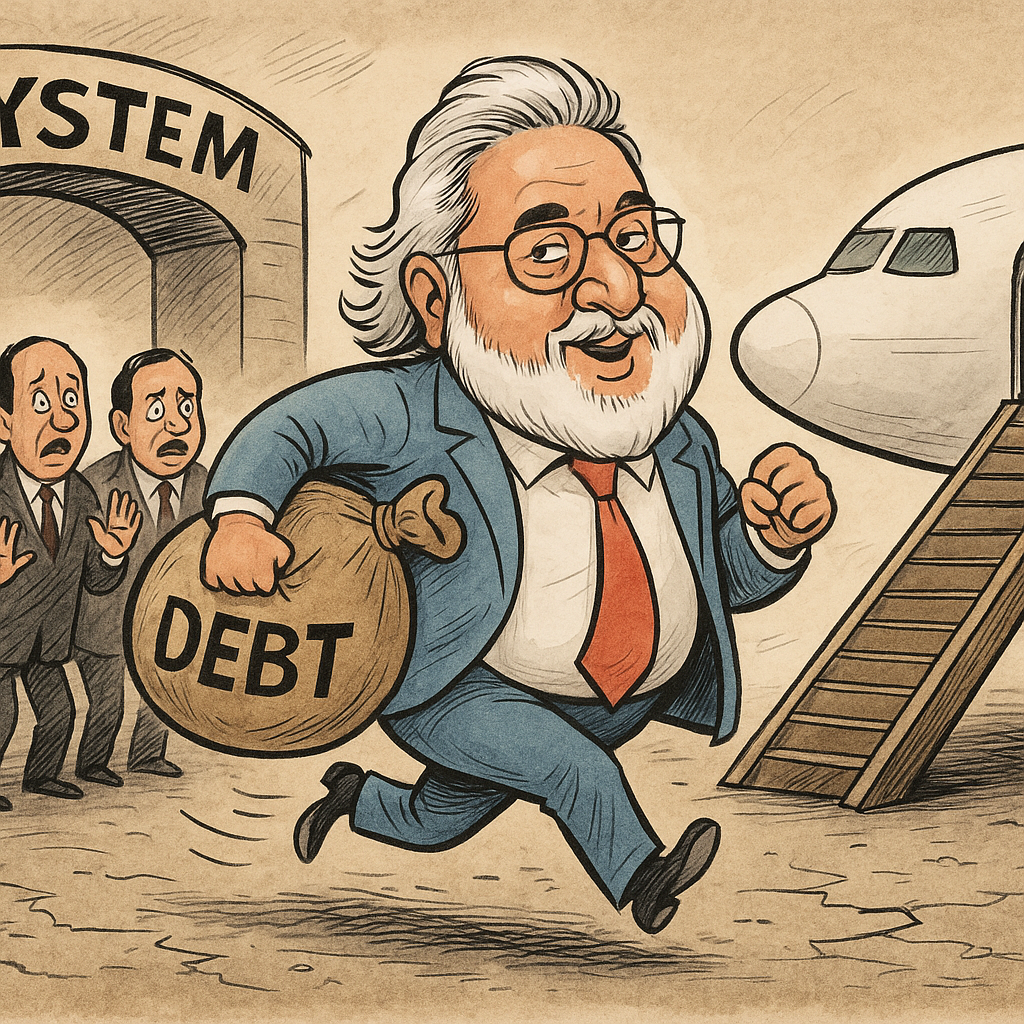
            Once upon a chai break in 2016, Mr. Vijay Mallya — India’s king of Good Times and even better loans — tiptoed past immigration with a “minor” ₹9,000 crore IOU hanging in his coat pocket.
            No alarms. No red flags. Just a smooth takeoff like a Kingfisher bird that forgot to return to its cage.


            Scene 2: British Breakfasts & Courtroom Cafés 🏛️🥐

            Fast-forward to the land of the Queen (and now the King), where Mallya sips espresso while fighting extradition one courtroom at a time. UK judges keep bouncing his bankruptcy appeals like unpaid bar bills. But hey — still not extradited.

            Just this April 2025, the UK High Court told him: “Sir, you are bankrupt.”
            To which Mallya may as well have replied: “Tell me something I didn’t already tweet.”


            Scene 3: IPL Banter & Billion-Rupee Banquets 🏏💸

            On May 27, 2025, our champagne fugitive tweeted congratulations to RCB.
            Twitter: “Come watch the final in India!”
            India: “Come FACE THE LAW in India!”
            Mallya: muted replies


            Scene 4: System – The Invisible Friend 👻

            Let’s be real — escaping a country with ₹9,000 crore unpaid debt isn’t a magic trick; it’s a team sport.
            Bankers approved loans like they were passing candy.
            Authorities blinked long enough for a business-class escape.
            And now? Every year, we just get another court hearing… and another RCB tweet.


            Scene 5: Recovery Claims & Media Gymnastics 🤹‍♂️

            Mallya says: “India has recovered ₹14,000 crore — more than I owed!”
            Banks say: “But… interest?”
            ED says: “We froze the assets!”
            Cartoonist says: “Y’all froze everything except his boarding pass back in 2016.”


            Final Scene (Yet to Come): Justice Delayed Is…

            …Another cartoon idea, I guess?

            Until then, Vijay Mallya remains the perfect punchline in a long-running courtroom sitcom — a reminder that in India, you can bankrupt a nation, toast to London sunsets, and still find time to tweet about cricket.


            🎨 Moral of the Doodle:
            The system didn’t just fail — it sent him off with a wave, and now we’re all sketching justice in slow motion.

            Disclaimer: This blog post is a satirical opinion piece meant for entertainment and commentary purposes. All references are based on publicly available information.

            Donald Trump’s 2025 Policy Decisions: A Global Overview

            donald-trump

            As President Donald Trump embarks on his second term, his administration has introduced several significant policies impacting both domestic affairs and international relations. This overview highlights key decisions made in 2025 and their broader implications.

            1. Immigration Policy: Project Homecoming

            In May 2025, President Trump announced “Project Homecoming,” a voluntary self-deportation program offering financial incentives and transportation assistance to undocumented immigrants who choose to leave the United States. The initiative also includes plans to expand the Immigration and Customs Enforcement (ICE) workforce by 20,000 officers, aiming to enhance immigration enforcement efforts. The Daily Beast

            2. Executive Orders on Cultural and Geographic Renaming

            President Trump signed Executive Order 14172, which reinstates the name “Mount McKinley” for Denali and renames the Gulf of Mexico to the “Gulf of America.” The order aims to honor American heritage through these renamings. Congress.gov+1The White House+1The White House+2Wikipedia+2Congress.gov+2

            3. Trade Agreements: U.S.-UK Deal

            The United States and the United Kingdom reached a trade agreement that reduces tariffs on UK-manufactured goods, including steel and automobiles, while expanding market access for U.S. agricultural products. The deal is designed to strengthen economic ties between the two nations. Business Insider

            4. Foreign Policy: India-Pakistan Ceasefire Support

            Following a ceasefire agreement between India and Pakistan, President Trump offered to increase trade with both nations and assist in facilitating discussions on long-standing issues, including the Kashmir conflict. The U.S. administration’s involvement underscores its commitment to promoting stability in the region. Reuters

            5. Cultural Policy: Proposed Tariffs on Foreign Films

            President Trump proposed a 100% tariff on foreign-produced films, aiming to bolster the domestic film industry. The proposal has sparked debate within the international film community, with concerns about potential impacts on global cultural exchange. AP News

            6. Federal Workforce and Education Reforms

            Aligning with the Project 2025 initiative, the Trump administration has implemented measures to reduce the size of the federal workforce and proposed significant changes to the Department of Education. These reforms include potential funding cuts and a shift towards increased state control over education policies.

            Conclusion

            President Trump’s policy decisions in 2025 reflect a focus on national sovereignty, economic restructuring, and cultural identity. These initiatives have elicited varied responses domestically and internationally, highlighting the complexities of governance in a globalized world.


            Disclaimer

            This article is intended for informational purposes only, summarizing recent policy developments based on publicly available sources. It does not constitute legal, political, or professional advice. Readers are encouraged to consult official government publications and reputable news outlets for comprehensive information.

            What I Learned After Taking a Break from Instagram for 30 Days

            Break!

            I didn’t plan it. One day I just didn’t feel like opening Instagram—and then that day turned into a week… and eventually, a month. What started as a random pause became one of the most eye-opening little experiments I’ve done on myself.

            Here’s what changed in just 30 days off the ‘gram:


            🧠 1. My Mind Felt… Quieter

            No constant scroll. No subconscious comparisons. No noise. I didn’t realize how much mental space those quick checks were taking up until they were gone.


            2. I Got Time Back

            Those “just 5 minutes” moments add up. I started filling that time with things I’d forgotten I loved—like reading, going on walks without my phone, or even just sitting still (wild, right?).


            🧍‍♂️ 3. I Felt More Present

            Instead of snapping photos for Stories, I lived in the moment. A sunset was just a sunset—not content. And honestly? It felt more beautiful that way.


            💭 4. My Self-Worth Wasn’t Tied to Likes

            I stopped measuring good days by how much engagement I got. That’s a shift I didn’t know I needed until I made it.


            🤳 Will I Go Back?

            Yes, but differently. With limits. With purpose. Because now I know I don’t need it—I just like using it when I want to.


            So, should you try it too?
            If Instagram (or any app) feels more like a habit than a joy—give yourself a break. Not forever. Just long enough to remember what life feels like without it.

            Summer Learning Ideas

            Summer vacation is a great time for kids to explore, have fun, and learn new things in a more relaxed environment. Here’s a mix of fun, educational, and skill-building ideas that children can learn during their summer break:


            🎨 Creative & Artistic Skills

            • Drawing & Painting – Explore different mediums like watercolor, crayons, or digital art.
            • Crafts & DIY Projects – Origami, jewelry making, clay modeling, or recycling crafts.
            • Photography – Teach basics using a phone or camera and go on photo walks.
            • Story Writing or Comic Making – Spark imagination and improve writing skills.

            🧠 Academic Enrichment

            • Reading Challenges – Read a set number of books over the summer.
            • Math Games & Puzzles – Use apps or books for fun math-based activities.
            • Science Experiments at Home – Simple experiments with kitchen items.
            • Learning a New Language – Duolingo or fun flashcards to learn basic words.

            💻 Tech & Digital Skills

            • Coding for Kids – Platforms like Scratch, Tynker, or Code.org.
            • Typing Practice – Learn proper typing skills with fun games.
            • Video Editing or Animation – Create short videos or stop-motion animations.
            • Building Websites – Simple HTML/CSS for older children.

            🏃‍♀️ Physical Activities

            • Swimming Lessons
            • Yoga or Dance Classes
            • Biking, Skating, or Hiking
            • Martial Arts or Self-Defense Classes

            🌱 Life & Soft Skills

            • Basic Cooking or Baking
            • Gardening and Plant Care
            • Money Management with Pocket Money
            • Time Management or Journaling

            🎭 Performing Arts

            • Acting or Drama Workshops
            • Music Lessons (Piano, Guitar, Singing, etc.)
            • Puppet Shows or Role Play Games

            🌍 Exploring the World

            • Visit Museums, Zoos, or Science Centers
            • Learn about a New Country Each Week
            • Nature Walks and Bug Hunting
            • Camping or Star Gazing

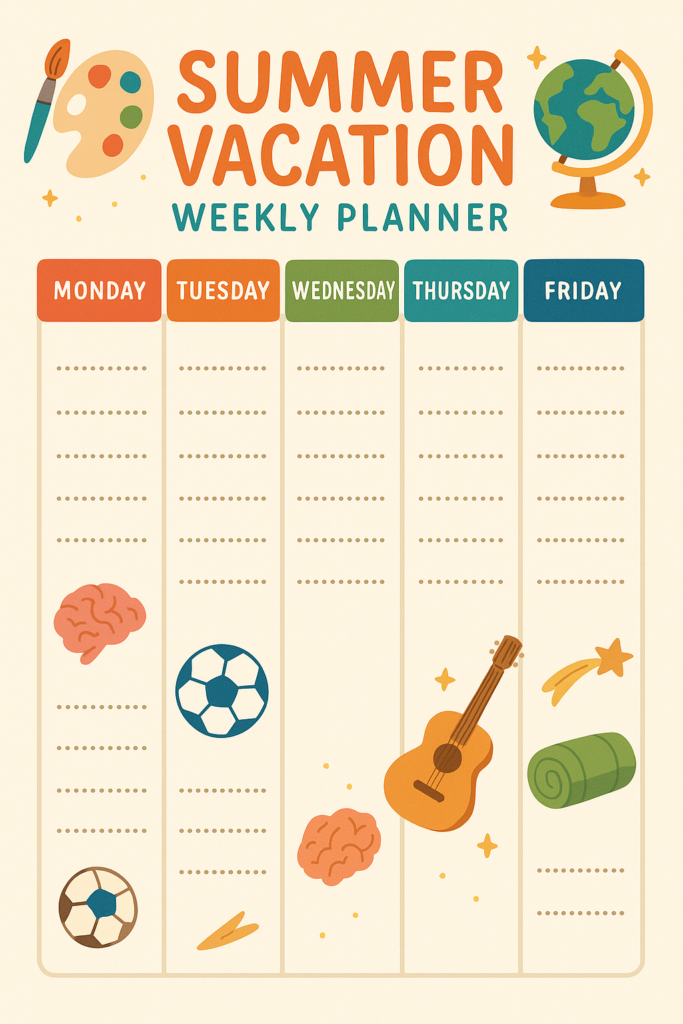
            Download our free Summer Vacation Weekly Planner Chart

            tortoisefeel-Summer-Vacation-Weekly-Planner-Chart

            How to Safe Custody your number for Airtel Postpaid plan information – Year 2024

            Hello, if you like to know or find the answer what happens and how to make Safe Custody and how Airtel process or allows your safe custody as of in year 2024, I think there response is a bit unclear please you take a note where and how, and comment us down below 👇 (in comment box if open)

            As per your concern, we would like to inform you that you can activate safe custody and deactivate the safe custody on same day.

            But kindly note that you can activate and deactivate safe custody only once in a bill cycle.

            And in order to activate safe custody you need to clear the billed and unbilled amount as on that day and need to made a advance payment of R.s 50 + 18% GST which is safe custody charges.

            And also for primary number to activate safe custody you need to separate all the add-on connection.


            1. Charges of safe custody are Rs.50+18% tax per month for the required period in advance.

            2. Your number will be on temporary disconnection status (TD).

            3. Inform payment modes like Cash / Airtel Website / My Airtel App / Airtel Money / Card Swipe.

            4. To activate safe custody, no SIM change should have been done in last 48hrs.

            5. Outstanding and unbilled amount to be cleared.

            6. Post advance payment, you can send us a written request via email at 121@in.airtel.com to activate safe custody and you will get revert within 4 hours.

            7. You can check outstanding and unbilled amount at any time by sending SMS OT to 121 and SMS UNB to 121 respectively from your Airtel mobile. (only for mobile number)

            Hope this helps!


            You can ask us your questions using Airtel Thanks App.

            This what we can learn about Airtel safe custody so far.

            There other emails from Airtel I think you should learn too when and how they respond.