Categories
Blog Senior Citizen Schemes & Benefits

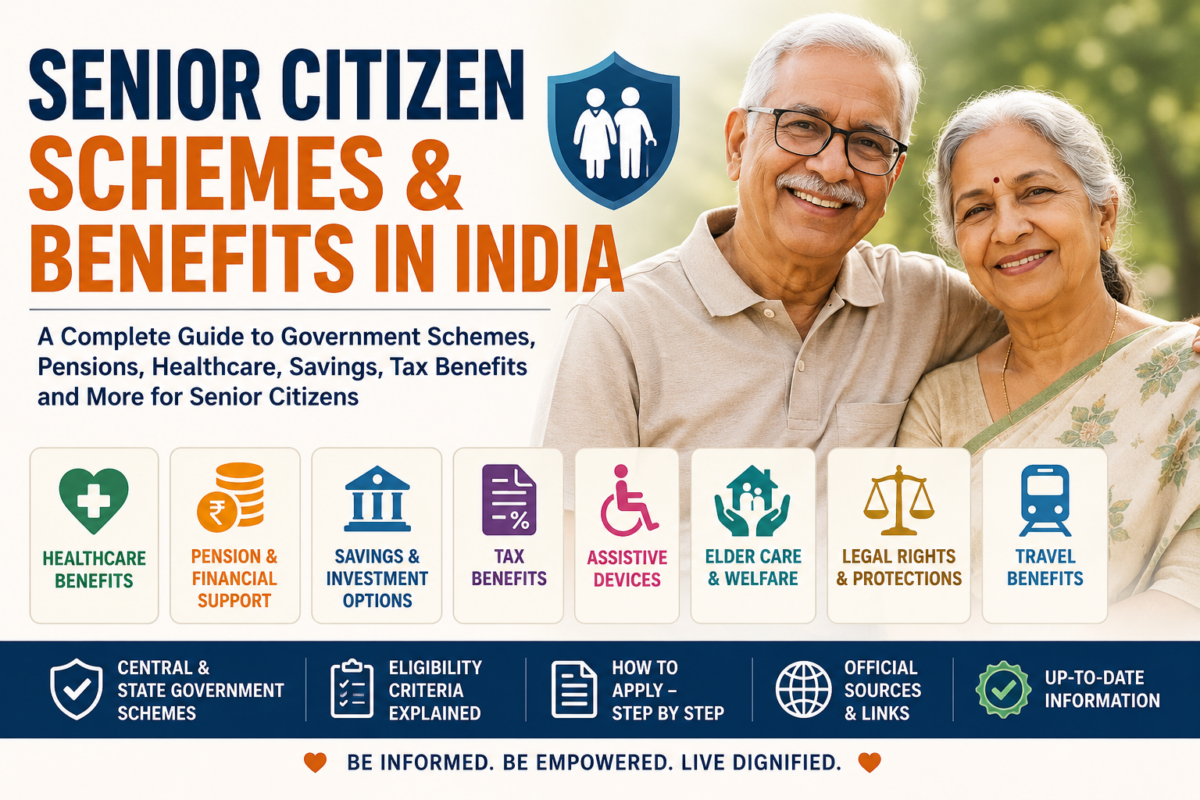
Senior Citizens Schemes, Benefits & Welfare Programs in India


1. DOCUMENT PURPOSE

This document provides the complete content structure, context, information architecture, and recommended sections for a comprehensive resource covering government schemes, financial benefits, healthcare support, pensions, welfare programmes, and other facilities available to senior citizens in India.

The objective is to create a reliable and easy-to-understand platform that helps senior citizens and their families discover:

  • Government schemes
  • Financial assistance
  • Pension schemes
  • Healthcare benefits
  • Insurance support
  • Investment options
  • Tax benefits
  • Banking benefits
  • State Government schemes
  • Legal rights
  • Travel concessions
  • Assistive devices
  • Care and support services

The content should simplify complex government schemes and present them in a structured, practical and actionable format.


2. PRIMARY CONTENT OBJECTIVE

The primary objective is:

To help every senior citizen in India understand what benefits they may be eligible for and how they can access them.

The platform should answer five fundamental questions for every scheme:

1. What is this scheme?

A simple explanation of the scheme.

2. Who is eligible?

Clear eligibility criteria.

3. What benefits are available?

Financial, healthcare or other benefits.

4. How can someone apply?

Step-by-step application guidance.

5. Where can official information be verified?

Official government or authorised source.


3. TARGET AUDIENCE

Primary Audience

Senior Citizens

Individuals aged 60 years and above looking for:

  • Financial security
  • Pension benefits
  • Healthcare support
  • Government schemes
  • Savings options
  • Welfare services

Secondary Audience

Family Members

Children and family members helping elderly parents understand:

  • Medical schemes
  • Pension applications
  • Financial planning
  • Government benefits
  • Elder care services

Caregivers

Individuals responsible for:

  • Elderly care
  • Medical assistance
  • Documentation
  • Government applications

Retirement Planning Audience

Individuals aged 50+ who want to understand:

  • Future retirement benefits
  • Pension options
  • Senior citizen investment schemes
  • Healthcare planning

4. MAIN CONTENT POSITIONING

The platform should not simply say:

“Here are some government schemes.”

Instead, it should position itself as:

India’s simplified guide to senior citizen benefits, schemes, rights and support services.

The content should be:

  • Simple
  • Trustworthy
  • Non-technical
  • Action-oriented
  • Updated regularly
  • Easy for elderly users to understand

5. MASTER CONTENT STRUCTURE

PAGE TITLE

Senior Citizen Schemes and Benefits in India โ€“ Complete Guide

Suggested Subtitle

Explore government schemes, pensions, healthcare benefits, savings options, tax advantages and welfare programmes available for senior citizens in India.


6. INTRODUCTION SECTION

Growing Older Should Not Mean Navigating Everything Alone

India has a rapidly growing senior citizen population. While multiple Central and State Government schemes are available, many senior citizens remain unaware of the benefits they may be entitled to.

Benefits may be available in areas such as:

  • Healthcare
  • Pension
  • Financial assistance
  • Savings
  • Investment
  • Taxation
  • Assistive devices
  • Housing
  • Legal protection
  • Social welfare

However, the information is often spread across multiple government departments and websites.

This guide brings important information together in one place.


7. QUICK BENEFITS OVERVIEW

Create a visual category section.

Explore Benefits by Category

๐Ÿฅ Healthcare Benefits

Health insurance, hospital treatment and medical support.

๐Ÿ’ฐ Pension & Financial Support

Government pensions and financial assistance.

๐Ÿฆ Savings & Investment

Safe investment and income options for retirement.

๐Ÿงพ Tax Benefits

Income tax deductions and exemptions.

โ™ฟ Assistive Devices

Mobility aids, hearing aids, spectacles and other support.

๐Ÿ  Elder Care & Welfare

Senior citizen homes, day care and support programmes.

โš–๏ธ Legal Rights

Protection and legal rights of senior citizens.

๐Ÿš† Travel Benefits

Travel-related concessions and facilities where applicable.

๐Ÿ›๏ธ State Government Schemes

Benefits available based on the state of residence.


8. FEATURED SCHEMES SECTION

Important Government Schemes for Senior Citizens

Display schemes in card format.

Each card should contain:

  • Scheme Name
  • Category
  • Short Description
  • Age Eligibility
  • Main Benefit
  • View Details Button

Suggested Featured Schemes

  1. Senior Citizens Savings Scheme
  2. Ayushman Bharat for Senior Citizens
  3. Atal Vayo Abhyuday Yojana
  4. Rashtriya Vayoshri Yojana
  5. Indira Gandhi National Old Age Pension Scheme
  6. State Old Age Pension Schemes
  7. Post Office Monthly Income Scheme
  8. Pradhan Mantri Vaya Vandana Yojana โ€“ Historical/Status-based information
  9. Senior Citizen Welfare Fund
  10. Tax Benefits for Senior Citizens

9. CATEGORY ONE โ€“ HEALTHCARE BENEFITS

Healthcare Schemes for Senior Citizens

Healthcare is one of the most important concerns during retirement. Medical expenses can increase significantly with age, making access to government healthcare programmes and insurance coverage extremely important.


9.1 Ayushman Bharat โ€“ PM-JAY

Purpose

Provides health coverage for eligible beneficiaries.

Key Information

  • Hospitalisation coverage
  • Cashless treatment
  • Empanelled hospitals
  • Secondary healthcare
  • Tertiary healthcare

Senior Citizen Focus

Special provisions and expanded coverage should be clearly explained for senior citizens aged 70 years and above, according to prevailing government rules.

Information Fields

FieldDetails
Scheme NameAyushman Bharat PM-JAY
CategoryHealthcare
Age EligibilityAs per current scheme rules
CoverageAs notified
ApplicationOnline / authorised centres
DocumentsAadhaar and required identification
Official PortalGovernment link

9.2 State Health Insurance Schemes

Create state-specific listings.

Examples may include:

  • Maharashtra schemes
  • Tamil Nadu schemes
  • Karnataka schemes
  • Delhi schemes
  • Gujarat schemes
  • Kerala schemes

Each state page should clearly explain:

  • Scheme name
  • Eligibility
  • Coverage
  • Hospitals
  • Application process

9.3 Free or Subsidised Healthcare Facilities

Cover information relating to:

  • Government hospitals
  • Geriatric departments
  • Primary healthcare centres
  • Subsidised medicines
  • Government health camps
  • Mobile healthcare services

10. CATEGORY TWO โ€“ PENSION & FINANCIAL ASSISTANCE

Pension Schemes for Senior Citizens

Financial independence is essential for a secure and dignified retirement.

Government pension schemes provide financial assistance to eligible elderly citizens, particularly those belonging to economically vulnerable households.


10.1 Indira Gandhi National Old Age Pension Scheme

Purpose

Financial assistance for eligible elderly citizens.

Content Structure

What is the Scheme?

Simple explanation.

Who Can Apply?

Explain eligibility based on:

  • Age
  • Economic category
  • Government criteria

Benefits

Explain:

  • Central assistance
  • Possible State Government contribution

How to Apply

Step-by-step guidance.

Documents Required

  • Aadhaar
  • Age proof
  • Bank details
  • Income/category documents where applicable

10.2 State Old Age Pension Schemes

This section should be highly developed.

State Selection

Allow users to select:

Select Your State

Example:

  • Maharashtra
  • Gujarat
  • Delhi
  • Karnataka
  • Tamil Nadu
  • Kerala
  • Rajasthan
  • Uttar Pradesh
  • Punjab
  • Haryana
  • West Bengal

For every state, display:

InformationDetails
Scheme Name
Minimum Age
Pension Amount
Eligibility
Application Method
Required Documents
Department
Official Link

11. CATEGORY THREE โ€“ SAVINGS & INVESTMENT

Safe Investment Options for Senior Citizens

Many senior citizens depend on savings accumulated during their working years.

The content should explain safe and government-backed investment options.


11.1 Senior Citizens Savings Scheme (SCSS)

Overview

Government-backed savings scheme designed specifically for senior citizens.

Important Information

  • Eligibility
  • Minimum investment
  • Maximum investment
  • Interest rate
  • Interest payment frequency
  • Tenure
  • Extension options
  • Premature withdrawal rules
  • Tax implications

Who Should Consider It?

Suitable for individuals looking for:

  • Regular income
  • Capital protection
  • Government-backed investment
  • Predictable returns

11.2 Post Office Monthly Income Scheme

Explain:

  • Monthly income concept
  • Investment tenure
  • Eligibility
  • Joint account options
  • Interest payout

11.3 Bank Fixed Deposits for Senior Citizens

Explain:

  • Additional interest benefits
  • Tenure comparison
  • Premature withdrawal
  • Safety considerations

11.4 Government Bonds and Other Safe Instruments

Educational section covering:

  • Government securities
  • RBI products
  • Bonds
  • Other low-risk instruments

Important:

The platform should remain educational and should not provide personalised investment advice without appropriate disclaimers.


12. CATEGORY FOUR โ€“ TAX BENEFITS

Income Tax Benefits for Senior Citizens

Senior citizens may receive different tax benefits depending on the applicable tax regime and prevailing income tax laws.

This section should be updated annually after the Union Budget.


Suggested Subsections

12.1 Income Tax Slabs

Explain differences where applicable between:

  • Individual
  • Senior Citizen
  • Super Senior Citizen

12.2 Health Insurance Deductions

Explain relevant deductions for:

  • Health insurance premiums
  • Medical expenditure where applicable

12.3 Interest Income Benefits

Explain applicable provisions relating to:

  • Bank interest
  • Post office interest
  • Savings interest

Important Disclaimer

Tax laws change regularly. Always verify the latest provisions or consult a qualified tax professional.


13. CATEGORY FIVE โ€“ ASSISTIVE DEVICES

Support for Senior Citizens with Age-Related Disabilities

Many elderly citizens experience mobility, hearing, vision and other age-related difficulties.

Government programmes may provide support through assistive devices.


Rashtriya Vayoshri Yojana

Possible Assistance

Depending on eligibility and assessment:

  • Walking sticks
  • Wheelchairs
  • Hearing aids
  • Spectacles
  • Dentures
  • Mobility devices

Purpose

To improve:

  • Mobility
  • Independence
  • Quality of life
  • Dignity

14. CATEGORY SIX โ€“ ELDER CARE & WELFARE

Welfare Programmes for Senior Citizens

This section should cover programmes supporting elderly citizens who require additional care and assistance.


14.1 Atal Vayo Abhyuday Yojana

Explain the broader senior citizen welfare framework.

Areas

  • Senior citizen care
  • Shelter
  • Medical assistance
  • Recreational activities
  • Active ageing
  • Community support

14.2 Old Age Homes

Provide information on:

  • Government-supported homes
  • NGO-operated homes
  • Eligibility
  • Admission process

14.3 Day Care Centres

Explain:

  • Day support
  • Social activities
  • Healthcare support
  • Recreational activities

15. CATEGORY SEVEN โ€“ LEGAL RIGHTS

Legal Rights of Senior Citizens in India

This is an important section that is often missing from senior citizen information platforms.

Content should explain the legal rights and protections available to elderly citizens.


Suggested Topics

Maintenance and Welfare Rights

Explain legal provisions relating to:

  • Maintenance responsibilities
  • Protection against neglect
  • Welfare mechanisms

Protection Against Abuse

Information on:

  • Elder abuse
  • Financial exploitation
  • Neglect
  • Property-related concerns

Legal Assistance

Explain where senior citizens can seek help:

  • Legal aid authorities
  • Senior citizen helplines
  • Police support
  • District welfare offices

16. CATEGORY EIGHT โ€“ BANKING BENEFITS

Banking Facilities for Senior Citizens

Senior citizens should be aware of banking facilities designed to make financial transactions easier.


Topics to Cover

Priority Services

Some institutions may provide:

  • Priority counters
  • Dedicated service desks
  • Simplified service processes

Doorstep Banking

Explain services where available:

  • Cash delivery
  • Document collection
  • Banking assistance

Senior Citizen Fixed Deposit Benefits

Compare:

  • Public sector banks
  • Private banks
  • Small finance banks

Important comparison fields:

BankSenior Citizen RateTenureMinimum DepositPremature Withdrawal

17. CATEGORY NINE โ€“ TRAVEL BENEFITS

Travel Facilities for Senior Citizens

This section should explain currently applicable benefits and facilities.

Topics may include:

  • Railway facilities
  • Reserved seating
  • Airport assistance
  • Public transport concessions
  • State transport benefits

Important:

Benefits and concessions may change. This section should always display the “Last Updated Date.”


18. CATEGORY TEN โ€“ STATE-WISE SCHEMES

Senior Citizen Schemes by State

This should become one of the strongest sections of the platform.


State Directory

Maharashtra

Include:

  • Pension schemes
  • Healthcare schemes
  • Senior welfare programmes
  • Transport benefits

Gujarat

Include relevant State Government benefits.

Delhi

Include relevant State Government benefits.

Karnataka

Include relevant State Government benefits.

Tamil Nadu

Include relevant State Government benefits.

Kerala

Include relevant State Government benefits.


Recommended Future Structure

Create individual pages:

/senior-citizen-schemes/maharashtra

/senior-citizen-schemes/gujarat

/senior-citizen-schemes/delhi

/senior-citizen-schemes/karnataka

/senior-citizen-schemes/tamil-nadu

This creates strong SEO architecture.


19. HOW TO APPLY SECTION

How to Apply for Senior Citizen Schemes

Many senior citizens find government application processes confusing.

Therefore, every scheme should have a standard application section.


Step 1 โ€“ Check Eligibility

Check:

  • Age
  • Income
  • Residence
  • Social category
  • Existing benefits

Step 2 โ€“ Keep Documents Ready

Common documents include:

  • Aadhaar Card
  • PAN Card
  • Age proof
  • Address proof
  • Bank account details
  • Passport photographs
  • Income certificate
  • Pension documents
  • Disability certificate where applicable

Step 3 โ€“ Apply Through the Correct Channel

Possible channels:

  • Online portal
  • Government office
  • CSC centre
  • Bank
  • Post office
  • District welfare office

Step 4 โ€“ Track Application

Explain:

  • Application number
  • Status tracking
  • Helpline
  • Escalation process

20. SCHEME DETAIL PAGE TEMPLATE

Every scheme should follow the same content format.


[SCHEME NAME]

Category

Healthcare / Pension / Investment / Welfare

Quick Summary

A simple 2โ€“3 line explanation.


What Is This Scheme?

Detailed but easy-to-understand explanation.


Who Is Eligible?

Bullet points:

  • Age requirement
  • Income requirement
  • Residence requirement
  • Other criteria

What Benefits Are Available?

Clearly explain:

  • Financial benefit
  • Healthcare coverage
  • Equipment
  • Pension
  • Interest income

How to Apply?

Step 1

Check eligibility.

Step 2

Prepare documents.

Step 3

Visit/apply through official channel.

Step 4

Submit application.

Step 5

Track status.


Documents Required

Checklist format.

โ˜ Aadhaar Card

โ˜ Age Proof

โ˜ Bank Passbook

โ˜ Address Proof

โ˜ Income Certificate


Important Things to Know

Highlight:

  • Deadlines
  • Renewal requirements
  • Limitations
  • Conditions

Frequently Asked Questions

Minimum 5โ€“10 FAQs.


Official Source

Always link to the official Government or authorised portal.


Last Updated

Display:

Last verified: [Date]


21. ELIGIBILITY FINDER โ€“ FUTURE FEATURE

This can become the most valuable feature.

“Find Benefits You May Be Eligible For”

Ask users:

Question 1

What is your age?

  • 60โ€“69
  • 70โ€“79
  • 80+

Question 2

Which state do you live in?

Dropdown.

Question 3

What is your income category?

Optional categories.

Question 4

What are you looking for?

  • Healthcare
  • Pension
  • Investment
  • Financial support
  • Assistive devices
  • Elder care

Result

Show:

Based on your information, you may wish to check these schemes.

Important:

Use wording such as “may be eligible” until official eligibility is confirmed.


22. SENIOR CITIZEN RESOURCE DIRECTORY

Create an additional directory.

Important Resources

Government Resources

  • Ministry of Social Justice
  • Ministry of Health
  • National Health Authority
  • India Post
  • Pension authorities

Emergency Resources

  • Emergency services
  • Senior citizen helplines
  • Police assistance

Legal Resources

  • Legal aid services
  • Senior citizen tribunals
  • Government grievance portals

23. FAQ SECTION

Frequently Asked Questions About Senior Citizen Benefits in India

At what age is a person considered a senior citizen in India?

Generally, 60 years and above for many schemes, although eligibility varies.


What schemes are available for senior citizens?

Schemes may cover healthcare, pensions, savings, welfare, assistive devices and other benefits.


Can senior citizens get free healthcare?

Eligibility depends on applicable Central and State Government healthcare programmes.


Which investment is suitable for senior citizens?

The answer depends on financial requirements, risk profile and income needs. Government-backed options such as SCSS may be considered after understanding eligibility and current terms.


Can senior citizens receive both Central and State benefits?

In some cases, eligibility for benefits from Central and State programmes may coexist, subject to individual scheme rules.


How can I find schemes available in my state?

Use official government portals and state welfare department websites.


24. CONTENT DISCLAIMER

Important Information Disclaimer

This platform provides general information about government schemes and benefits.

Scheme details, eligibility criteria, financial benefits, interest rates and application processes may change.

Users should always verify the latest information through:

  • Official Government websites
  • Authorised departments
  • Banks
  • Post offices
  • Government service centres

The platform should not be considered a substitute for legal, financial, tax or medical advice.


25. CONTENT UPDATE POLICY

Government schemes change regularly.

Therefore, every scheme page should include:

Last Updated Date

Example:

Last Updated: August 2026

Verification Status

  • Verified from Official Source
  • Update Pending
  • Recently Changed

26. CONTENT TRUST FRAMEWORK

To build credibility, every scheme should be categorised by source reliability.

๐ŸŸข Official Government Source

Directly verified from government portal.

๐Ÿ”ต Government Partner

Information verified from authorised institution.

๐ŸŸก Information Under Review

Information requires further verification.

Avoid publishing outdated or unverified financial information.


27. SEO STRUCTURE

Primary Keywords

  • Senior citizen schemes India
  • Government schemes for senior citizens
  • Senior citizen benefits India
  • Old age pension scheme India
  • Healthcare schemes for senior citizens
  • Senior citizen pension
  • Senior citizen savings scheme
  • Benefits for elderly people India

Long-Tail Keywords

  • What benefits are available for senior citizens in India
  • Government pension for senior citizens
  • Free healthcare for senior citizens India
  • Senior citizen schemes in Maharashtra
  • How to apply for old age pension
  • Best government schemes for senior citizens
  • Financial assistance for elderly people in India

28. RECOMMENDED WEBSITE ARCHITECTURE

Main Page

/senior-citizen-benefits


Category Pages

/senior-citizen-benefits/healthcare

/senior-citizen-benefits/pension

/senior-citizen-benefits/investment

/senior-citizen-benefits/tax-benefits

/senior-citizen-benefits/welfare

/senior-citizen-benefits/legal-rights

/senior-citizen-benefits/banking


State Pages

/senior-citizen-benefits/maharashtra

/senior-citizen-benefits/delhi

/senior-citizen-benefits/gujarat

/senior-citizen-benefits/karnataka


Individual Scheme Pages

/schemes/senior-citizens-savings-scheme

/schemes/ayushman-bharat-senior-citizens

/schemes/old-age-pension

/schemes/rashtriya-vayoshri-yojana


29. USER EXPERIENCE RECOMMENDATIONS

Since the target audience includes elderly users, the website should be designed differently from a normal content website.

Accessibility Recommendations

Larger Font Size

Avoid very small text.

Recommended:

  • Minimum 18px body text
  • Clear headings
  • High contrast

Simple Navigation

Use limited menu options.

Example:

HOME | SCHEMES | HEALTH | PENSION | STATE BENEFITS | HELP


Easy Language

Avoid government jargon.

Instead of:

Beneficiary shall be subject to means-tested eligibility criteria.

Use:

You may qualify depending on your income and financial situation.


Voice Search Compatibility

Future feature:

“What pension schemes can I get?”


Multilingual Support

Future expansion:

  • English
  • Hindi
  • Marathi
  • Tamil
  • Gujarati
  • Bengali
  • Kannada
  • Telugu

30. CONTENT DIFFERENTIATOR

Most websites simply list government schemes.

This platform should focus on:

“Understanding + Eligibility + Action”

Not just:

Here is the scheme.

But:

What does it mean?

Who can get it?

What documents are required?

How do I apply?

Where do I go?

What should I do if my application is rejected?

This practical approach can differentiate the platform.


31. RECOMMENDED HOMEPAGE FLOW

HERO SECTION

Heading

Discover Benefits Available for Senior Citizens

Subheading

Find government schemes, healthcare support, pensions, savings options and welfare benefits available for senior citizens in India.

CTA Buttons

[Explore Schemes]

[Find Benefits]


SECTION 2

What Are You Looking For?

Healthcare | Pension | Financial Support | Investment | Welfare


SECTION 3

Featured Schemes

Display 6 important scheme cards.


SECTION 4

Find Benefits in Your State

State selection dropdown.


SECTION 5

Recently Updated Schemes

Show recently verified information.


SECTION 6

Senior Citizen Guides

Articles such as:

  • How to apply for an old age pension
  • Healthcare options after retirement
  • Understanding SCSS
  • Documents every senior citizen should keep ready

SECTION 7

Frequently Asked Questions


SECTION 8

Important Disclaimer


32. FUTURE EXPANSION OPPORTUNITIES

The platform can eventually expand into:

Scheme Eligibility Calculator

Pension Calculator

Retirement Expense Calculator

Document Checklist Generator

State Benefit Finder

Senior Citizen Healthcare Directory

Government Hospital Finder

Old Age Home Directory

Senior Citizen Helpline Directory

Legal Assistance Directory


33. FINAL CONTENT STRATEGY

The recommended strategy is to build the platform in three layers.


LAYER 1 โ€“ INFORMATION

Provide accurate information.

What schemes exist?


LAYER 2 โ€“ UNDERSTANDING

Simplify government information.

What does this scheme actually mean?


LAYER 3 โ€“ ACTION

Help users take the next step.

What should I do now?


FINAL PLATFORM VISION

A Simple Vision

No senior citizen should miss an important benefit simply because they did not know it existed or did not understand how to apply.

The platform should become a trusted information resource that helps senior citizens and their families navigate India’s complex ecosystem of government schemes, healthcare benefits, pensions, financial assistance and welfare programmes.

The long-term objective should not be to create just another blog.

It should evolve into:

A Senior Citizen Benefits Knowledge & Discovery Platform for India

Combining:

Information + Eligibility + Guidance + Accessibility + Action

Recommended next step

Before developing individual articles, I would create a master scheme database structure behind this contentโ€”fields like Scheme Name, Ministry, Category, Age, Eligibility, Benefit Amount, Documents, Application URL, State, Last Verified Date, and Status.

That will prevent the blog from becoming just static articles and will allow you later to build filters, search, eligibility matching, and automatic state-wise pages.

Disclaimer: Scheme details, eligibility criteria, benefits, interest rates and application processes may change over time. Readers should verify the latest information through official government portals or authorised institutions before applying.

Categories
AI & Technology Javascript Programming Technology, Web Development World in Motion

๐Ÿš€ JavaScript Evolution: From Browser Scripting to Universal Runtime (2026 Deep Dive)

๐Ÿง  Introduction

JavaScript is no longer just a browser scripting languageโ€”it is now the backbone of modern software development. From powering interactive web pages in the 1990s to running full-scale distributed systems, JavaScript has evolved into a universal runtime shaping how applications are built and deployed.

In this deep dive, we explore:

  • How JavaScript has transformed over time
  • What major features and paradigms were introduced
  • How its ecosystem reshaped development
  • Where JavaScript is heading in the next decade

But beyond just evolution, JavaScript has fundamentally shifted its role in the tech ecosystem. It didnโ€™t just growโ€”it repositioned itself as a universal runtime across platforms.
๐Ÿ‘‰ Read deeper insight: JavaScript Didnโ€™t Just Evolve โ€” It Repositioned Itself


๐Ÿ•ฐ๏ธ Phase 1: The Early Days (1995โ€“2005)

JavaScript was created in 1995 with a simple goal:
๐Ÿ‘‰ Make web pages interactive.

Key Characteristics

  • Loosely typed
  • Prototype-based inheritance
  • Event-driven execution
  • Minimal tooling

Limitations

  • No modular architecture
  • Browser inconsistencies
  • Callback-heavy async patterns

At this stage, JavaScript was often underestimated and considered unreliable for serious engineering.


โš™๏ธ Phase 2: Standardization with ES5 (2009)

The release of ECMAScript 5 brought stability and structure.

What Changed

  • Strict mode ("use strict")
  • Native JSON support
  • Functional array methods (map, filter, reduce)
  • Better object control

Why It Mattered

This era laid the foundation for scalable JavaScript applications and enabled cleaner, more predictable codebases.


๐Ÿ”ฅ Phase 3: ES6 โ€“ The Turning Point (2015)

ES6 was not just an updateโ€”it was a complete transformation.

This transformation marked the beginning of a deeper shiftโ€”not just in syntax, but in how JavaScript positioned itself in the software world.
๐Ÿ‘‰ Explore the full perspective here: JavaScript Didnโ€™t Just Evolve โ€” It Repositioned Itself

Major Features Introduced

Block Scoping

let count = 0;
const MAX = 10;

Arrow Functions

const sum = (a, b) => a + b;

Classes (Cleaner OOP)

class User {
constructor(name) {
this.name = name;
}
}

Modules (Finally!)

export const api = {};
import { api } from './file.js';

Promises

fetch(url).then(res => res.json());

Destructuring

const { name } = user;

๐Ÿš€ Impact of ES6

  • Enabled large-scale applications
  • Improved readability and maintainability
  • Shifted JavaScript toward modern engineering standards

๐ŸŒ JavaScript Beyond the Browser

โšก Node.js Revolution

JavaScript expanded to the backend, enabling:

  • Server-side development
  • APIs and microservices
  • Real-time applications

๐Ÿ‘‰ One language, full stack.

This moment defined JavaScriptโ€™s identity shiftโ€”from a frontend scripting tool to a cross-platform runtime environment.
๐Ÿ‘‰ Detailed breakdown: JavaScript Didnโ€™t Just Evolve โ€” It Repositioned Itself


๐ŸŽจ Frontend Framework Shift

Development moved from manual DOM handling to structured UI systems:

  • React โ†’ Component-driven architecture
  • Angular โ†’ Full ecosystem
  • Vue โ†’ Reactive simplicity

This introduced:

Declarative UI + state-driven design


โณ Async Evolution: The Biggest Developer Pain Solved

Before (Callback Hell)

fs.readFile(file, (err, data) => {});

Promises

readFile(file).then(data => {});

Async/Await (Modern Standard)

async function load() {
const data = await readFile(file);
}

Result

  • Cleaner logic
  • Better debugging
  • Synchronous-like flow

๐Ÿงฉ TypeScript Influence (The Silent Takeover)

JavaScript itself didnโ€™t become typedโ€”but the ecosystem did.

Why TypeScript Won

  • Large app complexity
  • Need for type safety
  • Better tooling

Real Impact

  • Enterprise-level adoption
  • Reduced runtime errors
  • Strong IDE support

Today:

TypeScript is often the default, not optional.


โšก Modern JavaScript (ES2018โ€“2026)

JavaScript now evolves every year with incremental improvements.

Key Modern Features

Optional Chaining

user?.profile?.name

Nullish Coalescing

value ?? "default"

Top-Level Await

const data = await fetch(url);

Logical Assignment

x ||= 10;

BigInt

const big = 999999999999999999n;

๐Ÿง  The Real Power: JavaScript Ecosystem

The language is only part of the story.

Tooling Explosion

  • Bundlers: Webpack, Vite
  • Transpilers: Babel
  • Linters: ESLint
  • Formatters: Prettier

Runtime Expansion

  • Browser
  • Node.js
  • Deno
  • Bun

Cross-Platform Reach

  • Mobile โ†’ React Native
  • Desktop โ†’ Electron
  • Cloud โ†’ Serverless functions

๐Ÿ”„ Paradigm Shift Summary

AreaOld JavaScriptModern JavaScript
Code StructureScriptsModules
AsyncCallbacksAsync/Await
UIManual DOMComponent-based
RuntimeBrowser onlyEverywhere
TypingDynamicTyped (TS)

๐Ÿ”ฎ Where JavaScript Is Heading

1. Edge Computing

JavaScript is moving closer to users:

  • Faster response times
  • Distributed execution

2. WebAssembly Integration

JavaScript will act as a bridge for high-performance code:

  • Gaming
  • AI
  • Video processing

3. Type-Safe Future

  • TypeScript dominance
  • Possible native type support

4. AI + JavaScript

JavaScript is becoming the interface layer for AI systems:

  • Browser AI apps
  • Node.js AI orchestration
  • AI SDK ecosystems
This reinforces a critical idea: JavaScript isnโ€™t just evolvingโ€”itโ€™s strategically positioning itself at the center of modern computing.  
๐Ÿ‘‰ Read the deeper analysis: JavaScript Didnโ€™t Just Evolve โ€” It Repositioned Itself

5. New Runtimes

Emerging tools like Bun and Deno are pushing:

  • Faster execution
  • Better developer experience

โš ๏ธ Challenges Ahead

1. Ecosystem Overload

Too many tools, too many choices.

2. Complexity

Modern JS requires:

  • Build systems
  • Configurations
  • Dependency management

3. Backward Compatibility

JavaScript cannot break existing web appsโ€”limiting radical changes.


๐Ÿ Final Thoughts

JavaScriptโ€™s evolution is not just technicalโ€”itโ€™s philosophical.

It has transformed into:

A universal language that connects frontend, backend, mobile, cloud, and AI systems.

The future of JavaScript is not about replacing itโ€”but expanding it further into every layer of computing.

๐Ÿ”— Recommended Deep Read

If you want to truly understand the strategic shift behind JavaScriptโ€™s dominance, donโ€™t miss this:

๐Ÿ‘‰ JavaScript Didnโ€™t Just Evolve โ€” It Repositioned Itself

This article breaks down how JavaScript moved from a simple scripting language to becoming the backbone of modern development ecosystems.

Categories
Blog Life & Nature

๐ŸŒŸ What Jesus Loved: A Journey Into the Heart of His Life and Message

When we talk about Jesus, we often talk about what He did:
the miracles, the teachings, the cross, the resurrection.

But to truly understand Him, we must look at something deeper:
What did Jesus love?
What moved Him?
What was the pulse of His life?

Because love was not just something Jesus taught.
It was something He lived, moment by moment, breath by breath.

This is not just history.
This is the blueprint for a life filled with meaning, peace, and purpose.


  1. Jesus Loved God With His Whole Being

Jesus did not simply believe in God.
He lived in connection with God โ€” the way a tree lives rooted to the soil.

He would slip away early in the morning
to quiet hills and silent lakeshores.
There, the world fell away, and only love remained.

He spoke to God not as a distant power,
but as Abba โ€” a loving, intimate Father.

When we place God first,
everything else finds its place.


  1. Jesus Loved People โ€” Fully, Completely, Without Choosing

He loved:

The forgotten

The broken

The rejected

The proud

The kind

The sinners

The saints

No walls.
No labels.
No conditions.

Jesus did not love because people were perfect.
He loved because love itself transforms.

He saw what others couldnโ€™t see โ€”
the child of God within each person.


  1. Jesus Loved to Forgive, Even When It Hurt

Forgiveness was not weakness to Him.
It was freedom.

On the cross โ€” in pain, abandoned โ€”
He did not curse.
He did not hate.
He prayed.

โ€œFather, forgive them.โ€

He taught us the most difficult and most healing truth:

Forgiveness is not saying that what happened was okay.
Forgiveness is choosing to be free.


  1. Jesus Loved Teaching the Heart, Not Just the Mind

He did not preach at people.
He sat with them, walked with them, ate with them.

He used:

Seeds

Birds

Bread

Light

Water

Simple things โ€” because the deepest truths
are always simple.

His message was clear: Life itself is a classroom of love.


  1. Jesus Loved Peace โ€” Inner and Outer

He did not seek applause, argument, or victory.
He sought stillness.

Peace was not just the absence of conflict โ€”
It was the presence of God inside the heart.

He said:

โ€œMy peace I give to you โ€” not as the world gives.โ€

The peace of Jesus is a quiet river
that flows even during storms.


  1. Jesus Loved Justice โ€” Gentle, Firm, and Courageous

He stood up for the weak.
He challenged hypocrisy.
He overturned tables when love was being blocked.

But even in justice โ€”
His motive was never anger.

It was love defending love.

True justice is not revenge.
True justice restores dignity.


  1. Jesus Loved Serving Others

He washed His disciplesโ€™ feet โ€”
the act of a servant.

He wanted to show: Love is not proven by words.
Love is proven by service.

Greatness is not height.
Greatness is humility.


  1. Jesus Loved the Quiet Beauty of Nature

He prayed on mountains.
He taught by the sea.
He walked among olive trees.

Nature was His prayer room.
He saw God in:

The wind

The flowers

The sunrise

The silence

And He invites us to see it too.


๐ŸŒˆ The Heartbeat of Jesus

If we bring everything together, it becomes:

Love God.
Love People.
Forgive.
Serve.
Live in Peace.
Stand for Truth.
Stay Close to Nature.

This is not a religion.
This is a way of being.


๐ŸŒน A Reflection for Your Heart

Pause for a moment.

Breathe.

Let this sink in:

Your life becomes richer
not when you gain more โ€”
but when you love more.

Jesus shows us that love is the only treasure that grows when shared.
And every day gives us another chance to choose it.


A Closing Whisper

You are loved.
More deeply than you can imagine.

And you, too, were created
to love like Jesus loved.

Not perfectly.
But purely.

With sincerity.
With courage.
With an open heart.

This is the real miracle.

Categories
Blog Learning

๐ŸŒ Where AI Canโ€™t Reach โ€” The Hidden Corners of Our World

Artificial Intelligence (AI) seems to be everywhere today โ€” from helping us write emails to powering self-driving cars and even exploring outer space.
But believe it or not, there are still places โ€” both physical and digital โ€” where AI canโ€™t reach or has very limited power.

Whether youโ€™re a student curious about technology or a professional working in the field, this journey will give you a clear picture of AIโ€™s real-world boundaries.


๐Ÿœ๏ธ 1. Places Without Power or Internet

AI runs on electricity, data, and connectivity โ€” remove any of these, and it stops working.

Examples:

  • The heart of deserts like the Sahara or remote parts of Australia
  • Mountain peaks and deep valleys of the Himalayas or Andes
  • Antarcticaโ€™s frozen interior, where only a few research bases exist
  • Underground mines and ocean depths, where signals canโ€™t reach

In these areas, even your smartphone often struggles to connect โ€” so AI systems simply canโ€™t operate in real time.


๐Ÿ”’ 2. Air-Gapped and Secure Networks

Some networks are intentionally kept offline for safety. This is known as being air-gapped โ€” completely disconnected from the internet.

Examples:

  • Military and nuclear systems
  • Defense or space research labs
  • Government intelligence databases
  • Critical infrastructure controls like power grids or water treatment plants

AI might exist inside these systems in a limited way, but it canโ€™t connect to the outside world โ€” keeping it locked inside a digital fortress.


๐ŸŒ 3. Regions with Digital Barriers

AI also faces political and social boundaries. Some countries or regions restrict access to major AI platforms or limit online freedom.

Examples:

  • North Koreaโ€™s closed intranet (Kwangmyong)
  • Iranโ€™s and Chinaโ€™s filtered internet, where some global AI tools are blocked
  • Conflict or low-income regions where internet and technology are scarce

In these places, even if people want to use AI, access and infrastructure often make it impossible.


๐Ÿญ 4. Outdated and Offline Machines

Many industries around the world still depend on old, analog machines that donโ€™t support AI integration.

Examples:

  • Factories using 1980s machinery
  • Railways, shipping, or aviation systems running on legacy software
  • Rural communities relying on manual tools and basic communication devices

These systems work perfectly for their purpose, but AI canโ€™t โ€œtalkโ€ to them โ€” they were never built for it.


๐Ÿš€ 5. Beyond Earth โ€” The Cosmic Limit

AI has even reached space exploration, but beyond certain distances, communication breaks down.

Examples:

  • Deep-space probes traveling far from Earth eventually lose contact
  • The far side of the Moon or Mars caves, where radio waves canโ€™t reach

In such places, any AI must operate completely offline, without guidance or updates from Earth.


๐Ÿงญ Summary: The Limits of AI Reach

CategoryExamplesWhy AI Canโ€™t Reach
No infrastructureAntarctica, Sahara, deep oceanNo power or network
Air-gapped systemsMilitary, defense, governmentSecurity isolation
Restricted regionsNorth Korea, Iran, ChinaCensorship or limited access
Legacy technologyOld industrial and rural systemsNo AI interface
Space limitsDeep space probes, Moonโ€™s far sideLost communication

๐ŸŒ The Future: Slowly Closing the Gap

Technology is catching up.
Projects like Starlink, edge AI, and low-power microchips are pushing AI into the remotest corners โ€” from villages to satellites.

Still, there will always be edges of the world โ€” and edges of human experience โ€” that remain beyond AIโ€™s digital reach.


๐Ÿ’ก Final Thought

AI may be powerful, but itโ€™s not everywhere โ€” not yet.
And maybe thatโ€™s a good thing. Some parts of our world โ€” untouched, quiet, and disconnected โ€” remind us of the balance between technology and the natural, human world we still belong to.

Categories
Blog Learning Tech

The Rise of AI Tools and Why Humans Still Matter: Navigating the Digital Revolution in 2025

Introduction

Artificial Intelligence (AI) is no longer a futuristic concept โ€” itโ€™s part of our everyday life. From writing content with ChatGPT to designing visuals in Canva, automating workflows with Zapier, or managing projects in Notion, AI-driven tools are shaping how we think, work, and create.

But as these tools rise in popularity, a quiet resistance continues. Many people and businesses still prefer traditional methods โ€” relying on human intuition, personal experience, and manual control. The question is: Are we becoming too dependent on AI, or are we learning to coexist with it?


The Surge of AI Tools in 2025

The past few years have seen an explosion of AI-based platforms that simplify tasks, boost productivity, and save time.

Some of the most used AI tools today include:

  • ChatGPT & Gemini โ€“ AI assistants that write, code, and brainstorm ideas in seconds.
  • Canva & Adobe Firefly โ€“ Design tools with AI-generated templates and smart editing.
  • Notion & NotebookLM โ€“ Knowledge management systems that understand your content and summarize key insights.
  • Zapier & n8n โ€“ Workflow automation tools that connect hundreds of apps without coding.
  • Synthesia โ€“ AI video creation with lifelike avatars and multi-language support.

These tools have made digital work faster, cheaper, and more accessible than ever before. Yet, not everyone is rushing to adopt them.


Why Some People Still Avoid AI Tools

Despite the hype, thereโ€™s a strong segment of professionals, creators, and everyday users who remain skeptical of AI-powered platforms.

Hereโ€™s why:

1. Trust and Accuracy Concerns

AI can produce impressive results, but it can also make subtle mistakes or โ€œhallucinateโ€ facts. For sensitive work โ€” such as legal, financial, or medical โ€” many still prefer human oversight.

2. Comfort and Familiarity

Tools like Google Search, Excel, and even handwritten notes continue to thrive because theyโ€™re reliable and easy to control. Humans naturally trust what theyโ€™ve used for years.

3. Data Privacy Fears

Sharing data with cloud-based AI platforms raises questions about who owns the content and how securely itโ€™s stored.

4. Creative Authenticity

Writers, artists, and designers often feel that AI-generated content lacks emotion or originality. Many prefer to use AI as inspiration, not as a full replacement.


The Humanโ€“AI Balance: Coexisting, Not Competing

The smartest professionals arenโ€™t rejecting AI โ€” theyโ€™re mastering how to work alongside it.

Hereโ€™s how people are finding balance:

  • AI for Repetition, Humans for Emotion
    Use AI for repetitive or data-heavy tasks while keeping creative storytelling, empathy, and emotional intelligence human-led.
  • Human Review in Every Workflow
    Always review AI outputs โ€” from articles to analytics โ€” to ensure accuracy and alignment with your goals.
  • Learning AI Literacy
    Understanding how AI works, its biases, and its limitations helps professionals use it more responsibly.

What the Future Looks Like

By 2030, the AI landscape will evolve even further. Expect:

  • Personal AI Assistants integrated into phones, browsers, and even home devices.
  • AI-driven jobs where humans supervise, refine, and creatively guide automated systems.
  • Ethical AI frameworks ensuring data transparency and fair usage.

But even in that future, human decision-making, empathy, and originality will remain irreplaceable.


Conclusion

AI is here to stay โ€” but so are humans.
The key is not choosing one over the other but learning how to use both effectively.

AI can boost efficiency, simplify your workload, and open new creative doors. But human judgment, emotion, and authenticity will always define the difference between whatโ€™s simply generated and what truly connects.

So, as you explore new tools, remember: the smartest move isnโ€™t automation alone โ€” itโ€™s intelligent collaboration between human and machine.

Categories
Biz Blog

Flipkartโ€™s Tech Edge: Inside Innovations Powering Big Billion Days 2025

Introduction

Indiaโ€™s e-commerce battlefield is heating up as Flipkart gears up for its Big Billion Days 2025 mega sale. At Tech Day 2025, Flipkart unveiled AI-powered tools, logistics upgrades, and futuristic shopping experiences designed to handle millions of orders and stay ahead of rivals like Amazon.

Key Tech Announcements

  1. AI Shopping Assistant: Personalized recommendations, conversational queries.
  2. Faster Logistics: Expansion of supply chain with predictive delivery models.
  3. Enhanced Seller Tools: Data dashboards for SMEs to analyze trends.
  4. AR/VR Shopping: Early rollout of immersive try-before-you-buy features.

Why It Matters

  • Indiaโ€™s e-commerce market is projected to hit $200+ billion by 2026.
  • Big Billion Days is more than a saleโ€”itโ€™s Indiaโ€™s largest retail festival, drawing millions.
  • Flipkartโ€™s innovations arenโ€™t just about convenienceโ€”they shape consumer behavior.

Competitive Angle

  • Amazon India invests in drone pilots & Prime expansions.
  • Relianceโ€™s JioMart is targeting grocery dominance.
  • Flipkartโ€™s edge is blending tech + scale + Indian consumer psychology.

Conclusion

Flipkart isnโ€™t just preparing for a saleโ€”itโ€™s preparing for the future of Indian e-commerce. With AI, logistics, and immersive shopping, Big Billion Days 2025 could set new records and redefine how India shops.

Quick Fact Box:

  • Event: Flipkart Tech Day 2025
  • Sale: Big Billion Days (Septโ€“Oct 2025)
  • Key: AI assistant, AR shopping, logistics boost
Categories
Blog Learning

๐Ÿš€ From College Frustrations to AI Writing Code: I Saw This Coming

Back then, I was just another guy in college, buried in assignments, projects, and endless debugging.

Every time I sat in front of the screen, I had the same thought running in my head:

โ€œWhy the hell canโ€™t this be automated?โ€

I wasnโ€™t dreaming about sci-fi robots or some fantasy tech. I just wanted the machine to help me.
I was tired of writing boilerplate code. Tired of repeating the same logic in slightly different ways. Tired of wasting hours on things that felt like they shouldโ€™ve taken minutes.

Somewhere deep down, I kept asking myself โ€” what if one day, I could just tell the computer what I wanted, and it would do the rest?

At the time, it felt crazy. A daydream. Something impossible.


๐ŸŒฑ Early Work Days: The Same Thought Followed Me

When I started working, the thought never left.
Meetings, tasks, deadlines โ€” everything was moving fast, but the work still felt like it had friction.

Write. Debug. Rewrite. Test. Fix.
On loop.

I remember wishing, almost every week, โ€œthere has to be a smarter way.โ€


โšก And Thenโ€ฆ AI Happened

Fast forward to the last few years.

AI exploded.
Tools started rolling out that could:

  • Generate functions from a single line of English.
  • Suggest fixes before I even asked.
  • Explain code clearer than half the documentation Iโ€™d spent hours digging through.

The exact thing I used to imagine during late-night coding sessions? Itโ€™s here.
Itโ€™s real.
And itโ€™s getting better every single day.


๐Ÿ–ฅ๏ธ What It Feels Like Now

For me, itโ€™s a strange mix of relief and validation.

Relief โ€” because those repetitive, frustrating parts of coding finally have shortcuts.
Validation โ€” because the โ€œcrazy thoughtโ€ I had back in college wasnโ€™t crazy at all.

AI is not replacing developers. Itโ€™s amplifying them.
Itโ€™s letting us focus more on solving problems, designing smarter systems, and creating โ€” rather than drowning in repetitive tasks.


๐Ÿ”ฎ Looking Back, Looking Ahead

What I once thought was just a wild idea in my head has turned into everyday reality.

And hereโ€™s the real kicker: the future you imagine today might not be so far away.

So if youโ€™re sitting there, tired of something, wishing there was a better way โ€” donโ€™t ignore it.
That frustration might just be pointing toward the next big thing.

Because thatโ€™s exactly how I felt years ago.
And now? AI writes code.

Categories
Learning

AKJ เจธเจŸเจพเจˆเจฒ เจŸเจฌเจฒเจพ (เจ…เจ–เฉฐเจก เจ•เฉ€เจฐเจคเจจ เจœเจฅเจพ) เจฆเฉ€ เจ…เจญเจฟเจ†เจธ เจ•เจฟเจตเฉ‡เจ‚ เจ•เจฐเฉ€เจ

เจŸเจฌเจฒเจพ เจ…เจ–เฉฐเจก เจ•เฉ€เจฐเจคเจจ เจœเจฅเจพ (AKJ) เจธเฉˆเจธเจผเจจเจพเจ‚ เจตเจฟเฉฑเจš เจ‡เฉฑเจ• เจ…เจนเฉฐเจ•เจพเจฐเจชเฉ‚เจฐเจ• เจธเฉฐเจ—เฉ€เจคเจ• เจธเจพเจœเจผ เจนเฉˆเฅค AKJ เจธเจŸเจพเจˆเจฒ เจฆเจพ เจŸเจฌเจฒเจพ เจตเจฟเจธเจผเฉ‡เจธเจผ เจนเฉˆ เจ•เจฟเจ‰เจ‚เจ•เจฟ เจ‡เจน เจฒเจ—เจพเจคเจพเจฐ เจฐเจฟเจฅเจฎ, เจ•เฉ€เจฐเจคเจจ เจ—เจพเจ‡เจ•เจพเจ‚ เจฆเจพ เจธเจนเจฟเจฏเฉ‹เจ—, เจ…เจคเฉ‡ เจฒเฉฐเจฌเฉ‡ เจธเจฎเฉ‡เจ‚ เจฒเจˆ เจŠเจฐเจœเจพ เจฌเจฃเจพเจˆ เจฐเฉฑเจ–เจฃ โ€˜เจคเฉ‡ เจงเจฟเจ†เจจ เจฆเจฟเฉฐเจฆเจพ เจนเฉˆเฅค เจ•เจฒเจพเจธเฉ€เจ•เจฒ เจŸเจฌเจฒเจพ เจธเฉ‹เจฒเฉ‹ เจฆเฉ‡ เจตเจฟเจฐเฉเฉฑเจง, AKJ เจŸเจฌเจฒเจพ เจฆเจพ เจฎเฉ‚เจฒ เจ‰เจฆเฉ‡เจธเจผ เจนเฉˆ เจฐเจฟเจฅเจฎ, เจธเจชเฉฑเจธเจผเจŸเจคเจพ เจ…เจคเฉ‡ เจญเจพเจตเจชเฉ‚เจฐเจฃ เจ…เจนเจฟเจธเจพเจธ เจฌเจฃเจพเจˆ เจฐเฉฑเจ–เจฃเจพเฅค

เจนเฉ‡เจ เจพเจ‚ AKJ เจธเจŸเจพเจˆเจฒ เจŸเจฌเจฒเจพ เจ…เจญเจฟเจ†เจธ เจฒเจˆ เจ•เจฆเจฎ-เจฆเจฐ-เจ•เจฆเจฎ เจ—เจพเจˆเจก เจนเฉˆ:


1. เจธเฉฐเจฆเจฐเจญ เจจเฉ‚เฉฐ เจธเจฎเจเฉ‹

  • AKJ เจŸเจฌเจฒเจพ เจชเฉเจฐเจฎเฉเฉฑเจ– เจคเฉŒเจฐ โ€˜เจคเฉ‡ เจญเจœเจจ เจ•เฉ€เจฐเจคเจจ เจธเฉˆเจธเจผเจจเจพเจ‚ เจตเจฟเฉฑเจš เจตเจฐเจคเจฟเจ† เจœเจพเจ‚เจฆเจพ เจนเฉˆเฅค
  • เจฎเฉเฉฑเจ– เจฒเจ•เฉœเฉ€: เจฒเจ—เจพเจคเจพเจฐ เจ เฉ€เจ•เจพ เจฌเจฃเจพเจˆ เจฐเฉฑเจ–เจฃเจพ, เจ—เจพเจ‡เจ• เจฆเฉ‡ เจจเจพเจฒ เจธเฉฐเจ—เจค เจฌเจฃเจพเจˆ เจฐเฉฑเจ–เจฃเจพเฅค
  • เจฎเฉเจฐเจ•เฉ€ เจœเจพเจ‚ เจคเฉ‡เจœเจผเฉ€ เจ•เจฎ, เจชเจฐ เจงเฉ€เจฐเจœ เจ…เจคเฉ‡ เจธเจงเจพเจฐเจจ เจฒเจนเจฟเจฐ เจ‰เฉฑเจคเฉ‡ เจงเจฟเจ†เจจเฅค

2. เจญเจœเจจ เจคเจพเจฒเจพเจ‚ เจฒเจˆ เจฎเฉเฉฑเจ– เจ เฉ€เจ•เฉ‡ เจธเจฟเฉฑเจ–เฉ‹

เจ•เจˆ เจ†เจฎ เจคเจพเจฒเจพเจ‚ เจœเฉ‹ AKJ เจ•เฉ€เจฐเจคเจจ เจตเจฟเฉฑเจš เจตเจฐเจคเฉ€เจ†เจ‚ เจœเจพเจ‚เจฆเฉ€เจ†เจ‚ เจนเจจ:

  • เจ•เฉ‡เจนเฉ‡เจฐเจตเจพ (8 เจฌเฉ€เจŸ): เจงเจพ เจ—เฉ‡ เจจเจพ เจŸเจฟเจจ | เจจเจพ เจ•เจพ เจงเจฟเจจ เจจเจพ
  • เจฆเจพเจฆเจฐเจพ (6 เจฌเฉ€เจŸ): เจงเจพ เจงเฉ€ เจจเจพ | เจงเจพ เจคเฉ เจจเจพ
  • เจคเฉ€เจจ เจคเจพเจฒ (16 เจฌเฉ€เจŸ): เจ•เจˆ เจตเจพเจฐเฉ€ เจฒเฉฐเจฌเฉ‡ เจญเจœเจจเจพเจ‚ เจฒเจˆ

เจ…เจญเจฟเจ†เจธ เจธเฉเจเจพเจ…: เจ–เฉ‡เจก เจงเฉ€เจฐเฉ‡, เจธเจชเฉฑเจธเจผเจŸ เจ…เจคเฉ‡ เจจเจฐเจฎ เจฐเฉฑเจ–เฉ‹เฅค เจœเจผเจฟเจ†เจฆเจพ เจจเจพ เจ–เฉ‡เจกเฉ‹เฅค


3. เจธเจนเจฟเจฃเจธเจผเฉ€เจฒเจคเจพ เจฌเจฃเจพเจ“

  • AKJ เจ•เฉ€เจฐเจคเจจ 2โ€“6 เจ˜เฉฐเจŸเฉ‡ เจฒเฉฐเจฌเฉ‡ เจนเฉ‹ เจธเจ•เจฆเฉ‡ เจนเจจเฅค
  • เจธเจผเฉเจฐเฉ‚เจ†เจค 15โ€“20 เจฎเจฟเฉฐเจŸ เจฒเจ—เจพเจคเจพเจฐ เจ–เฉ‡เจกเจฃ เจจเจพเจฒ เจ•เจฐเฉ‹, เจซเจฟเจฐ เจนเฉŒเจฒเฉ€ เจนเฉŒเจฒเฉ€ 1โ€“2 เจ˜เฉฐเจŸเฉ‡ เจคเฉฑเจ• เจตเจงเจพเจ“เฅค
  • เจงเฉ€เจฎเฉ‡, เจฎเฉฑเจงเจฎ เจคเฉ‡ เจคเฉ‡เจœเจผ เจคเจพเจฒเจพเจ‚ โ€˜เจคเฉ‡ เจ…เจญเจฟเจ†เจธ เจ•เจฐเฉ‹ เจชเจฐ เจนเจฎเฉ‡เจธเจผเจพ เจฒเจ—เจพเจคเจพเจฐเจคเจพ เจ…เจคเฉ‡ เจธเจชเฉฑเจธเจผเจŸเจคเจพ เจฌเจฃเจพเจˆ เจฐเฉฑเจ–เฉ‹เฅค

4. เจฒเจฏ เจ…เจคเฉ‡ เจฒเจนเจฟเจฐ โ€˜เจคเฉ‡ เจงเจฟเจ†เจจ เจฆเจฟเจ“

  • เจ•เฉ€เจฐเจคเจจ เจฆเฉŒเจฐเจพเจจ เจฎเฉเจธเจ•เจพเจจ เจ…เจคเฉ‡ เจฒเจนเจฟเจฐเจตเจพเจ‚ เจฐเจฟเจฅเจฎ เจฌเจฃเจพเจˆ เจฐเฉฑเจ–เฉ‹เฅค
  • เจนเฉŒเจฒเฉ€ เจนเฉŒเจฒเฉ€ เจคเฉ‡เจœเจผ/เจงเฉ€เจฎเจพ เจ•เจฐเจจ เจฆเจพ เจ…เจญเจฟเจ†เจธ เจ•เจฐเฉ‹เฅค
  • เจฌเฉ‹เจฒเจพเจ‚ เจตเจฟเฉฑเจš เจธเฉเจ–เจฎเจพเจฐเฉ€ เจคเจฌเจฆเฉ€เจฒเฉ€เจ†เจ‚ (เจœเจฟเจตเฉ‡เจ‚ เจงเจพ เจงเจฟเจจ เจจเจพ โ†’ เจงเจพ เจŸเฉ€ เจจเจพ) เจฐเจฟเจฅเจฎ เจจเฉ‚เฉฐ เจฐเฉเจšเจฟเจ•เจฐ เจฌเจฃเจพเจ‰เจ‚เจฆเฉ€เจ†เจ‚ เจนเจจเฅค

5. เจ เฉ€เจ•เฉ‡ เจคเฉ‹เฉœเฉ‡ เจฌเจฟเจจเจพเจ‚ เจจเจตเฉ‡เจ‚ เจฌเฉ‹เจฒ

  • AKJ เจŸเจฌเจฒเจพ เจ›เฉ‹เจŸเฉ‡ เจธเฉเจเจพเจ… เจ…เจคเฉ‡ เจคเจฌเจฆเฉ€เจฒเฉ€เจ†เจ‚ เจฆเฉ€ เจ†เจ—เจฟเจ† เจฆเจฟเฉฐเจฆเจพ เจนเฉˆเฅค
  • เจธเจงเจพเจฐเจจ เจคเจฌเจฆเฉ€เจฒเฉ€เจ†เจ‚: เจงเจพ/เจจเจพ เจตเจงเจพเจ‰เจฃเจพ, เจฌเฉ‹เจฒ เจฌเจฆเจฒเจฃเจพ, เจจเจฐเจฎ เจฐเฉ‹เจฒ เจ•เจฐเจจเจพเฅค
  • เจนเจฎเฉ‡เจธเจผเจพ เจฎเฉเฉฑเจ– เจ เฉ€เจ•เฉ‡ เจคเฉ‡ เจตเจพเจชเจธ เจ†เจ‰เจฃเจพ เจฏเจ•เฉ€เจจเฉ€ เจฌเจฃเจพเจ“เฅค

6. เจธเฉเจฃเฉ‹ เจ…เจคเฉ‡ เจจเจพเจฒ เจ–เฉ‡เจกเฉ‹

  • เจฒเจพเจˆเจต AKJ เจ•เฉ€เจฐเจคเจจ เจฐเจฟเจ•เจพเจฐเจกเจฟเฉฐเจ— เจธเฉเจฃเฉ‹:
    • เจŸเจฌเจฒเจพ เจ—เจพเจ‡เจ•เจพเจ‚ เจจเจพเจฒ เจธเฉฐเจ—เจค เจ•เจฟเจตเฉ‡เจ‚ เจฌเจฃเจพเจ‰เจ‚เจฆเจพ เจนเฉˆ
    • เจฒเฉฐเจฌเฉ‡ เจธเจฎเฉ‡เจ‚ เจฒเจˆ เจฐเจฟเจฅเจฎ เจ•เจฟเจตเฉ‡เจ‚ เจฌเจฃเจพเจˆ เจฐเฉฑเจ–เฉ€ เจœเจพเจ‚เจฆเฉ€ เจนเฉˆ
    • เจฎเฉเจŸเจฟเจ† เจ…เจคเฉ‡ เจ—เฉ‚เฉฐเจœเจฆเจพเจฐ เจธเจŸเฉเจฐเฉ‹เจ•เจธ เจญเจพเจตเจจเจพเจคเจฎเจ• เจ…เจนเจฟเจธเจพเจธ เจฆเจฟเจ–เจพเจ‰เจ‚เจฆเฉ‡ เจนเจจ
  • เจจเจพเจฒ เจ–เฉ‡เจกเฉ‹ เจ…เจคเฉ‡ เจŠเจฐเจœเจพ เจ…เจคเฉ‡ เจญเจพเจตเจจเจพเจคเจฎเจ•เจคเจพ เจฎเจฟเจฒเจพเจ“เฅค

7. เจธเฉเจเจพเจ… เจชเฉเจฐเจ•เจŸเฉ€เจธ เจฐเฉ‚เจŸเฉ€เจจ

  1. เจตเจพเจฐเจฎ-เจ…เฉฑเจช: 10 เจฎเจฟเฉฐเจŸ เจฌเฉเจจเจฟเจ†เจฆเฉ€ เจฌเฉ‹เจฒเจพเจ‚
  2. เจ เฉ€เจ•เฉ‡ เจฆเจพ เจ…เจญเจฟเจ†เจธ: 15โ€“20 เจฎเจฟเฉฐเจŸ เจงเฉ€เจฎเฉ‡ เจ…เจคเฉ‡ เจฎเฉฑเจงเจฎ เจคเจพเจฒ โ€˜เจš
  3. เจฒเจ—เจพเจคเจพเจฐ เจ–เฉ‡เจกเจฃเจพ: 20โ€“40 เจฎเจฟเฉฐเจŸ เจธเจนเจฟเจฃเจธเจผเฉ€เจฒเจคเจพ เจคเฉ‡ เจฒเจนเจฟเจฐ โ€˜เจคเฉ‡ เจงเจฟเจ†เจจ
  4. เจคเจฌเจฆเฉ€เจฒเฉ€เจ†เจ‚: 10โ€“15 เจฎเจฟเฉฐเจŸ เจ›เฉ‹เจŸเฉ€เจ†เจ‚ เจคเจฌเจฆเฉ€เจฒเฉ€เจ†เจ‚
  5. เจ•เฉ‚เจฒ เจกเจพเจŠเจจ: เจฐเจฟเจ•เจพเจฐเจกเจฟเฉฐเจ— เจจเจพเจฒ เจจเจฐเจฎ เจ–เฉ‡เจก

เจ…เฉฐเจคเจฟเจฎ เจธเฉเจเจพเจ…

  • เจฐเฉ‹เจœเจผเจพเจจเจพ, เจญเจพเจตเจจเจพเจคเจฎเจ• เจ…เจญเจฟเจ†เจธ, เจ‰เจ‚เจ—เจฒเจพเจ‚ เจฆเฉ€ เจคเจพเจ•เจค เจ…เจคเฉ‡ เจธเจนเจฟเจฃเจธเจผเฉ€เจฒเจคเจพ เจฌเจฃเจพเจ‰เจ‚เจฆเจพ เจนเฉˆเฅค
  • เจธเจŸเฉเจฐเฉ‹เจ•เจธ เจธเจชเฉฑเจธเจผเจŸ เจ…เจคเฉ‡ เจ—เฉ‚เฉฐเจœเจฆเจพเจฐ เจนเฉ‹เจฃเฅค
  • เจ–เฉ‡เจก เจฆเจพ เจ…เจจเฉฐเจฆ เจฒเจ“โ€”เจ•เจฟเจฐเจคเจจ เจตเจฟเฉฑเจš เจŸเจฌเจฒเจพ เจธเจฟเจฐเจซ เจคเจ•เจจเฉ€เจ• เจจเจนเฉ€เจ‚, เจธเจพเจ‚เจคเจตเจพเจฆเจ• เจ…เจจเฉเจญเจต เจตเฉ€ เจนเฉˆเฅค
Categories
Learning Learning

How to Practice AKJ Style Tabla (Akhand Kirtan Jatha)

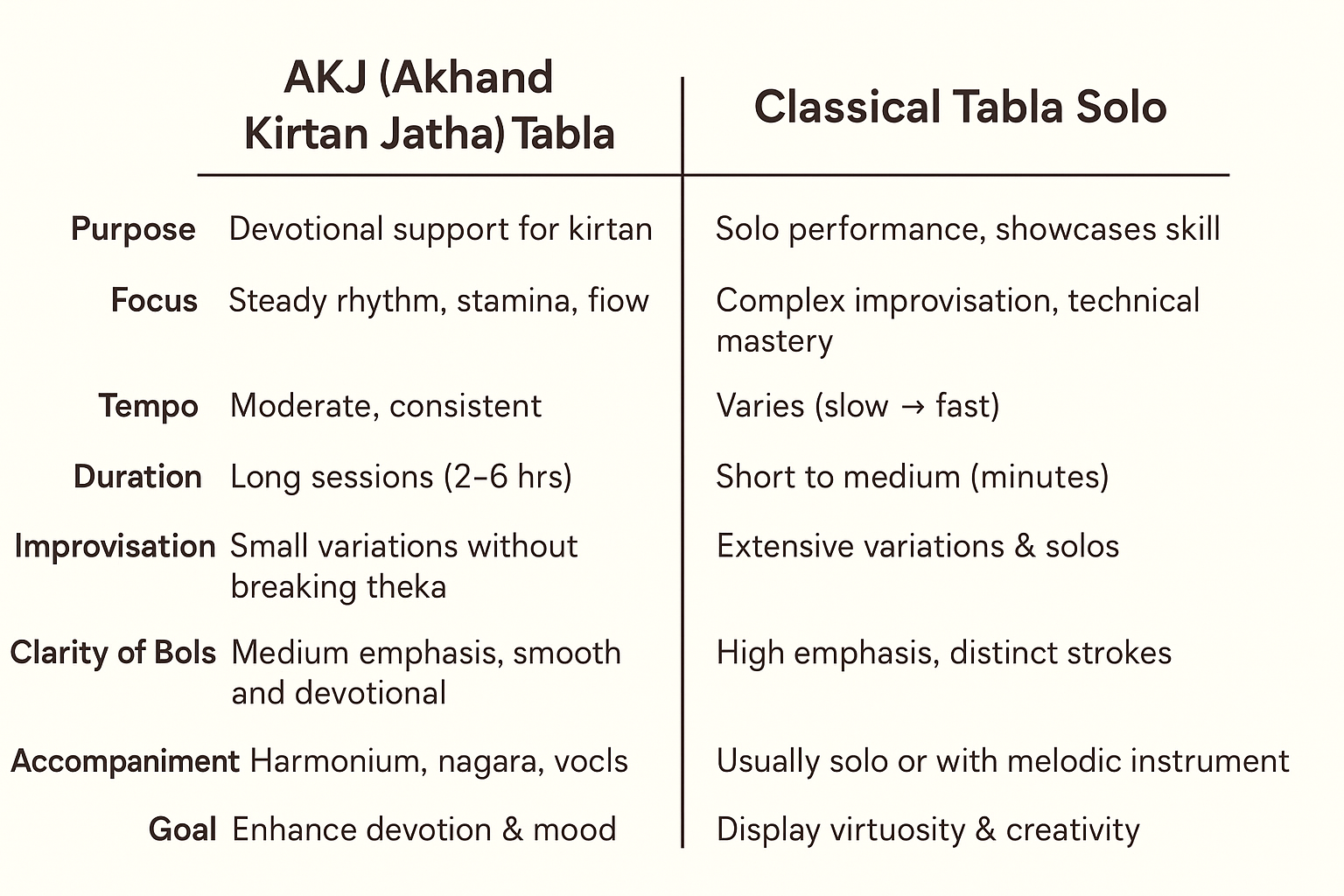
Tabla is an essential instrument in devotional music, especially in Akhand Kirtan Jatha (AKJ) sessions. The AKJ style of tabla is unique because it emphasizes continuous rhythm, supporting the kirtan singers, and maintaining energy for long hours. Unlike classical tabla solos, AKJ tabla focuses more on groove, clarity, and devotional feel rather than flashy improvisation.

Hereโ€™s a step-by-step guide on how to practice AKJ-style tabla:

1. Understand the Context

  • AKJ tabla is primarily used in devotional kirtan sessions, often alongside harmonium, nagara, and vocal singing.
  • The goal is to maintain a steady rhythm, enhancing the mood of the bhajan, without overpowering the singer.
  • Complexity is moderate, with an emphasis on stamina and smooth flow.

2. Learn Basic Thekas for Bhajan Talas

Some commonly used talas in AKJ kirtan include:

  • Keherwa (8 beats): Dha Ge Na Tin | Na Ka Dhin Na
  • Dadra (6 beats): Dha Dhi Na | Dha Tu Na
  • Teen Taal (16 beats): Occasionally for longer bhajans

Practice tip: Keep your playing steady, soft, and clear. Avoid overplaying.


3. Build Stamina

  • AKJ kirtans can last 2โ€“6 hours, so stamina is key.
  • Start with 15โ€“20 minutes of continuous playing and gradually increase to 1โ€“2 hours.
  • Practice slow, medium, and fast tempos, but always maintain consistency and clarity.

4. Focus on Laya and Flow

  • Maintain a smooth and flowing rhythm throughout the kirtan.
  • Learn to gradually accelerate or decelerate without breaking the theka.
  • Subtle variations in bols (like Dha Dhin Na โ†’ Dha Ti Na) help keep the rhythm interesting and dynamic.

5. Improvisation Without Breaking Rhythm

  • AKJ tabla allows small improvisations during intros, outros, or pauses.
  • Simple variations include adding extra Dha/Na, swapping bols, or doing gentle rolls.
  • Always return to the main theka smoothly.

6. Listen and Play Along

  • Listen to live AKJ kirtan recordings to understand:
    • How tabla complements singers
    • How rhythm is maintained for long periods
    • How muted and resonant strokes highlight the mood
  • Play along to match energy, dynamics, and devotion.

7. Suggested Practice Routine

  1. Warm-up: 10 minutes of basic bols
  2. Theka Practice: 15โ€“20 minutes in slow & medium tempo
  3. Continuous Play: 20โ€“40 minutes focusing on stamina and flow
  4. Variations: 10โ€“15 minutes of small improvisations
  5. Cool Down: Gentle play along recordings

Final Tips

  • Practice daily, even for short sessions, to build finger strength and endurance.
  • Keep your strokes resonant and clear, as clarity is the hallmark of AKJ tabla.
  • Enjoy the devotional processโ€”playing tabla in kirtan is as much about spiritual connection as technical skill.
Categories
Blog Learning Tech

Latest GST Invoicing & Compliance for B2B and B2C in India (2025 Updates)

Indiaโ€™s GST system continues to evolve, bringing in new invoicing and compliance requirements for businesses. Whether you deal with Business-to-Business (B2B) or Business-to-Consumer (B2C) transactions, staying updated is essential to avoid penalties and ensure smooth operations.

This post covers everything you need to know about GST billing, invoicing, and filing under the latest rules effective from May 2025 โ€” with facts, practical tips, and official references.


Understanding GST Invoicing: B2B vs. B2C

B2B Invoices: Mandatory E-Invoicing and Detailed Reporting

If your business has an annual turnover exceeding โ‚น5 crore, you are required to generate e-invoices for all B2B transactions. This means:

Uploading your invoice data to the Governmentโ€™s Invoice Registration Portal (IRP).

Receiving an Invoice Reference Number (IRN) and QR code for each invoice.

Including important details such as buyer GSTIN, HSN codes (first 4 digits for large businesses), invoice number, taxable value, and tax amount.

This system ensures real-time invoice validation and enhances transparency across the GST network.
Fact: E-invoicing for B2B is mandatory for turnover > โ‚น5 crore since January 2023. (Sovos.com)

Also, only invoices properly reported and uploaded by the supplier allow buyers to claim Input Tax Credit (ITC).


B2C Invoices: Consolidated and Detailed Reporting

B2C transactions are treated differently based on invoice value:

For invoices up to โ‚น1 lakh, businesses report consolidated details in GSTR-1 returns (taxable value and tax amounts).

For invoices above โ‚น1 lakh, detailed invoice-wise reporting is mandatory.

Dynamic QR codes are required on B2C invoices from September 2024 onward, facilitating digital payments and improving transparency.

Businesses with turnover up to โ‚น5 crore must report only the first two digits of HSN codes on invoices.


GSTR-1 Return Filing Changes from May 2025

A significant update is the bifurcation of Table 12 in GSTR-1:

Table 12A: For B2B transactions.

Table 12B: For B2C transactions.

Both tables require HSN-wise summaries of supplies, helping the tax authorities analyze sales data more granularly and reducing reconciliation errors.

Timely filing of GSTR-1 remains crucial. Late or incorrect filing can delay ITC claims for buyers, which impacts cash flow and compliance.


Workflow for GST Compliance

  1. Invoice Generation:

E-invoices for B2B transactions through IRP.

Standard invoices with QR codes for B2C transactions.

  1. GSTR-1 Filing:

Report invoices accurately under the correct category (B2B or B2C).

Ensure inclusion of all mandatory details โ€” GSTIN, HSN codes, invoice values, tax rates, etc.

  1. GSTR-3B Filing:

Cross-verify GSTR-1 data and declare tax liability.

Ensure ITC claims are supported by supplier invoice uploads.

  1. E-Way Bill Generation:

Mandatory for inter-state movement of goods exceeding โ‚น50,000 in value.


Key Compliance Checklist

Ensure accuracy of invoice data (GSTIN, HSN, tax rates).

Comply with e-invoicing mandates based on turnover.

Include dynamic QR codes on B2C invoices.

File GSTR-1 and GSTR-3B on time to avoid penalties.

Regularly reconcile returns to claim correct ITC.


Pro Tips to Stay Ahead

Use GST-compliant invoicing software that automatically generates e-invoices and helps with return filing.

Stay updated with notifications from the GST Council and the Government portal.

Periodically audit your GST returns for consistency between invoices and filings.


Conclusion

The GST landscape in India is advancing towards greater digitization and transparency, especially with the rise of e-invoicing and detailed return filings. Understanding the differences in billing requirements for B2B and B2C transactions โ€” along with the new GSTR-1 structures โ€” is critical for businesses to remain compliant and optimize their tax workflows.


References & Further Reading:

GST E-invoicing Mandate – Sovos

GST Return Filing Changes May 2025 – CaptainBiz

GST B2B vs B2C Invoice Reporting – EZTax

GST Updates – Economic Times