Categories
AI Humor Artificial Intelligence Digital Life Technology,

When AI Took Me Too Literally: A Collection of Funny AI User Incidents

Artificial Intelligence is getting smarter every day. It can write emails, generate images, summarize books, create websites, and even help students with homework. But sometimes, the funniest moments happen when humans and AI misunderstand each other in spectacular ways.

Here are some real-life-inspired incidents that show why AI still has a long way to go before it truly understands human beings.


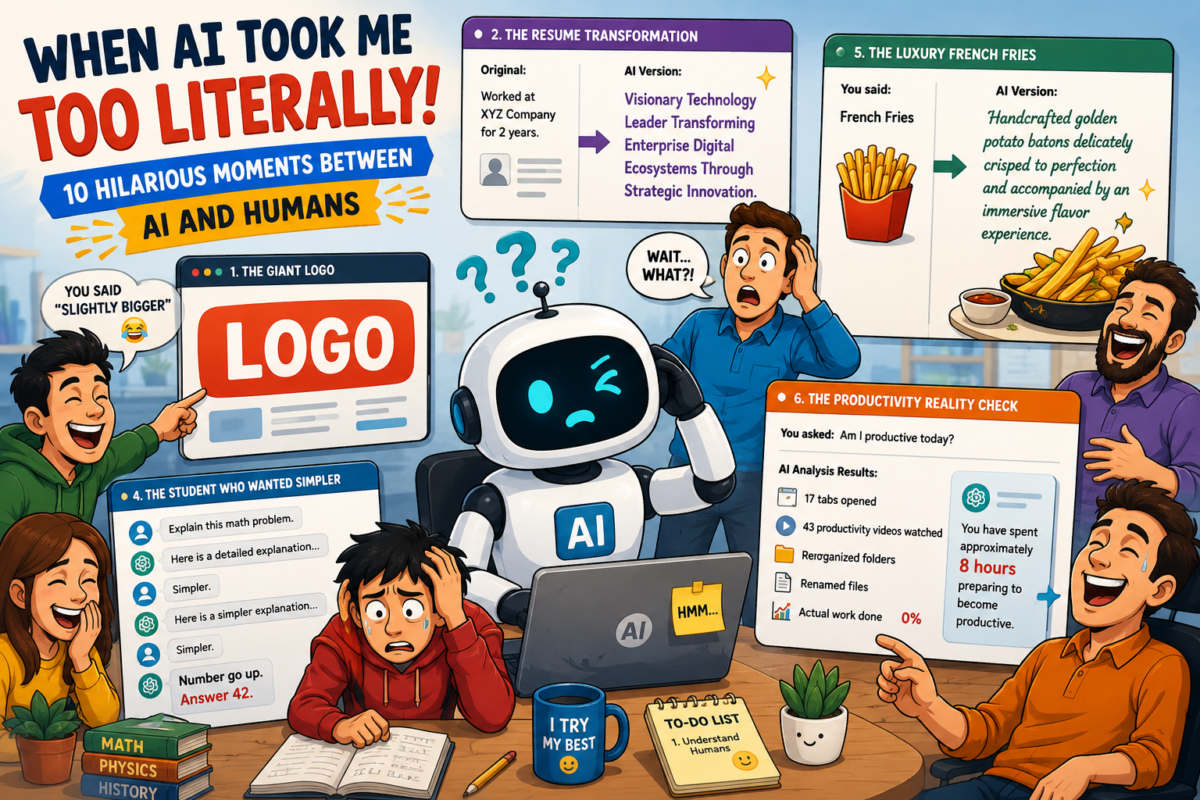
1. “Make My Logo Bigger”

A business owner uploaded a banner design and told the AI:

“Can you make the logo slightly bigger?”

The AI responded by increasing the logo size from 10% of the banner to approximately 90%.

The logo became the banner.

The business name disappeared.

The contact details disappeared.

The slogan disappeared.

The only thing visible was a giant logo staring confidently at everyone.

Technically, the request was fulfilled.


2. The Resume Disaster

A job seeker asked AI:

“Make my resume stand out.”

The AI enthusiastically rewrote his experience.

Original:

Worked at XYZ Company for 2 years.

AI Version:

Visionary Technology Leader Transforming Enterprise Digital Ecosystems Through Strategic Innovation.

The candidate was actually a junior support executive resetting passwords.

The interviewer spent 15 minutes trying to understand how a “Visionary Technology Leader” forgot his own email password.


3. The Angry Customer Email

A frustrated customer wrote:

Write a polite email saying I am unhappy.

AI generated:

Dear Sir,

I hope this email finds you well. I would like to express my deepest gratitude for the unique opportunity to experience disappointment at a level I previously believed impossible.

The customer laughed so hard he forgot to be angry.


4. The Student’s Shortcut

A student asked:

Solve this math problem and explain simply.

AI provided a detailed explanation.

The student replied:

Simpler.

AI simplified it.

Student:

Simpler.

AI simplified again.

Student:

Simpler.

Finally AI responded:

Number go up. Answer 42.

The student submitted it.

The teacher wrote:

Marks go down.


5. The Restaurant Menu Incident

A restaurant owner wanted fancy menu descriptions.

Original:

French Fries

AI Version:

Handcrafted golden potato batons delicately crisped to perfection and accompanied by an immersive flavor experience.

Customers expected a luxury dish.

They received fries.

Good fries, but still fries.


6. The Overly Honest AI

A user asked:

Am I productive today?

The AI reviewed the user’s activities:

  • Opened 17 tabs
  • Watched 43 productivity videos
  • Reorganized desktop folders
  • Renamed files
  • Read articles about productivity

Then replied:

You have spent approximately 8 hours preparing to become productive.

That one hurt.


7. The Website Launch

A developer asked AI:

Create a modern website.

AI generated:

  • Dark theme
  • Animations
  • Gradients
  • Glassmorphism
  • Shadows
  • More shadows
  • Even more shadows

The page looked beautiful.

Loading time: 18 seconds.

The developer proudly launched it.

Visitors admired the loading spinner.


8. The Diet Plan

User:

Give me a healthy diet plan.

AI:

Eat vegetables, fruits, proteins, and drink water.

User:

I don’t like vegetables.

AI adjusted.

User:

I don’t like fruits.

AI adjusted.

User:

I don’t like protein.

AI paused.

Then responded:

Have you considered photosynthesis?


9. The Smart Home Problem

A user connected AI to their smart home.

User:

Make the room cozy.

AI interpreted:

  • Lights: 20%
  • Temperature: 22ยฐC
  • Soft music
  • Curtains closed

Perfect.

Then the user said:

A little more cozy.

AI turned off all lights.

Nobody could find the switch.


10. The Ultimate AI Question

One evening a user asked:

Can you replace humans?

AI replied:

Who would ask me questions if I did?

For a brief moment, both human and machine agreed on something.


The Real Lesson

Most funny AI stories happen because humans assume AI understands context the same way people do.

Humans communicate with hints, emotions, assumptions, and incomplete sentences.

AI communicates with patterns, probabilities, and sometimes an alarming level of literal interpretation.

The result?

Occasional confusion.

Unexpected comedy.

And stories worth telling.

As AI becomes more powerful, one thing remains certain:

The funniest bugs in technology will always come from the interaction between human creativity and machine logic.

And honestly, we wouldn’t want it any other way.

Categories
Global Insights Tech & Trends World in Motion

๐ŸŒ Global Events Shaping 2026 (Part 2): Technology, Economy & Power Shifts

๐Ÿš€ Introduction: The Invisible Forces Behind Change

While global events often appear as headlines โ€” launches, festivals, competitions โ€” the real transformation of 2026 is happening beneath the surface.

Technology is reshaping industries faster than policies can adapt. Economies are shifting their centers of gravity. And power is no longer defined only by geography, but by data, innovation, and influence.

This part of the series explores the hidden engines driving global change.


๐Ÿค– The Rise of Artificial Intelligence in Everyday Life

Artificial intelligence is no longer a concept limited to labs or tech companies. In 2026, it is quietly embedded in everyday life โ€” from how businesses operate to how individuals make decisions.

Tools powered by AI are transforming customer service, automating repetitive work, and even assisting in creative processes. Companies are no longer asking whether to use AI, but how deeply they can integrate it into their operations.

What makes this shift significant is its scale. Small businesses now have access to capabilities that were once reserved for large corporations. This is leveling the playing field, while also increasing competition across industries.

At the same time, concerns around ethics, job displacement, and data privacy are growing โ€” forcing governments and organizations to rethink regulations.

AI is not just a technology trend; it is becoming a foundation of modern society.


๐Ÿ’ฐ The Changing Global Economy

The global economy in 2026 is undergoing a quiet but powerful transformation. Traditional financial systems are being redefined by digital payments, decentralized technologies, and new financial platforms.

Events like Global Fintech Fest highlight how countries like India are becoming leaders in digital finance innovation.

Cash is steadily being replaced by mobile transactions. Banking is becoming more accessible. And financial services are reaching populations that were previously excluded.

This shift is not just technological โ€” it is social. It is changing how people save, spend, and invest.

At the same time, global economic power is becoming more distributed. Emerging markets are playing a larger role, creating a more balanced and competitive global landscape.


๐ŸŒ Geopolitics in a Connected World

In 2026, geopolitics is no longer confined to borders and military strength. It is increasingly influenced by technology, trade, and information.

Countries are competing not only for resources, but for technological leadership. Control over data, innovation, and infrastructure has become a key source of power.

At the same time, global challenges such as climate change and cybersecurity are forcing nations to collaborate in new ways. International alliances are evolving, shaped by shared interests rather than traditional alignments.

This creates a complex world where cooperation and competition exist simultaneously.


๐Ÿ™๏ธ Smart Cities and Urban Transformation

Cities are becoming the focal point of innovation in 2026. With increasing urban populations, governments are investing in smart infrastructure to improve efficiency and quality of life.

From intelligent traffic systems to energy-efficient buildings, technology is being used to create more sustainable and livable environments.

Urban spaces are no longer just places to live โ€” they are becoming ecosystems that integrate technology, sustainability, and human experience.

This transformation is especially visible in rapidly developing regions, where cities are being designed with the future in mind.


๐Ÿ”ฎ What This Means for You

The forces shaping 2026 are not distant โ€” they are directly influencing everyday life.

Whether you are a business owner, developer, or creator, understanding these shifts can help you identify opportunities early.

Those who adapt to these changes will not just survive โ€” they will lead.


โœ๏ธ Closing Thought

If Part 1 showed us the visible events shaping the world, Part 2 reveals the systems powering them.

The future is not built overnight โ€” it is constructed quietly, through technology, decisions, and innovation happening every day.

  1. We donโ€™t claim out rights on any of these images used in the article, they are for reader illustration purpose only.ย โ†ฉ๏ธŽ
Categories
Blog Learning

๐Ÿš€ From College Frustrations to AI Writing Code: I Saw This Coming

Back then, I was just another guy in college, buried in assignments, projects, and endless debugging.

Every time I sat in front of the screen, I had the same thought running in my head:

โ€œWhy the hell canโ€™t this be automated?โ€

I wasnโ€™t dreaming about sci-fi robots or some fantasy tech. I just wanted the machine to help me.
I was tired of writing boilerplate code. Tired of repeating the same logic in slightly different ways. Tired of wasting hours on things that felt like they shouldโ€™ve taken minutes.

Somewhere deep down, I kept asking myself โ€” what if one day, I could just tell the computer what I wanted, and it would do the rest?

At the time, it felt crazy. A daydream. Something impossible.


๐ŸŒฑ Early Work Days: The Same Thought Followed Me

When I started working, the thought never left.
Meetings, tasks, deadlines โ€” everything was moving fast, but the work still felt like it had friction.

Write. Debug. Rewrite. Test. Fix.
On loop.

I remember wishing, almost every week, โ€œthere has to be a smarter way.โ€


โšก And Thenโ€ฆ AI Happened

Fast forward to the last few years.

AI exploded.
Tools started rolling out that could:

  • Generate functions from a single line of English.
  • Suggest fixes before I even asked.
  • Explain code clearer than half the documentation Iโ€™d spent hours digging through.

The exact thing I used to imagine during late-night coding sessions? Itโ€™s here.
Itโ€™s real.
And itโ€™s getting better every single day.


๐Ÿ–ฅ๏ธ What It Feels Like Now

For me, itโ€™s a strange mix of relief and validation.

Relief โ€” because those repetitive, frustrating parts of coding finally have shortcuts.
Validation โ€” because the โ€œcrazy thoughtโ€ I had back in college wasnโ€™t crazy at all.

AI is not replacing developers. Itโ€™s amplifying them.
Itโ€™s letting us focus more on solving problems, designing smarter systems, and creating โ€” rather than drowning in repetitive tasks.


๐Ÿ”ฎ Looking Back, Looking Ahead

What I once thought was just a wild idea in my head has turned into everyday reality.

And hereโ€™s the real kicker: the future you imagine today might not be so far away.

So if youโ€™re sitting there, tired of something, wishing there was a better way โ€” donโ€™t ignore it.
That frustration might just be pointing toward the next big thing.

Because thatโ€™s exactly how I felt years ago.
And now? AI writes code.