Categories
Economic Analysis Emerging Markets

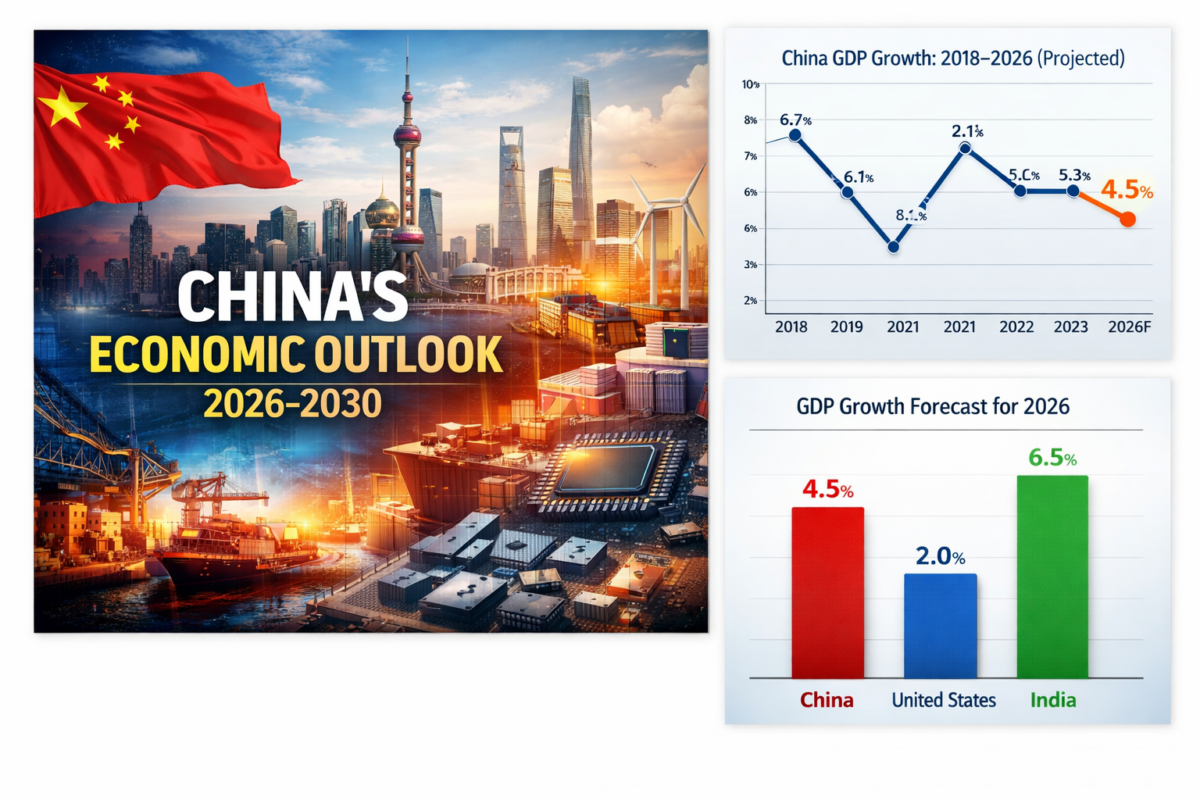
China’s Economic Outlook 2026–2030: Structural Transition, Real Risks, and Global Impact

Introduction: The End of the Old Growth Model

For much of the past three decades, China’s economic story was defined by velocity.

Industrialization at historic scale.
Urbanization at unprecedented speed.
Investment-led expansion that reshaped global supply chains.

That phase is complete.

China is not entering decline. But it is exiting the era of rapid catch-up growth and entering something more complex: structural transition.

The period from 2026 to 2030 will not be defined by explosive acceleration or sudden collapse. It will be defined by whether China can stabilize into a mature, mid-single-digit growth economy while rebalancing away from debt-heavy investment toward productivity, technology, and domestic consumption.

Understanding this shift requires moving beyond headlines and focusing on structural forces.


A Larger Economy Means Slower Arithmetic

Growth rates must be interpreted in context.

In the early 2000s, China could grow at 10% annually because its economic base was far smaller. Infrastructure gaps were enormous. Labor supply was expanding. Capital accumulation delivered rapid returns.

Today, China’s economy is approaching the size of the United States in nominal terms and already exceeds it in purchasing-power-adjusted output. At this scale, maintaining double-digit expansion would require output gains larger than entire G20 economies each year — an unrealistic benchmark.

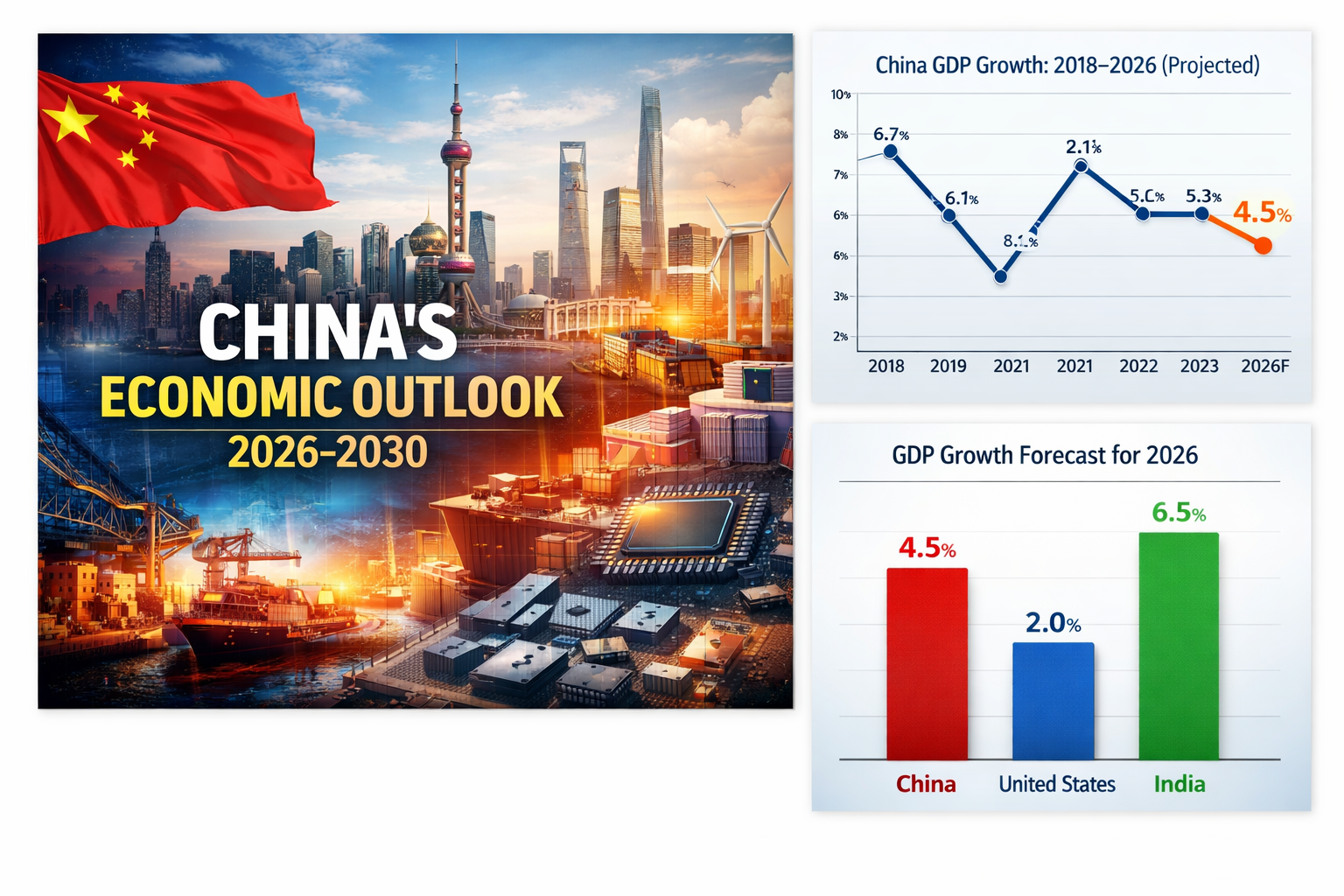
Most institutional forecasts now cluster around 4–5% annual growth in the medium term. That moderation reflects structural normalization, not systemic weakness.

At current scale, even 4.5% growth adds substantial absolute output annually — equivalent to creating an economy the size of a mid-tier European country every year.

Slower percentages no longer imply small impact.


Property: From Engine to Constraint

No single sector illustrates China’s transition more clearly than real estate.

For nearly two decades, property development functioned as an economic multiplier. Construction activity supported steel, cement, glass, household appliances, and local government revenues through land sales. Rising home values reinforced household wealth confidence.

But leverage accumulated. Oversupply expanded in lower-tier cities. Developer balance sheets grew fragile.

The regulatory tightening that began earlier this decade exposed those imbalances. Major developers struggled to refinance. Construction activity slowed. Land sales weakened, pressuring local fiscal systems.

This was not merely cyclical softness. It marked a structural resizing of a sector that had grown beyond sustainable levels.

Real estate is unlikely to regain its previous share of GDP contribution. The policy direction suggests stabilization, not renewed speculation.

For a deeper breakdown of this transformation, see our detailed analysis:
Understanding China’s Property Crisis: Structural Correction, Not Collapse.


Demographics: The Productivity Imperative

China’s demographic profile is shifting decisively.

The working-age population has begun to decline. The median age is rising. Fertility rates remain low despite policy adjustments.

This does not guarantee stagnation. Many advanced economies grow with aging populations. But it changes the mechanics of expansion.

When labor supply stops expanding, growth must come from:

  • Productivity gains
  • Technological advancement
  • Capital efficiency
  • Institutional reforms

China’s response has been clear: invest heavily in industrial upgrading and automation.

Whether these investments offset demographic drag will shape the 2026–2030 trajectory.


Industrial Upgrading and Strategic Positioning

China’s policy direction increasingly emphasizes advanced manufacturing and strategic industries.

Electric vehicles.
Battery supply chains.
Renewable energy equipment.
Artificial intelligence and semiconductor capability.

This shift reflects more than economic logic — it reflects geopolitical reality. As trade tensions and export controls increase, China seeks to reduce dependence on foreign technology inputs.

The renewable energy sector provides a useful example. China leads globally in solar manufacturing capacity and renewable installations, positioning itself at the center of the global energy transition. That industrial depth offers long-term strategic leverage.

Industrial upgrading is not a temporary stimulus measure. It is the core of China’s next growth model.


External Environment: Interdependence Under Pressure

China remains deeply integrated into global trade networks. It accounts for a substantial share of global manufacturing exports and is a major importer of raw materials.

However, the external environment has grown more complex.

Supply chain diversification — sometimes framed as “China+1” — reflects corporate risk management rather than complete disengagement. Production is expanding in Southeast Asia and India, but China’s ecosystem depth remains unmatched in many advanced manufacturing segments.

The risk for China is not immediate export collapse. It is gradual erosion of low-margin manufacturing combined with geopolitical friction in high-tech sectors.

This reinforces the urgency of domestic consumption growth.

For analysis on global transmission effects, see:
How China’s Growth Moderation Impacts the Global Economy.


The 2026–2030 Baseline

If current trends persist, the most plausible scenario is steady but moderated growth in the 4–5% range.

This would imply:

  • Property stabilizes at lower activity levels
  • Industrial upgrading continues
  • Consumption gradually strengthens but does not fully replace investment
  • Local government debt remains manageable but requires oversight

Such a trajectory would position China as a mature, systemically important economy rather than a high-velocity emerging one.

The greater risk is not slow growth — it is policy miscalibration.

Excessive tightening could deepen domestic weakness.
Excessive stimulus could reignite debt imbalances.

The balance between reform and stability will determine outcomes.


Global Consequences

Even moderated Chinese growth shapes global economics.

Commodity exporters depend on Chinese demand.
Emerging markets link into its supply chains.
Global inflation dynamics respond to its production capacity.

China’s economic transition does not reduce its influence. It changes the form of that influence.

The next five years will reveal whether China can execute a shift from investment intensity to productivity resilience without destabilizing growth.


Conclusion: From Expansion to Consolidation

China’s economic story is entering a consolidation phase.

The era of catch-up acceleration has passed. The new phase requires efficiency, technological depth, and consumption stability.

Mid-single-digit growth, sustained at China’s scale, would still anchor global expansion through the end of the decade.

The central question is not whether China will grow.

It is whether it can transform — without losing momentum.

References

International Monetary Fund (2026). People’s Republic of China: Article IV Consultation Press Release.
https://www.imf.org/en/Publications/CR/Issues

World Bank (2025). China Economic Update.
https://www.worldbank.org/en/country/china/publication

International Energy Agency (2025). Renewables Market Update.
https://www.iea.org/reports

Categories
Learning

AI in Software Development (2026): How Artificial Intelligence Is Transforming Programming

Introduction: AI Is No Longer Optional for Developers

Software development has changed more in the last three years than in the previous two decades.

Artificial Intelligence is no longer an experimental feature — it is now embedded into everyday development workflows. From writing code and reviewing pull requests to generating documentation and detecting security vulnerabilities, AI has become a permanent development partner.

In 2026, the real question is not:

Will AI replace developers?

The real question is:

Can developers remain competitive without AI?

This article explores how AI is reshaping software development, the tools leading this transformation, productivity impact, risks, and how developers should adapt.


AI developer illustration

What Is AI in Software Development?

AI in software development refers to machine learning and large language models assisting developers in:

  • Writing and refactoring code
  • Generating documentation
  • Creating test cases
  • Reviewing code for security and performance
  • Debugging applications
  • Automating DevOps processes

Instead of replacing developers, AI augments their productivity and shifts their role toward architecture and decision-making.


How AI Is Used in Everyday Development (2026)

1. AI Code Generation and Completion

Modern AI coding assistants can:

  • Generate full functions from natural language
  • Convert code between languages
  • Scaffold REST APIs
  • Write SQL queries
  • Build UI components
  • Create infrastructure configuration files

Example

Instead of manually building an authentication system, developers can prompt:

“Create a scalable JWT authentication system in Node.js with refresh tokens, rate limiting, and secure password hashing.”

The AI generates a structured starting point, which developers refine and validate.

Popular AI Coding Tools in 2026

  • GitHub Copilot
  • ChatGPT
  • Amazon CodeWhisperer
  • Cursor AI
  • Replit AI

These tools integrate directly into IDEs, enabling real-time suggestions.


2. AI-Powered Code Reviews

AI now assists in:

  • Identifying security vulnerabilities
  • Detecting performance bottlenecks
  • Suggesting architectural improvements
  • Enforcing code standards

This reduces dependency on senior developer bandwidth and improves review turnaround time.

AI review tools are particularly strong in identifying:

  • SQL injection risks
  • Insecure authentication logic
  • Memory leaks
  • Inefficient loops
  • Duplicate code patterns

3. Automated Test Case Generation

Writing unit tests is often repetitive and time-consuming. AI now:

  • Generates unit and integration tests
  • Covers edge cases automatically
  • Simulates user scenarios
  • Suggests mocking strategies

This leads to:

  • Better test coverage
  • Faster release cycles
  • Reduced manual QA burden

However, human validation remains critical to ensure logical correctness.


4. AI for Documentation and Knowledge Sharing

Documentation is traditionally neglected. AI now automatically generates:

  • README files
  • API documentation
  • Inline code comments
  • Release notes
  • Technical summaries

This dramatically improves onboarding speed for new developers and reduces knowledge silos.


5. AI-Assisted Debugging

AI tools can:

  • Analyze stack traces
  • Suggest probable root causes
  • Explain legacy code
  • Provide step-by-step debugging guidance

This reduces mean time to resolution (MTTR) and improves system reliability.


Productivity Impact: What the Data Shows

Companies adopting AI-assisted development report:

  • 30%–55% faster feature delivery
  • Reduced junior developer onboarding time
  • Faster MVP creation
  • Lower burnout from repetitive tasks

However, productivity gains depend on how AI is used. Blind trust in generated code can increase technical debt.

AI accelerates development, but it does not eliminate responsibility.


Risks and Challenges of AI in Programming

Despite its advantages, AI-assisted development introduces real risks.

1. Overdependence

Developers who rely entirely on AI may lose core problem-solving skills.

Fundamentals such as:

  • Data structures
  • System design
  • Security principles
  • Performance optimization

Remain essential.


2. Security Vulnerabilities

AI-generated code may:

  • Include insecure defaults
  • Use outdated libraries
  • Misconfigure authentication logic

Every AI output must be reviewed carefully.


3. Licensing and Intellectual Property Concerns

Since AI models are trained on large public datasets, organizations must ensure:

  • Compliance with software licenses
  • No proprietary code exposure
  • Legal review of AI-generated assets

4. Skill Gap Expansion

Developers who refuse to adopt AI tools risk falling behind.
Conversely, developers who master AI workflows gain significant leverage.


The Future of Software Development

Based on current trends, by 2030:

  • Over 70% of boilerplate code will be AI-generated
  • Developers will focus on system architecture and business logic
  • AI agents will manage CI/CD pipelines
  • Self-optimizing applications will become standard
  • Prompt engineering will be a core development skill

The developer role is evolving from coder to orchestrator.


How Developers Should Adapt in 2026

To remain competitive:

1. Use AI Daily

Integrate AI tools into your IDE and workflows.

2. Strengthen System Design Skills

Architecture will matter more than syntax.

3. Focus on Security Fundamentals

AI does not guarantee secure code.

4. Master Debugging

Understanding system behavior remains a uniquely human strength.

5. Learn Effective Prompt Engineering

Clear instructions produce better AI outputs.

Example of a high-quality prompt:

“Generate a scalable REST API using Laravel with token-based authentication, role-based access control, input validation, and proper error handling following best security practices.”

Better prompts = better results.


Frequently Asked Questions (FAQ)

Will AI replace software developers?

No. AI automates repetitive tasks but cannot replace architectural thinking, business logic understanding, and complex problem-solving.

Is AI-generated code safe?

Not always. Developers must review AI output for security vulnerabilities and performance issues.

What are the best AI coding tools in 2026?

GitHub Copilot, ChatGPT, Amazon CodeWhisperer, Cursor AI, and Replit AI are leading platforms.

Should junior developers use AI?

Yes, but as a learning assistant — not a replacement for foundational knowledge.


Final Thoughts

AI in software development is not a temporary trend. It is a structural shift in how software is built.

Developers who embrace AI strategically will build faster, smarter, and more scalable systems.

Those who ignore it risk becoming obsolete.

The future of programming belongs to developers who collaborate with AI — not compete against it.

Categories
Environment & Lifestyle World in Motion

Nature Is Returning — Not Outside, But Inside -🌍 WORLD IN MOTION — Episode 17

Nature Is Returning — Not Outside, But Inside

Technology once symbolized separation from nature.

Climate-controlled rooms. Artificial lighting. Digital immersion.

But across architecture, design, and urban policy, a quiet integration is taking place.

Biophilic design — the practice of incorporating natural elements into built environments — is no longer niche. Major corporations are redesigning campuses around open air, water features, and organic materials. Residential developments emphasize natural light, balconies, rooftop gardens, and shared green space.

Cities are expanding urban forests and green corridors not only for aesthetics but for temperature regulation and public health.

Even interior design trends reflect this shift. Indoor plant ownership has surged globally. Natural textures, earth tones, and sustainable materials dominate modern construction and renovation.

This is not decorative preference.

It is neurological alignment.

Environmental psychology research consistently shows that exposure to natural elements reduces cortisol levels, improves concentration, and enhances emotional regulation.

As screen time increases, biological counterbalance becomes essential.

Integration, Not Opposition

The future is not choosing between digital and natural.

It is blending them.

Smart homes coexist with solar integration. Urban density coexists with green rooftops. Remote work coexists with forest retreats.

The most advanced spaces of the coming decade will not look futuristic in the cold sense. They will feel grounded.

Conclusion

Nature is not retreating to the edges of society.

It is returning to the center.

And this reintegration signals something important: progress is becoming balanced.

If you want to revisit how cities are structurally adapting to this balance, return to:

👉 Episode 15 — Cities Are Quietly Reinventing Themselves
https://tortoisefeel.com/world-in-motion-episode-15

Because physical space and human well-being are no longer separate conversations.

Categories
World in Motion

The Quiet Return of Curiosity – 🌍 WORLD IN MOTION — Episode 16

The Quiet Return of Curiosity

There was a time when knowing a little about everything felt impressive.

Now it feels overwhelming.

In response to information overload, something subtle is happening across digital culture: people are returning to depth.

Long-form newsletters on platforms like Substack continue to grow. Podcasts extending beyond two hours attract millions of consistent listeners. Cohort-based online courses are replacing scattered tutorial consumption. Niche learning communities — from astrophysics enthusiasts to regenerative agriculture groups — are expanding quietly but steadily.

This isn’t nostalgia.

It is adaptation.

The early internet rewarded speed and surface knowledge. Algorithms amplified brevity. Summaries replaced nuance.

But as complexity in the real world increases — economic shifts, climate change, technological transformation — shallow understanding no longer feels sufficient.

Search behavior itself reflects this. Queries are becoming longer and more specific. Readers are choosing specialized analysis over general commentary.

Curiosity is shifting from passive consumption to intentional exploration.

The Cultural Maturity Phase

The information age is entering a maturity phase.

Instead of asking, “What’s new?” more people are asking, “What does this mean?”

Instead of collecting headlines, they are seeking coherence.

This return to curiosity builds something important: stability.

Deep learning reduces reaction. It increases context. And context reduces anxiety.

Conclusion

Curiosity is no longer a hobby.

It is resilience.

Those who choose depth over distraction are building an intellectual foundation that compounds over time.

To see how this intellectual shift intersects with physical design and lifestyle evolution, continue with:

👉 Episode 17 — Nature Is Returning — Not Outside, But Inside
https://tortoisefeel.com/world-in-motion-episode-17

Because how we learn is increasingly connected to how we live.

Categories
World in Motion

Cities Are Quietly Reinventing Themselves – 🌍 WORLD IN MOTION — Episode 15

Cities Are Quietly Reinventing Themselves

For decades, cities competed on scale.

Taller skylines. Wider highways. Larger commercial districts. Growth was visible, measurable, and loud.

But in recent years, something quieter has been unfolding.

Across Europe, Latin America, Asia, and parts of North America, cities are shifting from expansion toward livability.

Paris has expanded pedestrian zones and reduced car access along major riverbanks. Barcelona’s “superblocks” redesign entire neighborhoods to limit traffic and prioritize public space. Bogotá continues investing heavily in cycling infrastructure. Melbourne and Copenhagen consistently rank high for walkability and human-centered urban planning.

These changes do not dominate headlines. But they reshape daily experience.

Remote and hybrid work accelerated this transformation. When commuting patterns softened, cities were forced to reconsider how space functions. Office districts began blending into mixed-use neighborhoods. Public parks became flexible environments for work, meetings, and community life.

Urban real estate trends now show increasing demand for:

  • proximity to green space
  • access to local markets
  • walkable neighborhoods
  • quieter residential zones

This signals something deeper than aesthetic preference.

It reflects a philosophical shift.

Cities are no longer being designed only for economic throughput. They are being redesigned for human rhythm.

The Structural Shift

Modern urban planning is increasingly guided by one question:

How does daily life feel here?

Not how fast can traffic move.
Not how high can buildings rise.

But how sustainable is the lived experience?

As climate awareness grows and environmental policy strengthens, green corridors, rooftop gardens, and energy-efficient buildings are becoming default rather than exceptional.

The reinvention of cities is not dramatic.

It is deliberate.

Conclusion

The cities of the next decade will compete less on spectacle and more on stability.

Livability is becoming infrastructure.

If you’re interested in how this physical shift connects to intellectual and cultural changes, continue with:

👉 Episode 16 — The Quiet Return of Curiosity
https://tortoisefeel.com/world-in-motion-episode-16

Because as our environments change, so does how we think within them.

Categories
Human Growth World in Motion

What a Good Week Actually Feels Like Now -🌍 WORLD IN MOTION — Episode 14

What a Good Week Actually Feels Like Now

Ask someone ten years ago what a successful week looked like.

They would likely describe output. Metrics. Momentum.

Ask the same question now, and the answer sounds different.

A good week today feels stable.

Not explosive. Not dramatic. Stable.

It includes progress, yes — but not at the cost of energy collapse. It includes productivity — but without emotional residue. It includes ambition — but anchored in sustainability.

The modern reader is increasingly aware that exhaustion is not a badge of honor. It is a warning sign.

A well-lived week now includes:

  • Work that moved something forward.
  • Rest that wasn’t negotiated.
  • Decisions made deliberately.
  • Fewer regrets than reactions.

The definition of progress is compressing into something simpler: did this week leave me clearer than it found me?

There is a growing rejection of performative busyness. Not laziness — clarity. The desire to build a rhythm that can be repeated without damage.

Reflection is playing a larger role. People are reviewing their weeks instead of just surviving them. Small corrections are replacing dramatic resets.

This shift is subtle but profound.

Success is becoming quieter.

And quiet success tends to last longer.

If your week contained focus, boundaries, and at least one meaningful step forward — it counted.

Even if no one saw it.

Conclusion: Sustainable Weeks Build Sustainable Lives

A well-lived week does not leave you depleted.

It leaves you steady.

In earlier episodes, we explored:

  • The discipline of selective attention (Episode 12)
  • The architecture of boundaries (Episode 13)
  • The redefinition of progress (Episode 11)

This episode ties those threads together.

Progress that cannot be repeated is not progress — it is a spike.

Sustainable weeks create sustainable identities. And sustainable identities build long arcs of growth.

If you’re new to the series, start with:

Then continue to:

Each builds toward a calmer, clearer model of success.

The world is not slowing down.

But you can design how you move through it.

Categories
Learning Society & Culture World in Motion

Boundaries Are Becoming a Form of Intelligence – 🌍 WORLD IN MOTION — Episode 13

Boundaries Are Becoming a Form of Intelligence

There was a time when accessibility signaled importance.

If you were reachable at all hours, you were needed. If you responded instantly, you were reliable. If you accepted every opportunity, you were ambitious.

That era is fading.

Today, constant availability signals something else: a lack of filtration.

In a hyper-connected environment, the ability to filter input is no longer personal preference — it is cognitive survival. Without boundaries, attention fractures. Without attention, judgment weakens. Without judgment, quality declines.

Digital boundaries are the first layer. Limiting notifications. Closing tabs. Structuring communication windows. These actions sound small, but they rebuild mental coherence.

The second layer is professional. Clarity around timelines. Clear expectations. Fewer reactive commitments. High performers are not constantly responsive — they are predictably focused.

The third layer is emotional. Choosing not to engage in every debate. Separating feedback from identity. Refusing to measure self-worth through algorithmic reactions.

Boundaries are not about isolation. They are about signal preservation.

The world has become noisier. The individuals who thrive are not the loudest. They are the most internally stable.

There is a maturity in knowing when not to respond. In declining without explanation. In protecting deep work without apology.

As systems accelerate, boundaries become ballast.

And ballast keeps you steady when speed increases.

Conclusion: Boundaries as Architecture, Not Resistance

Boundaries are often misunderstood as restriction. In reality, they are structure.

Structure creates stability. Stability creates clarity. And clarity creates momentum.

In a hyper-connected world, intelligence is no longer measured by how much you consume, but by how well you filter.

If Episode 12 focused on selective attention, this episode deepens that idea into design. You cannot protect attention without boundaries.

To see how this plays out practically, revisit:

And to understand how this connects to sustainable success, read:

Boundaries are not barriers to growth.

They are the framework that allows it.

Categories
Future Trends World in Motion

The Week Will Test What You Ignore – WORLD IN MOTION — Episode 12

The Week Will Test What You Ignore

This week won’t overwhelm you with obvious pressure.

It will test something smaller — and harder to notice.

What you choose to ignore.

Modern life rarely collapses under dramatic weight. It erodes through accumulation. A message that doesn’t require an answer but gets one anyway. A task accepted out of habit. A meeting attended “just in case.” A tab opened and never closed.

None of these decisions feel significant in isolation. Together, they fragment a week.

You’ll notice this especially in the way attention behaves. Notifications won’t explode. They will drip. New tools won’t demand adoption. They will suggest optimization. AI systems won’t feel intrusive. They will offer convenience.

And that’s the real tension.

Technology is becoming smoother. More helpful. More ambient. But ambient systems still consume mental bandwidth. They still shape how you think, what you prioritize, and how quickly you react.

This week will reward people who pause before responding.

At work, urgency will appear credible. But if you slow down long enough to evaluate it, much of it dissolves. The most valuable contribution you can make may not be speed — it may be discernment.

Socially, you’ll see a shift too. Fewer loud declarations. More people quietly restructuring their routines. There is a subtle move away from performance toward calibration.

The quiet question behind the week is simple:
Does this deserve my attention?

Not everything that asks for energy deserves it.

If you protect one uninterrupted hour a day, you will feel the difference immediately. Not because you did more — but because you did less with intention.

The week is not testing your capacity.

It is testing your selectivity.

Conclusion: The Discipline of Selective Attention

This week is not asking for more effort. It is asking for sharper judgment.

The difference between a scattered week and a strong one will not be how many tasks you complete. It will be how many unnecessary demands you quietly decline.

Selective attention is becoming a discipline. The more noise the world produces, the more valuable clarity becomes.

If this theme resonates, you may want to continue with:

Both explore the structural shifts behind the week you’re about to live.

The week ahead will test what you ignore.

And what you ignore may define what you build.

Categories
Future Trends World in Motion

🌍 WORLD IN MOTION — Episode 11

🔹 INTRO

For decades, progress meant faster:

  • faster growth
  • faster tech
  • faster output
  • faster lives

But something is changing.

Episode 11 closes the week by asking a deeper question:

What does progress look like when speed no longer impresses us?

1. SPEED IS LOSING ITS STATUS SYMBOL

Speed once signaled:

  • ambition
  • success
  • intelligence

Now it often signals:

  • fragility
  • burnout
  • short-term thinking

People are beginning to value:

  • sustainability
  • durability
  • long arcs of growth

Progress is being redefined.


2. THE NEW MARKERS OF PROGRESS

https://images.squarespace-cdn.com/content/v1/5e3b2fe97d777f2b32c258e2/1706941952420-9CBXGOCO2L7VTGRKLCM8/ArticleIllustration_SRO_AREA17.jpg?utm_source=chatgpt.com

Progress now looks like:

  • systems that last
  • health that holds
  • work that compounds
  • learning that adapts
  • lives that feel livable

Deeper meaning

True progress improves quality, not just quantity.


3. TECHNOLOGY WILL SUPPORT DEPTH, NOT JUST SPEED

The next phase of technology:

  • reduces overload
  • protects attention
  • supports reflection
  • enables better decisions

This continues the shift we’ve tracked since Episode 6:

Tools stop pushing → start supporting.


4. SOCIETY IS MOVING FROM PERFORMANCE TO PRESENCE

People increasingly value:

  • being present
  • being intentional
  • being healthy
  • being aligned

Not everything needs to be optimized.
Some things need to be felt.


5. WHAT THIS MEANS FOR YOUR OWN IDEA OF SUCCESS

Ask yourself:

  • Does this progress improve my life — or just my metrics?
  • Is this speed sustainable — or temporary?
  • What would progress look like if no one was watching?

These questions define the next era.


6. A FRIDAY REFLECTION

Progress doesn’t always move forward.
Sometimes it moves deeper.

Those who learn to recognize this will:

  • build better lives
  • create meaningful work
  • stay relevant longer
  • remain human in fast systems

🔗 CONTINUE READING

Categories
Global Insights Society & Culture World in Motion

🌍 WORLD IN MOTION — Episode 10

🔹 INTRO

Last week, we explored how attention, energy, and simplicity are shaping the near future.
Episode 10 goes deeper into why simplicity itself is becoming one of the most valuable skills in the modern world.

Not minimalism as a trend —
but simplicity as intelligence.

This episode connects strongly with:

  • Episode 7 → Human slowdown
  • Episode 8 → Quiet skills
  • Episode 9 → Attention & energy shifts

1. COMPLEXITY IS NO LONGER A SIGNAL OF INTELLIGENCE

For years, complexity was rewarded:

  • complicated systems
  • packed schedules
  • overloaded workflows
  • constant multitasking

But complexity has a cost:

  • slower decisions
  • mental fatigue
  • fragile systems
  • burnout

Deeper insight

In high-change environments, simple systems adapt faster.

This is why:

  • simple products win
  • simple routines last
  • simple explanations spread

Simplicity is not “less thinking.”
It is better thinking.


2. TECHNOLOGY IS QUIETLY HIDING ITS OWN COMPLEXITY

Modern technology is becoming:

  • less visible
  • more automatic
  • more anticipatory

The best tools now:

  • reduce decisions
  • collapse steps
  • remove friction
  • stay out of the way

Why this matters

When technology simplifies the surface, humans regain:

  • focus
  • creativity
  • judgment

This supports a core pattern we’ve seen since Episode 4:

Intelligence moves inward, interfaces move outward — then disappear.


3. WORK IS SHIFTING FROM BUSY → MEANINGFUL

People are asking new questions:

  • What actually matters here?
  • What can be removed?
  • What gives long-term value?

Workplaces that thrive are:

  • reducing unnecessary meetings
  • shortening workflows
  • focusing on outcomes
  • respecting energy limits

Deeper pattern

The future doesn’t reward those who do everything
it rewards those who do the right few things well.


4. SIMPLICITY IS BECOMING A FORM OF POWER

Those who can simplify:

  • lead better
  • teach better
  • sell better
  • decide better

Why?
Because clarity builds trust.

In uncertain times:

  • simple messages calm people
  • simple choices move people
  • simple systems survive

5. WHAT THIS MEANS FOR DAILY LIFE

Simplicity now applies to:

  • fewer apps
  • fewer commitments
  • fewer goals at a time
  • clearer routines
  • cleaner information diets

This is not about doing less forever.
It’s about removing noise to hear signal.


6. A PRACTICAL SHIFT YOU CAN TRY THIS WEEK

  • Remove one unnecessary task
  • Simplify one routine
  • Focus on one priority per day
  • Say “no” once without guilt
  • Explain something in fewer words

Small acts of simplicity compound.


🔗 CONTINUE READING

Episode 7 → Human slowdown

Episode 9 → Attention & energy shifts

Episode 8 → Quiet skills