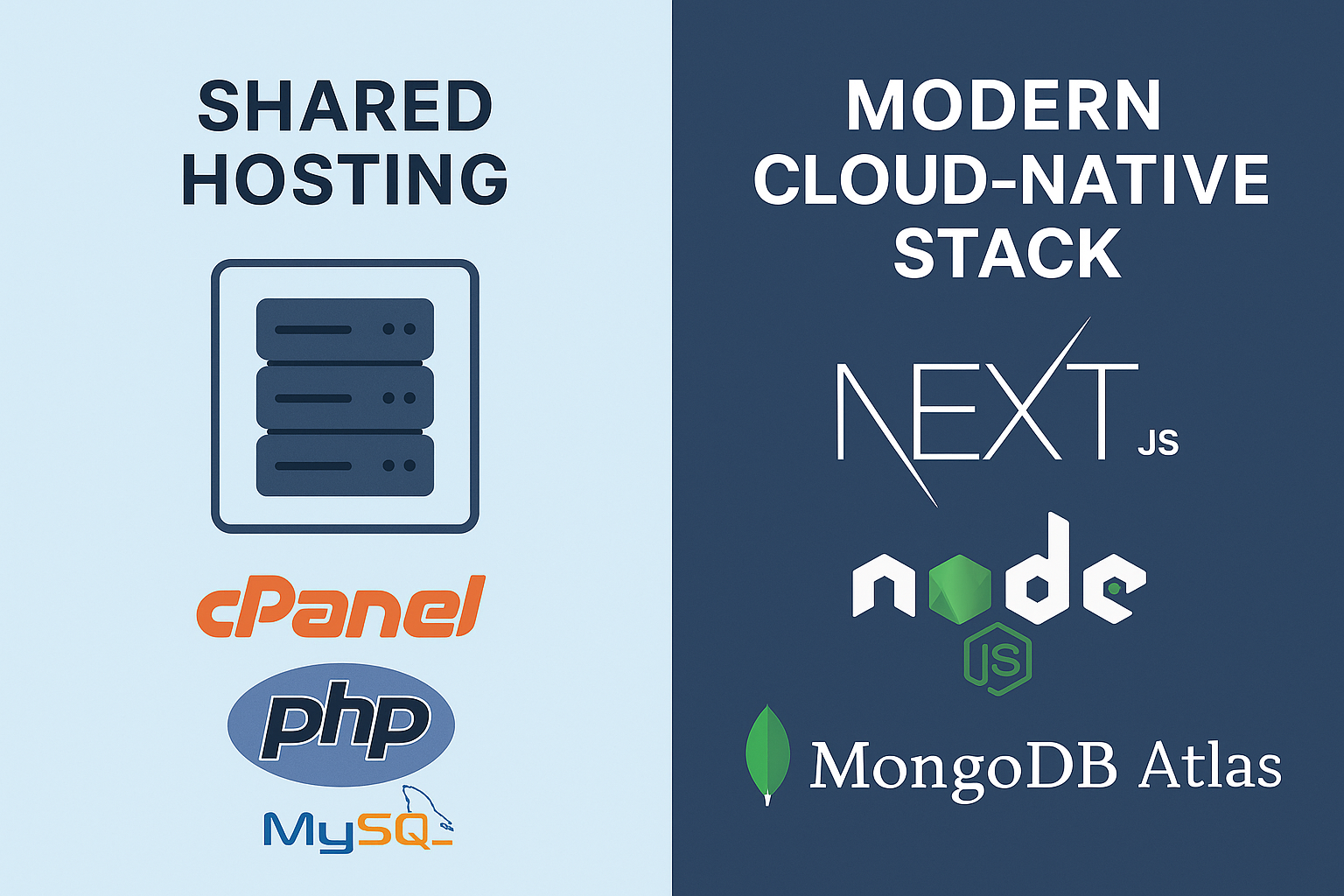
🧠 Can You Build a Hybrid App Using Python and MongoDB on Shared Hosting? (Modern Dev Stack Insights – 2025)

❓ User Question:

“I am on a shared host using cPanel. Can I develop a hybrid application using Python and MongoDB? Or what is the recommended database and coding language?”

βœ… Expert Answer:

If you’re on a shared hosting plan with cPanel, there are certain limitations that will shape what kind of stack you can use β€” especially for hybrid applications (like mobile/web apps built using React Native, Capacitor, or Flutter Web).

βš™οΈ Can You Use Python & MongoDB on Shared Hosting?

βœ… Python Support (Limited)

  • Most shared hosts offer limited Python support, often via CGI or Passenger.
  • Long-running apps like Flask or FastAPI may not be supported unless your host offers it specifically (some do via Passenger or SSH access).

❌ MongoDB Support (Nope)

  • MongoDB is not supported on most shared hosting plans.
  • Shared hosting is built around MySQL or MariaDB, and does not allow custom server processes like MongoDB.
  • You can use MongoDB Atlas as a cloud database, but you’d still need a proper backend server to connect to it.

βœ… So What Stack is Recommended on Shared Hosting?

Tech LayerRecommended on Shared Hosting
FrontendReact (static build), HTML/CSS/JS
BackendPHP (Laravel or Vanilla), maybe Python if supported
DatabaseMySQL or MariaDB
Hybrid App APIBuild REST API in PHP or limited Python
HostingUse cPanel to manage files, cron jobs, and MySQL

Conclusion: Use PHP + MySQL for backend API if you’re sticking to shared hosting.


🌍 What’s the Recommended Dev Stack in 2025?

If you’re not restricted to shared hosting and want a future-ready stack for professional, scalable development, here’s what we recommend:


πŸ”§ Frontend

  • Next.js (React) + Tailwind CSS + TypeScript
  • Alternatives: SvelteKit, Vite + React, Astro
  • For mobile: React Native, Expo, Capacitor (hybrid app framework)

βš™οΈ Backend

  • Node.js + Express / Fastify
  • NestJS (if you prefer structure and TypeScript)
  • Python (FastAPI) – Best for data-heavy apps or AI
  • Laravel (PHP) – Rapid development for traditional apps
  • Go or Rust – For performance-heavy systems

πŸ—ƒοΈ Database

TypeRecommended
RelationalPostgreSQL (modern), MySQL
NoSQLMongoDB Atlas (external), Firestore (for real-time), Redis (cache)

πŸš€ Hosting & Deployment Options

PlatformUse Case
VercelBest for frontend (Next.js)
Render / RailwayFull-stack hosting with DB
Firebase / SupabaseAll-in-one backend, auth, DB
DigitalOcean / Hetzner VPSFull control + Docker setup
MongoDB AtlasFully-managed MongoDB, free tier available

πŸ“Œ Summary

GoalRecommended Action
Use Python + MongoDB on shared hosting❌ Not feasible
Stick to shared hostingβœ… Use PHP + MySQL
Want modern, scalable stackβœ… Use Node.js, Python, or Laravel + cloud DB
Build hybrid mobile appβœ… Backend API (Node/PHP) + React Native or Capacitor

✨ Final Thought

If you’re starting small, shared hosting is a great launch pad. But for serious hybrid or full-stack app development in 2025, modern cloud platforms offer better flexibility, tooling, and scalability.


🧠 Need Help Choosing the Right Stack?

Comment below or contact us β€” we can help you decide the best stack based on your goals, skill level, and resources.

πŸ“Œ Tags:

Laravel; How to pull existing records on select change event using session type and date passed to dynamic web route in Laravel?

Welcome to Post,

Lets learn how to do the thing in the question, assuming you have basic or advance knowledge or learning something of your own to understand the things or you have got stuck due to simple issues of mistakes.

Using jQuery, HTML, Laravel Blade, Controller, Web Route and AJAX.

Lets begin.

Lets we talk first and defined about the HTML form field and its jQuery functionality. (I will be skipping middle parts of the code what it does and how its populated for the form fields ) and we will be using two fields here to show the example : session_date and session_type, which would look like below in the html code. session_type values would be morning, evening and so on for the day session.

<div class="row">
                            
                            <div class="form-group col-md-3">
                                <label for="session_date">Session Date:<sup>*</sup> </label>
                                <input type="date" name="session_date" id="session_date" class="form-control jsSessionDate" 
                                    value="{{ old('session_date', now()->format('Y-m-d'))}}"    
                                />
                                <!--<div class="text-end"><small class="text-muted"></small></div>-->
                            </div>
                            
                            <div class="form-group col-md-3">
                                <!--<input type="hidden" name="session_type" class="form-control hide mt-1" value="morning" />-->
                                                
                                <label for="session_type">Select Session Type:<sup>*</sup></label>
                                <select name="session_type" id="session_type" class="form-select text-capitalize jsSessionTypeChange" 
                                    >
                                    @foreach ($sessions_types as $ddSession)
                                        <option value="{{ $ddSession }}" {{old('session_type') ==  $ddSession ? 'selected' : ''}}>{{ $ddSession }}</option>
                                    @endforeach
                                </select>
                            </div>
                        </div>

Once we have the basic fields ready in HTML side we can write the jQuery side of it to fetch the records and make the AJAX call our server side of Laravel Controller.

$(document).on('change', '.jsSessionTypeChange', function(e) {
                const { value } = e.target;
                const sessionDateVal = $('.jsSessionDate').val();
                console.log(value)
                
                if(!value) return;
                
                const $this = $(this);
                const payload = { 
                    _token:  $('meta[name="csrf-token"]').attr('content'),
                };
                
                const sessionType = value || 'morning';
                const sessionDate = sessionDateVal ?? {{now()->format('Y-m-d')}};
                
                const baseUrl = window.location.origin+'/ams';
                const url = `${baseUrl}/existing-session/${sessionType}/${sessionDate}`;
                    
                console.log({url, sessionType, sessionDate});
                
                $.ajax({
                    url,
        			type: "get",
        			cache: false,
                }).done(function(resp) {
                    if(resp) {
                          console.log({
                              resp
                          })
                    }
                   })
                   .fail(function(err) {
                     console.error("Existing session fetch  error: ", err, err.responseText);
                });
            });

//IGNORE THE CONSOLE LOGS

Here, I am getting values from date filed and select dropdown for session type, on session type change event forming server side api end point url, not using PHP Laravel Blade example with javascript is its very difficult for blade to understand passing dynamic javascript variable to it.

Because PHP code executed on the page load even we defining the blade {{ }} in onChange event function scope. so its looks for that variable and its goes undefined , tried otherways around the then get the error from rotue generation syntax as route is forming dynamically.

So I thought to set back with simple Javascript code for forming the base URL and its endpoint for ajax call to happen.

Giving you context what I said above and for what thing i was trying to do in Javascript of code using Laravel Blade syntax, which didn’t worked out simply.

Try 1:

const type = value || 'morning';
const url = "{{ route('existing-session', ['sessionType' => '${type}']) }}";

$.ajax({
    url: url,
    // ... rest of your AJAX configuration
});

Try 2:
const type = value || 'morning';
const url = "{{ route('existing-session', ['sessionType' => '${type}']) }}";

$.ajax({
    url: url,
    // ... rest of your AJAX configuration
});

Try 3: Finally
const type = value || 'morning';
const baseUrl = window.location.origin;
const url = `${baseUrl}/existing-session/${type}`;

$.ajax({
    url: url,
    // ... rest of your AJAX configuration
});

Okay, now our HTML and JQUERY code is ready, lets quickly add in to our routes/web.php, dynamic route for ajax to work!

// To get existing Session on Create View
Route::get('existing-session/{sessionType}/{sessionDate}', [App\Http\Controllers\EventSessionController::class, 'existingSession'])->name('existing-session');

Now Finally in Controller side, write as method to get the sessionType and sessionDate and pull it the data from database and return as json response to the ajax call. Then we are good to finish!

public function existingSession($sessionType, $sessionDate) {
    // Fetch session with today's date and specific session type

    if($sessionType  !== '' && $sessionDate !== '') {
        $existingSession = EventSession::with(['members', 'samagams'])->where('session_type', $sessionType)
        ->whereDate('session_date', $sessionDate ?? now()->format('Y-m-d'))
        ->first();

        $response = ["data" => $existingSession, "success" => true, "error" => false, "message" => $sessionType." session found for date ".$sessionDate];
    } else {
        $response = [ "data" => null, "success" => false, "error" => true, "message" => "No existing session found for given session type ". $sessionType ." and date " .$sessionDate];
    }

    return response()->json($response);
}

Voila, your quick AJAX example ready in Laravel with pulling in data with dynamic passing of data to the GET route.

Hope this gives you hints, idea how to do the things in PHP Laravel.

Thanks for reading the post and happy learning!

Laravel getting error: Target class [App\Http\Controllers\GurbaniReadingController::class] does not exist. But file already exists!!

Hello Guys,

Facing this issue and struggling to find the cause?, okay then lets direct jump in to the fix I found or more precisely mistake I found!

In picture you might seeing controller name is different than I have mentioned below; I am changed it to Book, so don’t get confuse.

In my case I was wrapped the loading on controller in web.php route with single quotes!

Line of code causing this error:

Route::get('/book-readings/upload-photos', ['App\Http\Controllers\BookReadingController::class', 'uploadPhotos']);

Very carefully watch in above code code was wrapped in quotes: ‘App\Http\Controllers\BookReadingController::class’,
Controller should be loaded without single quotes;

And second important reason is it, this line should shall fall before the resource route if you have similar to this controller, in my case it was :

Route::resource('/book-readings', App\Http\Controllers\BookReadingController::class); 
// this line was defined before the above route I wanted to work! (I am not sure why this line causing to stop showing the page :/)

Finally I make these changes so everything started working smoothly & all routes loading fine and up!.

// Upload Audio Files:
Route::get('/book-readings/upload-photos', [App\Http\Controllers\BookReadingController::class, 'showPhotos'])->name('book-readings.upload-photos');
Route::post('/book-readings/upload-photos', [App\Http\Controllers\BookReadingController::class, 'uploadPhotos']);
Route::delete('/book-readings/upload-photos/{id}', [App\Http\Controllers\BookReadingController::class, 'destroyPhoto']);

Route::resource('/book-readings', App\Http\Controllers\BookReadingController::class);

Hope this will give you a hint to point the issue you might come up like this mostly when we are new and learning and developing new things!

Happy Learnings

How to use “where” with “pluck” in laravel?

Hello,

Here is the quick solution:

$categoryId = ProductCategory::where('id',$id)->pluck('categoryId')[0];
$parentId = ProductCategory::where('id',$id)->pluck('parentId')[0];
        
print_r($categoryId);
print_r($parentId);
        

Plucking it array index 0 as the return from pluck is array based so indexing gives us the value for the particular column you need to pluck from table.

Hope this will give you an idea or solution to your problem.

Happy Learning, Happy Learning Laravel!

How to use if else conditions in laravel blade view or for html code?

Hello, thanks for checking out here!

Here is the quick and short answer with the examples:

Example 1
<img src="@if($category->image) {{ ($category->image) }} @else {{'https://via.placeholder.com/50'}} @endif" alt="{{ $category->name}}" width="50" height="50" />

This is what I was looking for my part of development laravel! same you can achieve for the html blocks: here is the example:

Example 2
@if ($message = Session::get('success'))
    <script>
      if(window.toastr)
          toastr["success"]("{{ session()->get('success') }}"); 
    </script> 
@endif
Example 3
@if ($message = Session::get('success'))
  <div class="alert alert-success">
     session()->get('success')
  </div>
@endif

To use elseif just use following syntax @elseif(condition) along your code or between.

Thanks & Happy learning Laravel!

If Laravel created_at or updated_at SQL error, what to do?

Hello, welcome to my random post.

Quick to elaborate, what I was doing what I found it right to fix.

I am building an application with Laravel and I was facing with this below error:

// Illuminate\Database\QueryException
// SQLSTATE[42S22]: Column not found: 1054 Unknown column ‘created_at’ in ‘order clause’ (SQL: select * from food order by created_at desc limit 10 offset 0)

The cause of such error is when we don’t have column name in our database table, as to be created_at and updated_at.

In my case I was following camel case styles column names in database table: createdAt and upatedAt, so it was cause of this error and further to it, as I were looking for the solution and found that I am using latest() method to fetch the code (which is not allowed when don’t have laravel style column names of our database table), example like below

$food = Food::latest()->paginate(10);

so we have to have a columns names with created_at and updated_at in our database table, if want to use latest() method

Otherwise we need to change the method to orderBy() or first() method to fetch the result from database, also remember to add arguments to orderBy method/function like below, otherwise you would face again error of arguments need to be passed.

$food = Food::orderBy('createdAt', 'desc')->paginate(10);

Thanks for reading and happy coding. Have a nice day πŸ™‚
