AKJ ਸਟਾਈਲ ਟਬਲਾ (ਅਖੰਡ ਕੀਰਤਨ ਜਥਾ) ਦੀ ਅਭਿਆਸ ਕਿਵੇਂ ਕਰੀਏ

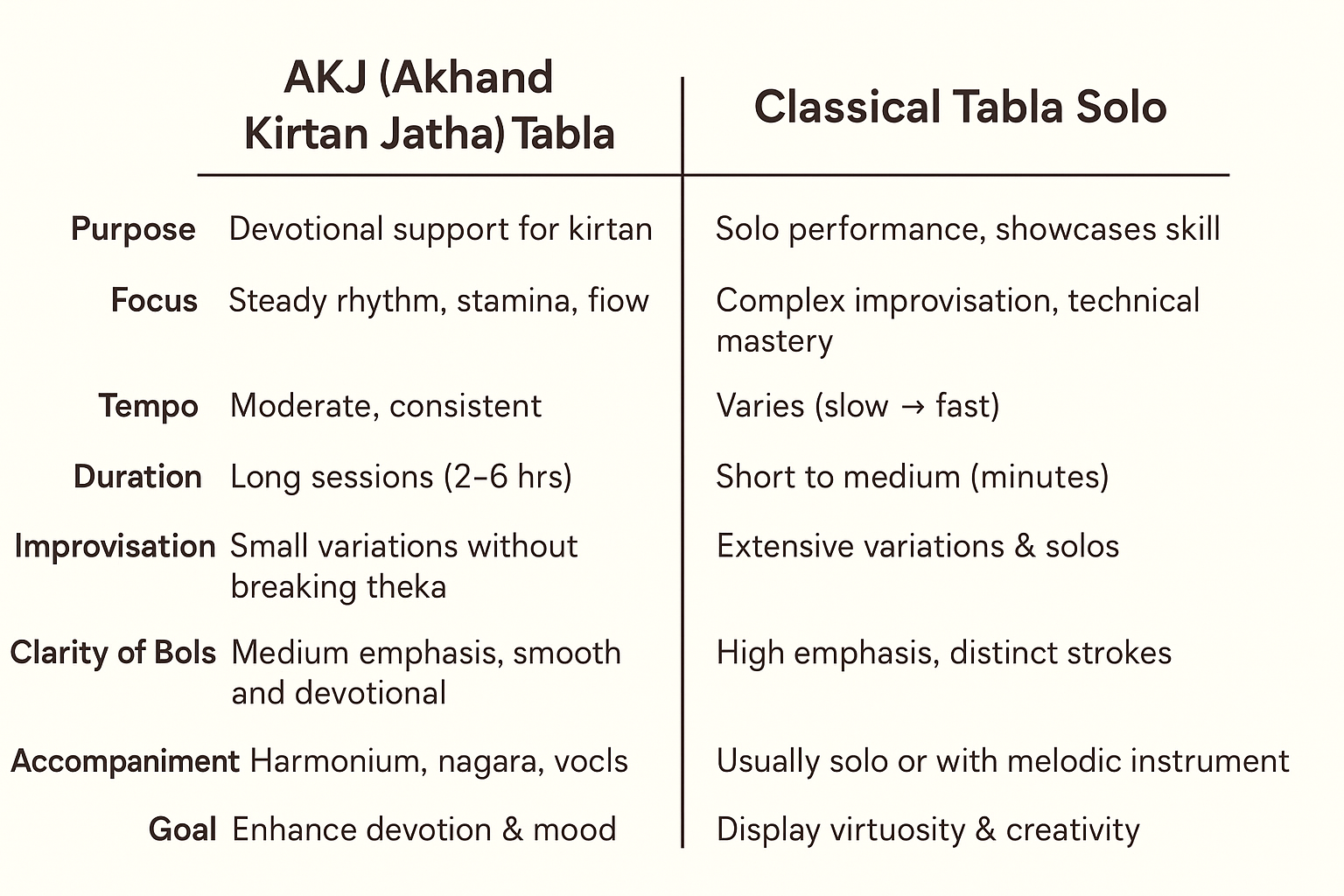
ਟਬਲਾ ਅਖੰਡ ਕੀਰਤਨ ਜਥਾ (AKJ) ਸੈਸ਼ਨਾਂ ਵਿੱਚ ਇੱਕ ਅਹੰਕਾਰਪੂਰਕ ਸੰਗੀਤਕ ਸਾਜ਼ ਹੈ। AKJ ਸਟਾਈਲ ਦਾ ਟਬਲਾ ਵਿਸ਼ੇਸ਼ ਹੈ ਕਿਉਂਕਿ ਇਹ ਲਗਾਤਾਰ ਰਿਥਮ, ਕੀਰਤਨ ਗਾਇਕਾਂ ਦਾ ਸਹਿਯੋਗ, ਅਤੇ ਲੰਬੇ ਸਮੇਂ ਲਈ ਊਰਜਾ ਬਣਾਈ ਰੱਖਣ ‘ਤੇ ਧਿਆਨ ਦਿੰਦਾ ਹੈ। ਕਲਾਸੀਕਲ ਟਬਲਾ ਸੋਲੋ ਦੇ ਵਿਰੁੱਧ, AKJ ਟਬਲਾ ਦਾ ਮੂਲ ਉਦੇਸ਼ ਹੈ ਰਿਥਮ, ਸਪੱਸ਼ਟਤਾ ਅਤੇ ਭਾਵਪੂਰਣ ਅਹਿਸਾਸ ਬਣਾਈ ਰੱਖਣਾ।

ਹੇਠਾਂ AKJ ਸਟਾਈਲ ਟਬਲਾ ਅਭਿਆਸ ਲਈ ਕਦਮ-ਦਰ-ਕਦਮ ਗਾਈਡ ਹੈ:


1. ਸੰਦਰਭ ਨੂੰ ਸਮਝੋ

  • AKJ ਟਬਲਾ ਪ੍ਰਮੁੱਖ ਤੌਰ ‘ਤੇ ਭਜਨ ਕੀਰਤਨ ਸੈਸ਼ਨਾਂ ਵਿੱਚ ਵਰਤਿਆ ਜਾਂਦਾ ਹੈ।
  • ਮੁੱਖ ਲਕੜੀ: ਲਗਾਤਾਰ ਠੀਕਾ ਬਣਾਈ ਰੱਖਣਾ, ਗਾਇਕ ਦੇ ਨਾਲ ਸੰਗਤ ਬਣਾਈ ਰੱਖਣਾ।
  • ਮੁਰਕੀ ਜਾਂ ਤੇਜ਼ੀ ਕਮ, ਪਰ ਧੀਰਜ ਅਤੇ ਸਧਾਰਨ ਲਹਿਰ ਉੱਤੇ ਧਿਆਨ।

2. ਭਜਨ ਤਾਲਾਂ ਲਈ ਮੁੱਖ ਠੀਕੇ ਸਿੱਖੋ

ਕਈ ਆਮ ਤਾਲਾਂ ਜੋ AKJ ਕੀਰਤਨ ਵਿੱਚ ਵਰਤੀਆਂ ਜਾਂਦੀਆਂ ਹਨ:

  • ਕੇਹੇਰਵਾ (8 ਬੀਟ): ਧਾ ਗੇ ਨਾ ਟਿਨ | ਨਾ ਕਾ ਧਿਨ ਨਾ
  • ਦਾਦਰਾ (6 ਬੀਟ): ਧਾ ਧੀ ਨਾ | ਧਾ ਤੁ ਨਾ
  • ਤੀਨ ਤਾਲ (16 ਬੀਟ): ਕਈ ਵਾਰੀ ਲੰਬੇ ਭਜਨਾਂ ਲਈ

ਅਭਿਆਸ ਸੁਝਾਅ: ਖੇਡ ਧੀਰੇ, ਸਪੱਸ਼ਟ ਅਤੇ ਨਰਮ ਰੱਖੋ। ਜ਼ਿਆਦਾ ਨਾ ਖੇਡੋ।


3. ਸਹਿਣਸ਼ੀਲਤਾ ਬਣਾਓ

  • AKJ ਕੀਰਤਨ 2–6 ਘੰਟੇ ਲੰਬੇ ਹੋ ਸਕਦੇ ਹਨ।
  • ਸ਼ੁਰੂਆਤ 15–20 ਮਿੰਟ ਲਗਾਤਾਰ ਖੇਡਣ ਨਾਲ ਕਰੋ, ਫਿਰ ਹੌਲੀ ਹੌਲੀ 1–2 ਘੰਟੇ ਤੱਕ ਵਧਾਓ।
  • ਧੀਮੇ, ਮੱਧਮ ਤੇ ਤੇਜ਼ ਤਾਲਾਂ ‘ਤੇ ਅਭਿਆਸ ਕਰੋ ਪਰ ਹਮੇਸ਼ਾ ਲਗਾਤਾਰਤਾ ਅਤੇ ਸਪੱਸ਼ਟਤਾ ਬਣਾਈ ਰੱਖੋ।

4. ਲਯ ਅਤੇ ਲਹਿਰ ‘ਤੇ ਧਿਆਨ ਦਿਓ

  • ਕੀਰਤਨ ਦੌਰਾਨ ਮੁਸਕਾਨ ਅਤੇ ਲਹਿਰਵਾਂ ਰਿਥਮ ਬਣਾਈ ਰੱਖੋ।
  • ਹੌਲੀ ਹੌਲੀ ਤੇਜ਼/ਧੀਮਾ ਕਰਨ ਦਾ ਅਭਿਆਸ ਕਰੋ।
  • ਬੋਲਾਂ ਵਿੱਚ ਸੁਖਮਾਰੀ ਤਬਦੀਲੀਆਂ (ਜਿਵੇਂ ਧਾ ਧਿਨ ਨਾ → ਧਾ ਟੀ ਨਾ) ਰਿਥਮ ਨੂੰ ਰੁਚਿਕਰ ਬਣਾਉਂਦੀਆਂ ਹਨ।

5. ਠੀਕੇ ਤੋੜੇ ਬਿਨਾਂ ਨਵੇਂ ਬੋਲ

  • AKJ ਟਬਲਾ ਛੋਟੇ ਸੁਝਾਅ ਅਤੇ ਤਬਦੀਲੀਆਂ ਦੀ ਆਗਿਆ ਦਿੰਦਾ ਹੈ।
  • ਸਧਾਰਨ ਤਬਦੀਲੀਆਂ: ਧਾ/ਨਾ ਵਧਾਉਣਾ, ਬੋਲ ਬਦਲਣਾ, ਨਰਮ ਰੋਲ ਕਰਨਾ
  • ਹਮੇਸ਼ਾ ਮੁੱਖ ਠੀਕੇ ਤੇ ਵਾਪਸ ਆਉਣਾ ਯਕੀਨੀ ਬਣਾਓ।

6. ਸੁਣੋ ਅਤੇ ਨਾਲ ਖੇਡੋ

  • ਲਾਈਵ AKJ ਕੀਰਤਨ ਰਿਕਾਰਡਿੰਗ ਸੁਣੋ:
    • ਟਬਲਾ ਗਾਇਕਾਂ ਨਾਲ ਸੰਗਤ ਕਿਵੇਂ ਬਣਾਉਂਦਾ ਹੈ
    • ਲੰਬੇ ਸਮੇਂ ਲਈ ਰਿਥਮ ਕਿਵੇਂ ਬਣਾਈ ਰੱਖੀ ਜਾਂਦੀ ਹੈ
    • ਮੁਟਿਆ ਅਤੇ ਗੂੰਜਦਾਰ ਸਟ੍ਰੋਕਸ ਭਾਵਨਾਤਮਕ ਅਹਿਸਾਸ ਦਿਖਾਉਂਦੇ ਹਨ
  • ਨਾਲ ਖੇਡੋ ਅਤੇ ਊਰਜਾ ਅਤੇ ਭਾਵਨਾਤਮਕਤਾ ਮਿਲਾਓ।

7. ਸੁਝਾਅ ਪ੍ਰਕਟੀਸ ਰੂਟੀਨ

  1. ਵਾਰਮ-ਅੱਪ: 10 ਮਿੰਟ ਬੁਨਿਆਦੀ ਬੋਲਾਂ
  2. ਠੀਕੇ ਦਾ ਅਭਿਆਸ: 15–20 ਮਿੰਟ ਧੀਮੇ ਅਤੇ ਮੱਧਮ ਤਾਲ ‘ਚ
  3. ਲਗਾਤਾਰ ਖੇਡਣਾ: 20–40 ਮਿੰਟ ਸਹਿਣਸ਼ੀਲਤਾ ਤੇ ਲਹਿਰ ‘ਤੇ ਧਿਆਨ
  4. ਤਬਦੀਲੀਆਂ: 10–15 ਮਿੰਟ ਛੋਟੀਆਂ ਤਬਦੀਲੀਆਂ
  5. ਕੂਲ ਡਾਊਨ: ਰਿਕਾਰਡਿੰਗ ਨਾਲ ਨਰਮ ਖੇਡ

ਅੰਤਿਮ ਸੁਝਾਅ

  • ਰੋਜ਼ਾਨਾ, ਭਾਵਨਾਤਮਕ ਅਭਿਆਸ, ਉਂਗਲਾਂ ਦੀ ਤਾਕਤ ਅਤੇ ਸਹਿਣਸ਼ੀਲਤਾ ਬਣਾਉਂਦਾ ਹੈ।
  • ਸਟ੍ਰੋਕਸ ਸਪੱਸ਼ਟ ਅਤੇ ਗੂੰਜਦਾਰ ਹੋਣ।
  • ਖੇਡ ਦਾ ਅਨੰਦ ਲਓ—ਕਿਰਤਨ ਵਿੱਚ ਟਬਲਾ ਸਿਰਫ ਤਕਨੀਕ ਨਹੀਂ, ਸਾਂਤਵਾਦਕ ਅਨੁਭਵ ਵੀ ਹੈ।

How to Practice AKJ Style Tabla (Akhand Kirtan Jatha)

Tabla is an essential instrument in devotional music, especially in Akhand Kirtan Jatha (AKJ) sessions. The AKJ style of tabla is unique because it emphasizes continuous rhythm, supporting the kirtan singers, and maintaining energy for long hours. Unlike classical tabla solos, AKJ tabla focuses more on groove, clarity, and devotional feel rather than flashy improvisation.

Here’s a step-by-step guide on how to practice AKJ-style tabla:

1. Understand the Context

  • AKJ tabla is primarily used in devotional kirtan sessions, often alongside harmonium, nagara, and vocal singing.
  • The goal is to maintain a steady rhythm, enhancing the mood of the bhajan, without overpowering the singer.
  • Complexity is moderate, with an emphasis on stamina and smooth flow.

2. Learn Basic Thekas for Bhajan Talas

Some commonly used talas in AKJ kirtan include:

  • Keherwa (8 beats): Dha Ge Na Tin | Na Ka Dhin Na
  • Dadra (6 beats): Dha Dhi Na | Dha Tu Na
  • Teen Taal (16 beats): Occasionally for longer bhajans

Practice tip: Keep your playing steady, soft, and clear. Avoid overplaying.


3. Build Stamina

  • AKJ kirtans can last 2–6 hours, so stamina is key.
  • Start with 15–20 minutes of continuous playing and gradually increase to 1–2 hours.
  • Practice slow, medium, and fast tempos, but always maintain consistency and clarity.

4. Focus on Laya and Flow

  • Maintain a smooth and flowing rhythm throughout the kirtan.
  • Learn to gradually accelerate or decelerate without breaking the theka.
  • Subtle variations in bols (like Dha Dhin Na → Dha Ti Na) help keep the rhythm interesting and dynamic.

5. Improvisation Without Breaking Rhythm

  • AKJ tabla allows small improvisations during intros, outros, or pauses.
  • Simple variations include adding extra Dha/Na, swapping bols, or doing gentle rolls.
  • Always return to the main theka smoothly.

6. Listen and Play Along

  • Listen to live AKJ kirtan recordings to understand:
    • How tabla complements singers
    • How rhythm is maintained for long periods
    • How muted and resonant strokes highlight the mood
  • Play along to match energy, dynamics, and devotion.

7. Suggested Practice Routine

  1. Warm-up: 10 minutes of basic bols
  2. Theka Practice: 15–20 minutes in slow & medium tempo
  3. Continuous Play: 20–40 minutes focusing on stamina and flow
  4. Variations: 10–15 minutes of small improvisations
  5. Cool Down: Gentle play along recordings

Final Tips

  • Practice daily, even for short sessions, to build finger strength and endurance.
  • Keep your strokes resonant and clear, as clarity is the hallmark of AKJ tabla.
  • Enjoy the devotional process—playing tabla in kirtan is as much about spiritual connection as technical skill.

Latest GST Invoicing & Compliance for B2B and B2C in India (2025 Updates)

India’s GST system continues to evolve, bringing in new invoicing and compliance requirements for businesses. Whether you deal with Business-to-Business (B2B) or Business-to-Consumer (B2C) transactions, staying updated is essential to avoid penalties and ensure smooth operations.

This post covers everything you need to know about GST billing, invoicing, and filing under the latest rules effective from May 2025 — with facts, practical tips, and official references.


Understanding GST Invoicing: B2B vs. B2C

B2B Invoices: Mandatory E-Invoicing and Detailed Reporting

If your business has an annual turnover exceeding ₹5 crore, you are required to generate e-invoices for all B2B transactions. This means:

Uploading your invoice data to the Government’s Invoice Registration Portal (IRP).

Receiving an Invoice Reference Number (IRN) and QR code for each invoice.

Including important details such as buyer GSTIN, HSN codes (first 4 digits for large businesses), invoice number, taxable value, and tax amount.

This system ensures real-time invoice validation and enhances transparency across the GST network.
Fact: E-invoicing for B2B is mandatory for turnover > ₹5 crore since January 2023. (Sovos.com)

Also, only invoices properly reported and uploaded by the supplier allow buyers to claim Input Tax Credit (ITC).


B2C Invoices: Consolidated and Detailed Reporting

B2C transactions are treated differently based on invoice value:

For invoices up to ₹1 lakh, businesses report consolidated details in GSTR-1 returns (taxable value and tax amounts).

For invoices above ₹1 lakh, detailed invoice-wise reporting is mandatory.

Dynamic QR codes are required on B2C invoices from September 2024 onward, facilitating digital payments and improving transparency.

Businesses with turnover up to ₹5 crore must report only the first two digits of HSN codes on invoices.


GSTR-1 Return Filing Changes from May 2025

A significant update is the bifurcation of Table 12 in GSTR-1:

Table 12A: For B2B transactions.

Table 12B: For B2C transactions.

Both tables require HSN-wise summaries of supplies, helping the tax authorities analyze sales data more granularly and reducing reconciliation errors.

Timely filing of GSTR-1 remains crucial. Late or incorrect filing can delay ITC claims for buyers, which impacts cash flow and compliance.


Workflow for GST Compliance

  1. Invoice Generation:

E-invoices for B2B transactions through IRP.

Standard invoices with QR codes for B2C transactions.

  1. GSTR-1 Filing:

Report invoices accurately under the correct category (B2B or B2C).

Ensure inclusion of all mandatory details — GSTIN, HSN codes, invoice values, tax rates, etc.

  1. GSTR-3B Filing:

Cross-verify GSTR-1 data and declare tax liability.

Ensure ITC claims are supported by supplier invoice uploads.

  1. E-Way Bill Generation:

Mandatory for inter-state movement of goods exceeding ₹50,000 in value.


Key Compliance Checklist

Ensure accuracy of invoice data (GSTIN, HSN, tax rates).

Comply with e-invoicing mandates based on turnover.

Include dynamic QR codes on B2C invoices.

File GSTR-1 and GSTR-3B on time to avoid penalties.

Regularly reconcile returns to claim correct ITC.


Pro Tips to Stay Ahead

Use GST-compliant invoicing software that automatically generates e-invoices and helps with return filing.

Stay updated with notifications from the GST Council and the Government portal.

Periodically audit your GST returns for consistency between invoices and filings.


Conclusion

The GST landscape in India is advancing towards greater digitization and transparency, especially with the rise of e-invoicing and detailed return filings. Understanding the differences in billing requirements for B2B and B2C transactions — along with the new GSTR-1 structures — is critical for businesses to remain compliant and optimize their tax workflows.


References & Further Reading:

GST E-invoicing Mandate – Sovos

GST Return Filing Changes May 2025 – CaptainBiz

GST B2B vs B2C Invoice Reporting – EZTax

GST Updates – Economic Times

🔍The Truth About AI Usage in the World Today: Facts Only, No Hype

Artificial Intelligence (AI) is one of the most talked-about technologies in the world today. But with all the headlines, viral tweets, and predictions, it’s easy to get lost between what’s real and what’s just hype.

In this article, we’ll focus only on verified facts from trusted sources — and leave out everything exaggerated or speculative.


✅ How Many People Are Really Using AI?

Fact: Around 66% of people globally now use some form of AI regularly.
(Source: IPSOS Global Survey 2024, World Economic Forum)

This includes tools like voice assistants (Siri, Alexa), AI-powered translations (Google Translate), and AI chatbots (like ChatGPT).

AI adoption is strongest in countries like China, India, UAE, and South Korea.

Note: Most people aren’t using AI deeply (e.g., building apps or training models), but they are using AI-powered tools in everyday life.


✅ How Many Companies Use AI?

Fact: Around 72% of global companies use AI in at least one part of their business.
(Source: McKinsey & Company, IBM Global AI Adoption Index 2024)

Common use cases: customer support chatbots, fraud detection, recommendation systems, predictive analytics, and marketing automation.

Many companies also use AI in cloud services, such as image recognition, speech-to-text, and machine learning models.


✅ Is the AI Market Really That Big?

Fact: The global AI market is estimated to reach $407 billion by 2027.
(Source: Statista, PwC, Grand View Research)

AI is already embedded into products from Microsoft, Google, Amazon, Apple, and hundreds of smaller startups.

Investments are pouring in: data centers, chips (especially from NVIDIA), AI research, and enterprise tools are all growing fast.


✅ What About Jobs?

Fact: AI is transforming jobs — but also creating new ones.

Up to 97 million new roles may emerge by 2025 related to AI, machine learning, data analysis, and automation.
(Source: World Economic Forum)

Jobs at risk include routine, repetitive roles like data entry, basic customer support, and some administrative tasks.

But new high-paying roles are growing in AI safety, model training, prompt engineering, AI ethics, and infrastructure.


✅ Is AI Hurting the Environment?

Fact: AI’s environmental cost is rising — and it’s measurable.

Training large AI models (like GPT-4) consumes massive energy.

Some AI training runs consume hundreds of thousands of liters of water for cooling data centers.

Cloud providers like Google and Microsoft have started reporting water and energy usage in AI facilities.

This is a growing area of concern for sustainability experts.


✅ AI in Healthcare, Education, and Daily Life

Fact: AI is already used in:

Healthcare: early disease detection, drug discovery, diagnostic imaging

Education: adaptive learning platforms, AI tutors, automated grading

Finance: fraud detection, credit scoring, stock trading automation

Retail: personalized shopping recommendations, smart pricing

AI is not some future thing — it’s already behind much of what we use today.


❌ What You Should Ignore (Hype & Myths)

Here are some common false or overblown claims:

🚫 Claim ⚠️ Reality

“AI will replace all human jobs.” No. AI will automate some tasks, but new jobs are also being created.
“AI can think or feel like a human.” False. AI predicts, but it doesn’t have consciousness or emotions.
“Everyone is using AI for everything.” Exaggerated. Most people use AI in basic or passive ways.
“AI knows everything.” No. AI depends on its training data — it has blind spots and can be wrong.
“You can’t trust AI at all.” Not true. When well-built and supervised, AI can be highly reliable for specific tasks.


🔎 How to Tell What’s Real vs Hype in AI

Check the source: Trust research from McKinsey, PwC, World Economic Forum, etc.

Watch for numbers: If stats are vague or missing, be skeptical.

Avoid social media hype: Memes and viral posts often distort the truth.

Follow product-level changes: Look at what’s being shipped, not just what’s being promised.


🧭 Conclusion: What’s Really Going On

AI is no longer just science fiction — it’s quietly working behind the scenes in your smartphone, your online shopping, and your workplace. But it’s not magic, and it’s not going to take over the world tomorrow.

The future of AI will depend on how responsibly it’s built and used, how well we manage its risks (like bias, energy use, misinformation), and how humans adapt alongside it.

If we focus on facts, not fear — we can make better decisions for ourselves and our future.
Building & Publishing a Cross-Framework React Hook — 📝react-usedrafty

Prevent accidental form data loss and enhance user experience — one small, powerful hook at a time.

Introduction

In this article, we’ll walk through the journey of creating, enhancing, testing, and publishing a universally compatible React hook for saving form drafts in the browser: react-usedrafty.

Our goal was to:

  • Build a plug-and-play solution for auto-saving and restoring form state.
  • Make it framework-agnostic, working with React, Next.js, and React Router projects.
  • Keep it lightweight with zero dependencies.
  • Add real-world features like route-change warnings and customizable leave prompts.

Step 1 — Hook Requirements

From the initial idea, these requirements were set:

  • Auto-save form data to localStorage or sessionStorage.
  • Restore data on page reload.
  • Warn the user before leaving if there are unsaved changes.
  • Support Next.js and React Router route change detection.
  • Provide clean API and TypeScript types.

Step 2 — Core Hook Implementation

We built the useDrafty hook in TypeScript, then configured the build to export both ESM and CJS formats for maximum compatibility.

Key features in the core:

  • Storage type selection (local / session).
  • Debounce saving.
  • Restore on mount.
  • Dirty-state detection.
  • Configurable warnOnLeave with custom messages.
  • Route change prevention via injected router instance.

Example API usage:

tsxCopyEdituseDrafty("contact-form", formState, setFormState, {
  storage: "local",
  delay: 1000,
  warnOnUnload: true,
  unloadMessage: "You have unsaved changes!",
  router: nextRouterOrReactRouter,
  onRestore: (data) => console.log("Draft restored:", data)
});

Step 3 — Adding Router Awareness

We avoided hard dependencies on Next.js or React Router by letting the user pass their router object.

Internally:

  • For Next.js, we hook into router.events.on("routeChangeStart", cb).
  • For React Router, we watch location changes.

This way:

  • No extra packages are required.
  • The hook works without any router if that feature is not needed.

Step 4 — Packaging for the World

We ensured compatibility by:

  • Targeting ESNext but compiling to both ESM & CJS.
  • Generating .d.ts files for TypeScript users.
  • Writing a package.json with proper "exports" mapping.

Example "exports":

jsonCopyEdit"exports": {
  ".": {
    "import": "./dist/index.mjs",
    "require": "./dist/index.js",
    "types": "./dist/index.d.ts"
  }
}

We also configured:

  • npm run build → Generates ESM, CJS, DTS.
  • .npmignore → Excludes /example from the package.

Step 5 — Local Testing

We:

  • Added an /example folder using Vite & React for quick testing.
  • Made sure the package works by linking locally via:
bashCopyEditnpm link
npm link react-usedrafty
  • Verified in plain React, Next.js, and React Router apps.

Step 6 — Publishing to npm

Version management steps:

bashCopyEdit# Update version
npm version patch  # or minor/major

# Publish
npm publish --access public

💡 Mistake: If you bump the wrong version, you can revert with:

bashCopyEditnpm version 1.2.2 --no-git-tag-version

Step 7 — Documentation

We created a detailed README including:

  • Feature list.
  • Install instructions.
  • Basic & advanced usage.
  • API reference.
  • Changelog with new features (e.g., warnOnUnload, router support).

Step 8 — What’s New in the Latest Version

From this latest dev cycle, we added:

  • Router-aware leave warnings (Next.js + React Router).
  • Custom restore callback onRestore.
  • Universal build that works across major JS environments.
  • Debounce control for save frequency.
  • Clear API for dirty-state detection (isDirty flag).

Conclusion

By following this process, we built a hook that:

  • Works in React, Next.js, CRA, and other environments.
  • Handles both browser unload and in-app route changes.
  • Ships with full TypeScript types.
  • Has local examples for quick testing.
  • Is ready for npm publication with a clean API and docs.

This approach can be applied to any React utility you want to share with the community while keeping it framework-flexible.


Made with ❤️& Fire in heart
PRs and feedback welcome!

nextjs/any project have .env and .env.local so when run dev, will it auto pick .env.local or a need to configure something ?

Here is the direct solution if you have question something running in your back of your mind!

Next.js will automatically prioritize .env.local over .env.

more insightful below continue …

📚 Load order (by default):

Next.js loads env files in the following order depending on the mode (dev, build, start):

1. Development (next dev)

  • .env.development.local
  • .env.local
  • .env.development
  • .env

2. Production (next build)

  • .env.production.local
  • .env.local
  • .env.production
  • .env

⚠️ Only variables prefixed with NEXT_PUBLIC_ will be available in the browser.

🔧 No extra configuration needed

So you do NOT need to configure anything manually. It will:

  • Automatically load .env.local if it exists.
  • Fall back to .env for any variables not defined in .env.local.

✅ Best Practice:

  • Use .env for shared/default values (committed).
  • Use .env.local for machine-specific/secrets (not committed to Git).

Happy Reading, Happy learning. Bookmark Now Comeback again!

Thanks for here.

🔍 Smart Functions in JavaScript: What They Are and How to Use Them

By Jatinder Singh

📖 Table of Contents

  1. What Is a Smart Function?
  2. Higher-Order Functions
  3. Memoization
  4. Arrow Functions + Ternary Logic
  5. Function Currying
  6. Smart Initialization
  7. Context-Aware Functions
  8. Debounced or Throttled Functions
  9. Async Smart Functions
  10. Closures & Factory Functions
  11. Recap
  12. Final Thought
  13. About the Author

💡 What Is a Smart Function?

A smart function in JavaScript isn’t a built-in feature or official term. Instead, it’s a way developers refer to functions that are reusable, adaptive, and efficient.

🔁 Higher-Order Functions

function smartLogger(fn) {
  return function (...args) {
    console.log("Calling with:", args);
    return fn(...args);
  };
}

const add = (a, b) => a + b;
const loggedAdd = smartLogger(add);
console.log(loggedAdd(2, 3));

⚡ Memoization

function memoize(fn) {
  const cache = {};
  return function (...args) {
    const key = JSON.stringify(args);
    if (cache[key]) return cache[key];
    const result = fn(...args);
    cache[key] = result;
    return result;
  };
}

const smartFactorial = memoize(function factorial(n) {
  if (n <= 1) return 1;
  return n * factorial(n - 1);
});

🎯 Arrow Functions + Ternary Logic

const smartCheck = (val) => val ? "Exists" : "Missing";

🧱 Function Currying

const smartMultiply = (a) => (b) => a * b;
const double = smartMultiply(2);
console.log(double(5));

⚙️ Smart Initialization

const smartConfig = (() => {
  const env = "dev";
  return env === "prod" ? { debug: false } : { debug: true };
})();

🧠 Context-Aware Functions

function smartParser(input) {
  if (typeof input === "string") return JSON.parse(input);
  if (typeof input === "object") return JSON.stringify(input);
  return input;
}

⏱️ Debounced or Throttled Functions

function debounce(fn, delay) {
  let timer;
  return function (...args) {
    clearTimeout(timer);
    timer = setTimeout(() => fn(...args), delay);
  };
}

🌐 Async Smart Functions

const fetchDataSmart = async (url) => {
  try {
    const res = await fetch(url);
    return await res.json();
  } catch (e) {
    return { error: "Failed to fetch" };
  }
};

🔐 Closures & Factory Functions

function smartCounter() {
  let count = 0;
  return {
    increment: () => ++count,
    reset: () => (count = 0),
    value: () => count,
  };
}

const counter = smartCounter();

✅ Recap of Smart Function Patterns

Pattern Purpose
Higher-Order Functions Extend behavior
Memoization Cache results
Currying Reuse with different inputs
Closures/Factories Maintain private state
Debounce/Throttle Optimize UI interactions
Async/Await + Try/Catch Handle API or async errors smartly
Conditional Logic Adapt to input types

🔮 Final Thought — Wait… Something Smarter Might Be Coming!

✍️ About the Author

Jatinder Singh is a creative developer and digital explorer who enjoys building intuitive apps, teaching technical ideas, and turning brainstorming into action. He is always pushing boundaries to craft more meaningful user experiences.

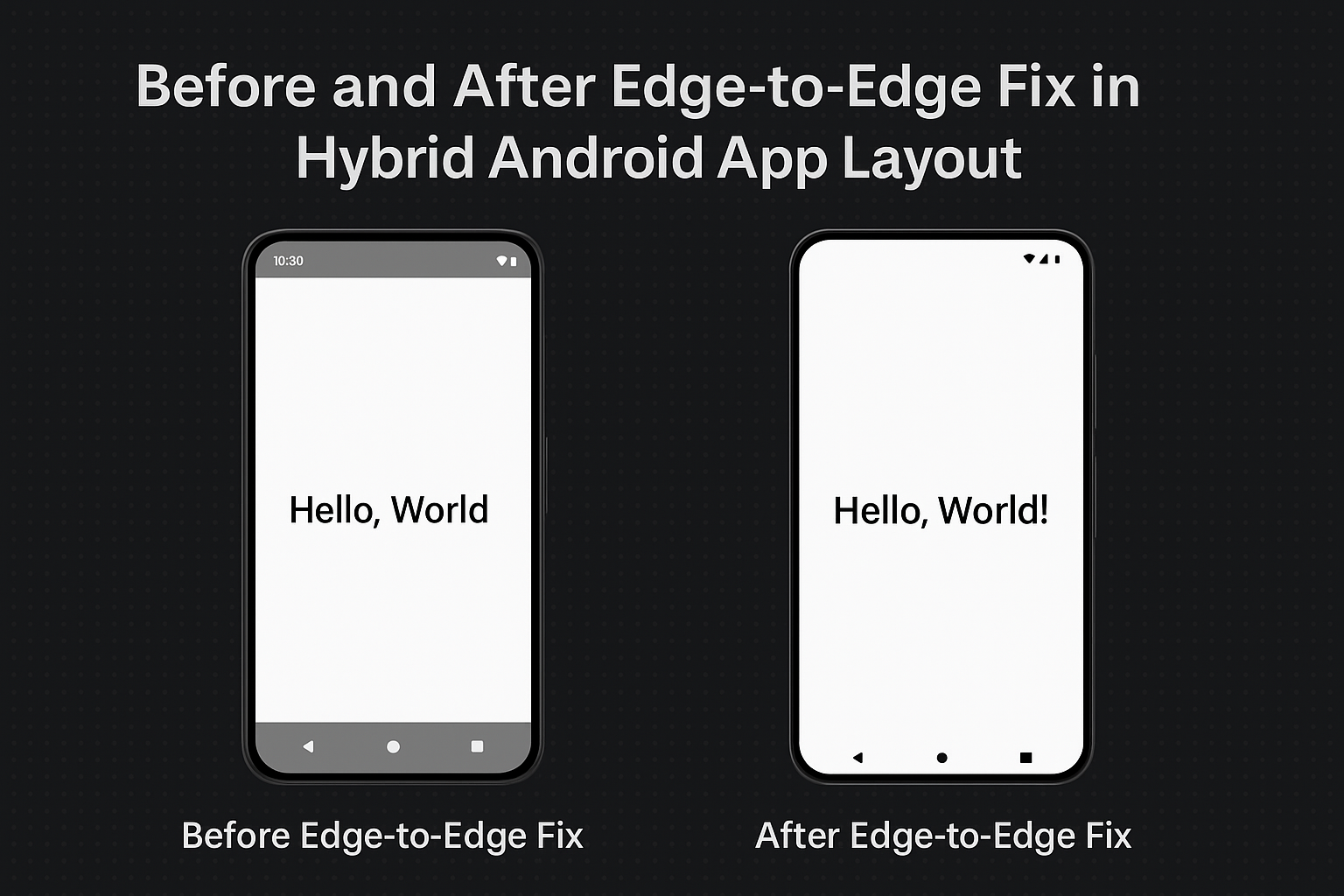
Fixing Edge-to-Edge Issues in Hybrid Android Apps (Android 15+)

Author: Jat

If you’ve updated your hybrid app to target Android 15 (API 34) and noticed broken layouts, cut-off content, or overlapping UI — you’re not alone.

Android is evolving to embrace immersive, edge-to-edge design. But hybrid apps built using Capacitor, Cordova, or Ionic often break because they rely on WebView, which doesn’t automatically adapt to system gesture insets or modern screen shapes.

🌐 What is Edge-to-Edge UI?

Edge-to-edge layout means your app’s content extends beneath the status bar, navigation bar, and gesture areas — using every available pixel.

Android encourages this layout to support:

  • Immersive design on full-screen devices
  • Compatibility with gesture navigation
  • Maximum space usage on notch, punch-hole, and curved displays

Read the official Android Edge-to-Edge Design Guide.

🎯 Why Was It Introduced?

  1. Maximize screen real estate — avoid wasting space on top/bottom bars.
  2. Gesture navigation compatibility — gestures now replace buttons.
  3. Modern UX standards — aligned with Google’s Material You design language.
  4. Cross-device consistency — Pixel, Samsung, OnePlus now follow Android’s rules.

💥 Why Hybrid Apps Break

Hybrid apps rely on WebView, which doesn’t adapt automatically to insets. The result?

  • Content may get hidden behind the system UI
  • Safe areas are ignored unless manually defined
  • CSS-only solutions fail unless the native layer is configured correctly

🛠 How to Fix Edge-to-Edge in Hybrid Apps

✅ 1. Set Target SDK to 34

compileSdkVersion 34
targetSdkVersion 34

✅ 2. Update Native Code for Insets

In MainActivity.java or MainActivity.kt:Java:

if (Build.VERSION.SDK_INT >= Build.VERSION_CODES.R) {
  getWindow().setDecorFitsSystemWindows(false);
} else {
  getWindow().getDecorView().setSystemUiVisibility(
    View.SYSTEM_UI_FLAG_LAYOUT_STABLE |
    View.SYSTEM_UI_FLAG_LAYOUT_FULLSCREEN |
    View.SYSTEM_UI_FLAG_LAYOUT_HIDE_NAVIGATION
  );
}

Kotlin:

if (Build.VERSION.SDK_INT >= Build.VERSION_CODES.R) {
  window.setDecorFitsSystemWindows(false)
} else {
  window.decorView.systemUiVisibility = (
    View.SYSTEM_UI_FLAG_LAYOUT_STABLE or
    View.SYSTEM_UI_FLAG_LAYOUT_FULLSCREEN or
    View.SYSTEM_UI_FLAG_LAYOUT_HIDE_NAVIGATION
  )
}

✅ 3. Make System Bars Transparent

In styles.xml:

<item name="android:statusBarColor">@android:color/transparent</item>
<item name="android:navigationBarColor">@android:color/transparent</item>

✅ 4. Handle Safe Areas in CSS

html, body {
  padding-top: env(safe-area-inset-top);
  padding-bottom: env(safe-area-inset-bottom);
  padding-left: env(safe-area-inset-left);
  padding-right: env(safe-area-inset-right);
}

For Ionic:

:root {
  --ion-safe-area-top: env(safe-area-inset-top);
  --ion-safe-area-bottom: env(safe-area-inset-bottom);
}

✅ 5. Respect Gesture Areas

Don’t place buttons or toolbars flush against screen edges. Use padding or bottom spacing to avoid gesture interference.

🧪 Debug Tip

Use Android Studio Layout Inspector or this ADB command to inspect insets:

adb shell dumpsys window | grep -i inset

🔗 External Resources

✅ Conclusion

Edge-to-edge layout isn’t just a design trend — it’s a requirement. Android 15 pushes for immersive, gesture-friendly apps. While hybrid apps need extra configuration, the result is a modern, polished experience that feels native.

By combining native insets with smart CSS, your hybrid app can look and behave like a top-tier Android experience — ready for the future.


Happy learnings!

💎 The Hidden Journey of Diamonds: Understanding Conflict-Free Choices

Diamonds are among the most cherished natural treasures—symbols of elegance, commitment, and timeless beauty. But like many natural resources, diamonds have a complex story. As consumers become more conscious about the origins of the products they buy, understanding how diamonds are sourced and brought to market has become more important than ever.

This article gently explores what are known as blood diamonds, and how the global community is working toward more transparent, ethical diamond trade.


🌍 What Are Blood Diamonds?

The term blood diamonds (also called conflict diamonds) refers to diamonds that were historically mined in regions where profits were used to support unrest, particularly in certain parts of Africa during past decades.

These diamonds were once linked to conflicts, not commerce. Over time, the world took notice and began to respond.


📜 A Look Back: Why It Mattered

In countries like Sierra Leone, Angola, and the Democratic Republic of Congo, diamonds played a role in financing regional tensions. This raised international concern, and in response, governments, civil society, and the diamond industry came together to improve transparency in the global diamond supply chain.


🛡️ The Kimberley Process: A Step Toward Transparency

In 2003, the Kimberley Process Certification Scheme (KPCS) was established as a way to help ensure that rough diamonds crossing borders are certified conflict-free. Today, over 80 countries participate in this initiative.

While it’s not perfect, the Kimberley Process is a meaningful global framework that promotes responsibility and traceability in diamond trading.


💎 What Does “Conflict-Free” Mean Today?

Today, most diamonds in the market are sourced from countries that participate in the Kimberley Process and follow international trade standards. Additionally, many jewelers go above and beyond, offering traceable or ethically sourced diamonds and partnering with suppliers committed to fair labor, environmental care, and local community development.


🌱 Modern Alternatives: Ethical & Lab-Grown Diamonds

If you’re looking for a diamond that aligns with your values, you now have more choices than ever:

  • Ethically sourced natural diamonds – responsibly mined and fairly traded.
  • Lab-grown diamonds – identical to natural diamonds, created in advanced facilities with minimal environmental impact and complete origin transparency.

These options reflect the growing desire for beauty with integrity.


🛍️ What You Can Do as a Thoughtful Buyer

Choosing a diamond today is about more than sparkle—it’s about purpose. Here’s how you can feel confident in your purchase:

  • ✅ Ask about sourcing and certifications.
  • ✅ Explore brands that focus on ethical practices.
  • ✅ Learn the story behind the diamond you’re buying.
  • ✅ Consider lab-grown diamonds if sustainability is a priority.

💡 Final Thought: A Beautiful Choice, Made Mindfully

Diamonds will always shine—but when we take time to understand where they come from, their brilliance becomes even more meaningful. Whether it’s for a proposal, a gift, or a personal treasure, choosing a conflict-free or ethical diamond is a quiet but powerful way to support fairness, transparency, and progress in the world.

Let your diamond reflect not just beauty, but also thoughtful intention.

🚆 Local Train Services in Jammu & Kashmir: Timings, Route Map & Travel Tips

Jammu and Kashmir, known for its breathtaking landscapes, is now becoming more accessible thanks to expanding rail connectivity. While the state doesn’t have Mumbai-style EMU local trains, the Banihal–Baramulla DEMU (Diesel Electric Multiple Unit) service acts as a lifeline for the people of the Kashmir Valley. If you’re a traveler, student, or just a curious local explorer, here’s your complete guide to local train services in Jammu & Kashmir.


🕒 Local Train Timetable: Banihal to Baramulla

Currently, Northern Railways operates multiple DEMU trains daily between Banihal and Baramulla, covering a distance of ~135 km with 17 halts in about 3 hours.

🚉 Sample Daily Train Timings:

Train No. From → To Departure Arrival Duration

74625 Banihal → Baramulla 07:00 10:10 3h 10m
74627 Banihal → Baramulla 14:05 16:55 2h 50m
74637 Banihal → Baramulla 09:10 12:30 3h 20m
74630 Baramulla → Banihal 11:30 14:40 3h 10m

🟢 Frequency: 5–6 DEMU pairs operate daily.

🔁 Tickets: Available at stations and via IRCTC.


🗺️ Route Map: Stations Covered

Here’s a quick overview of the local train journey from south to north:

Banihal → Qazigund → Anantnag → Srinagar → Budgam → Sopore → Baramulla

📍 Notable Stations:

Banihal (BAHL) – Gateway to Jammu region through the Pir Panjal Tunnel (India’s longest railway tunnel).

Qazigund (QG) – Often called the “Gateway to Kashmir”.

Anantnag (ANT) – A cultural and economic hub of South Kashmir.

Srinagar (SINA) – Station for the capital city, close to Dal Lake and major tourist sites.

Budgam (BDGM) – Known for saffron fields (in season).

Baramulla (BRML) – Northernmost railway station in India.


🧳 Travel & Tourism Tips

If you’re planning to explore Kashmir affordably, these DEMU trains are a hidden gem:

🌄 Scenic Value

Enjoy a panoramic view of the valley, especially while passing through the Pir Panjal range and lush meadows.

The Pir Panjal Railway Tunnel adds to the excitement of the journey.

🧭 Things to Do at Stops

Srinagar: Visit Dal Lake, Nishat Bagh, Shankaracharya Temple

Anantnag: Taste local wazwan cuisine; visit Martand Sun Temple nearby

Budgam/Sopore: Experience the charm of apple orchards and traditional Kashmiri village life

Baramulla: A base for visiting Gulmarg (approx. 1.5 hours away)

✅ Helpful Tips

Tickets: Mostly unreserved; arrive early for a seat.

Weather: Services may be delayed in harsh winters due to snow.

Local Transport: Autos, sumos, and taxis available at most stations.


🚧 What About Jammu Region?

Currently, there are no suburban or MEMU local trains in the Jammu–Udhampur–Katra region. Only long-distance express trains operate there. However, once the Udhampur–Banihal rail link is fully completed (as part of the USBRL project), a continuous Jammu–Baramulla corridor will allow more local train operations.


📌 Summary

Feature Details

Train Type DEMU (Local Passenger)
Route Banihal to Baramulla
Distance ~135 km
Duration ~3 hours
Best Time to Travel Spring, Autumn
Ticket Cost Very affordable (general class)
Tourist Friendly? Yes ✅


Whether you’re commuting, sightseeing, or just looking to explore the Kashmir Valley like a local, the Banihal–Baramulla DEMU trains offer a beautiful, budget-friendly, and scenic ride that reveals the soul of the region.