Categories
Blog Learning

🌍 Where AI Can’t Reach — The Hidden Corners of Our World

Artificial Intelligence (AI) seems to be everywhere today — from helping us write emails to powering self-driving cars and even exploring outer space.
But believe it or not, there are still places — both physical and digital — where AI can’t reach or has very limited power.

Whether you’re a student curious about technology or a professional working in the field, this journey will give you a clear picture of AI’s real-world boundaries.


🏜️ 1. Places Without Power or Internet

AI runs on electricity, data, and connectivity — remove any of these, and it stops working.

Examples:

  • The heart of deserts like the Sahara or remote parts of Australia
  • Mountain peaks and deep valleys of the Himalayas or Andes
  • Antarctica’s frozen interior, where only a few research bases exist
  • Underground mines and ocean depths, where signals can’t reach

In these areas, even your smartphone often struggles to connect — so AI systems simply can’t operate in real time.


🔒 2. Air-Gapped and Secure Networks

Some networks are intentionally kept offline for safety. This is known as being air-gapped — completely disconnected from the internet.

Examples:

  • Military and nuclear systems
  • Defense or space research labs
  • Government intelligence databases
  • Critical infrastructure controls like power grids or water treatment plants

AI might exist inside these systems in a limited way, but it can’t connect to the outside world — keeping it locked inside a digital fortress.


🌐 3. Regions with Digital Barriers

AI also faces political and social boundaries. Some countries or regions restrict access to major AI platforms or limit online freedom.

Examples:

  • North Korea’s closed intranet (Kwangmyong)
  • Iran’s and China’s filtered internet, where some global AI tools are blocked
  • Conflict or low-income regions where internet and technology are scarce

In these places, even if people want to use AI, access and infrastructure often make it impossible.


🏭 4. Outdated and Offline Machines

Many industries around the world still depend on old, analog machines that don’t support AI integration.

Examples:

  • Factories using 1980s machinery
  • Railways, shipping, or aviation systems running on legacy software
  • Rural communities relying on manual tools and basic communication devices

These systems work perfectly for their purpose, but AI can’t “talk” to them — they were never built for it.


🚀 5. Beyond Earth — The Cosmic Limit

AI has even reached space exploration, but beyond certain distances, communication breaks down.

Examples:

  • Deep-space probes traveling far from Earth eventually lose contact
  • The far side of the Moon or Mars caves, where radio waves can’t reach

In such places, any AI must operate completely offline, without guidance or updates from Earth.


🧭 Summary: The Limits of AI Reach

CategoryExamplesWhy AI Can’t Reach
No infrastructureAntarctica, Sahara, deep oceanNo power or network
Air-gapped systemsMilitary, defense, governmentSecurity isolation
Restricted regionsNorth Korea, Iran, ChinaCensorship or limited access
Legacy technologyOld industrial and rural systemsNo AI interface
Space limitsDeep space probes, Moon’s far sideLost communication

🌐 The Future: Slowly Closing the Gap

Technology is catching up.
Projects like Starlink, edge AI, and low-power microchips are pushing AI into the remotest corners — from villages to satellites.

Still, there will always be edges of the world — and edges of human experience — that remain beyond AI’s digital reach.


💡 Final Thought

AI may be powerful, but it’s not everywhere — not yet.
And maybe that’s a good thing. Some parts of our world — untouched, quiet, and disconnected — remind us of the balance between technology and the natural, human world we still belong to.

Categories
Blog Learning Tech

The Rise of AI Tools and Why Humans Still Matter: Navigating the Digital Revolution in 2025

Introduction

Artificial Intelligence (AI) is no longer a futuristic concept — it’s part of our everyday life. From writing content with ChatGPT to designing visuals in Canva, automating workflows with Zapier, or managing projects in Notion, AI-driven tools are shaping how we think, work, and create.

But as these tools rise in popularity, a quiet resistance continues. Many people and businesses still prefer traditional methods — relying on human intuition, personal experience, and manual control. The question is: Are we becoming too dependent on AI, or are we learning to coexist with it?


The Surge of AI Tools in 2025

The past few years have seen an explosion of AI-based platforms that simplify tasks, boost productivity, and save time.

Some of the most used AI tools today include:

  • ChatGPT & Gemini – AI assistants that write, code, and brainstorm ideas in seconds.
  • Canva & Adobe Firefly – Design tools with AI-generated templates and smart editing.
  • Notion & NotebookLM – Knowledge management systems that understand your content and summarize key insights.
  • Zapier & n8n – Workflow automation tools that connect hundreds of apps without coding.
  • Synthesia – AI video creation with lifelike avatars and multi-language support.

These tools have made digital work faster, cheaper, and more accessible than ever before. Yet, not everyone is rushing to adopt them.


Why Some People Still Avoid AI Tools

Despite the hype, there’s a strong segment of professionals, creators, and everyday users who remain skeptical of AI-powered platforms.

Here’s why:

1. Trust and Accuracy Concerns

AI can produce impressive results, but it can also make subtle mistakes or “hallucinate” facts. For sensitive work — such as legal, financial, or medical — many still prefer human oversight.

2. Comfort and Familiarity

Tools like Google Search, Excel, and even handwritten notes continue to thrive because they’re reliable and easy to control. Humans naturally trust what they’ve used for years.

3. Data Privacy Fears

Sharing data with cloud-based AI platforms raises questions about who owns the content and how securely it’s stored.

4. Creative Authenticity

Writers, artists, and designers often feel that AI-generated content lacks emotion or originality. Many prefer to use AI as inspiration, not as a full replacement.


The Human–AI Balance: Coexisting, Not Competing

The smartest professionals aren’t rejecting AI — they’re mastering how to work alongside it.

Here’s how people are finding balance:

  • AI for Repetition, Humans for Emotion
    Use AI for repetitive or data-heavy tasks while keeping creative storytelling, empathy, and emotional intelligence human-led.
  • Human Review in Every Workflow
    Always review AI outputs — from articles to analytics — to ensure accuracy and alignment with your goals.
  • Learning AI Literacy
    Understanding how AI works, its biases, and its limitations helps professionals use it more responsibly.

What the Future Looks Like

By 2030, the AI landscape will evolve even further. Expect:

  • Personal AI Assistants integrated into phones, browsers, and even home devices.
  • AI-driven jobs where humans supervise, refine, and creatively guide automated systems.
  • Ethical AI frameworks ensuring data transparency and fair usage.

But even in that future, human decision-making, empathy, and originality will remain irreplaceable.


Conclusion

AI is here to stay — but so are humans.
The key is not choosing one over the other but learning how to use both effectively.

AI can boost efficiency, simplify your workload, and open new creative doors. But human judgment, emotion, and authenticity will always define the difference between what’s simply generated and what truly connects.

So, as you explore new tools, remember: the smartest move isn’t automation alone — it’s intelligent collaboration between human and machine.

Categories
Learning

Tech Quality in 2025: Steering Strategy, Ethics, and Resilience

🌐 Introduction: Why Tech Quality Defines Leadership in 2025

In 2025, technology leadership is no longer just about delivering fast—it’s about delivering right. From AI agents making autonomous decisions, to cybersecurity threats powered by the same AI breakthroughs, to global regulations reshaping data practices, “tech quality” has become the true north star for executives and CIOs.

Top tech leaders now ask: How do we build systems that are ethical, sustainable, resilient, and future-ready?


1️⃣ Agentic AI & Ethical Design

The leap from copilots to agentic AI marks one of the most profound shifts since the internet. Unlike copilots, which assist with prompts, agentic systems act independently to complete multi-step tasks—optimizing logistics, managing workflows, even negotiating transactions.

But quality means building responsibly:

  • Embedding explainability so stakeholders understand how AI reached its conclusions.
  • Applying bias detection at scale to avoid unfair outcomes.
  • Introducing human-in-the-loop oversight for critical business functions.

🔎 Case Insight: Microsoft’s AI copilots are moving toward agentic behavior. The risk? “Hallucinations at scale.” The opportunity? Radical productivity gains if governed responsibly (TechRadar).


2️⃣ Cybersecurity & AI Threat Defense

As AI strengthens organizations, it also empowers attackers. Deepfake phishing campaigns, automated vulnerability scanners, and AI-powered malware are already here.

Tech quality in cybersecurity means:

  • Adopting Zero Trust architectures.
  • Investing in AI-driven detection that fights fire with fire.
  • Preparing for quantum threats to encryption—NIST already released post-quantum cryptography standards in 2024.

💡 Leadership Move: Appointing Chief AI Security Officers (CAISOs) is emerging as a strategic role, bridging AI innovation with robust defense.


3️⃣ Sustainability & Green IT

Data centers consume nearly 2% of global electricity—a number rising with AI workloads. For leaders, tech quality is inseparable from sustainability.

Strategies include:

  • Carbon-aware computing (Google shifts workloads to renewable-rich regions).
  • Extending hardware life cycles via refurbishment and circular design.
  • Tracking Scope 3 emissions in supply chains.

🌍 Case Insight: Dell and Apple are leading with circular hardware programs—recycling, refurbishing, and reducing e-waste.


4️⃣ Human Capital & AI Literacy

A resilient tech organization depends on its people as much as its systems. AI adoption is widening the skills gap, with AI, cybersecurity, and data analytics in highest demand.

Quality investment = continuous reskilling.

  • Executive programs like ISB’s Leadership with AI help bridge C-suite literacy gaps (Economic Times).
  • Gartner predicts 70% of CIOs identify talent shortage as the top barrier to transformation.
  • New C-suite roles (CAIO, Chief Data Ethics Officer) are emerging to institutionalize quality.

5️⃣ Data Sovereignty & Synthetic Integrity

Geopolitics is reshaping tech. Laws like GDPR (EU), Cloud Act (US), and India’s DPDP Act require organizations to rethink how and where they store data.

What leaders must prioritize:

  • Sovereignty-aware architectures (choosing local/hybrid deployments where required).
  • Embedding compliance policies at the infrastructure layer.
  • Leveraging synthetic data for innovation without regulatory risk—finance and healthcare are early adopters.

📊 Insight: Data sovereignty is no longer a “compliance checkbox”; it’s a strategic differentiator (TechRadar).


6️⃣ Future-Ready Infrastructure: Quantum, 6G & XR

Leaders must now prepare for next-gen tech waves:

  • Quantum computing: IBM and Google are advancing roadmaps, with near-term applications in logistics optimization and drug discovery.
  • 6G research: Expected by 2030, with early pilots already shaping IoT and industrial use cases.
  • Extended Reality (XR): Transforming workforce training, healthcare, and collaboration.

⚡ Prediction: Nvidia’s CEO Jensen Huang forecasts AI + accelerated computing will dominate the next five years (Times of India).


🧭 Practical Actions for Leaders

  1. Audit AI systems → for transparency, bias, and explainability.
  2. Transition IT infrastructure → toward carbon-aware, energy-efficient design.
  3. Invest in AI fluency → launch training programs from execs to engineers.
  4. Architect for sovereignty → hybrid/multi-cloud with compliance baked in.
  5. Leverage synthetic data → for safe innovation in regulated sectors.
  6. Pilot emerging tech → quantum-safe encryption, XR workforce tools, 6G testbeds.

🎯 Conclusion: Tech Quality as a Culture

In 2025, tech quality is not a metric—it’s a mindset. It requires embedding ethics, resilience, and sustainability into every strategic decision.

Leaders who succeed won’t just adopt the latest AI or infrastructure; they’ll earn trust, future-proof their organizations, and unlock competitive advantage by weaving quality into the very fabric of technology.

The future belongs to leaders who recognize that responsible innovation is the ultimate measure of quality.

Categories
Biz Blog

Flipkart’s Tech Edge: Inside Innovations Powering Big Billion Days 2025

Introduction

India’s e-commerce battlefield is heating up as Flipkart gears up for its Big Billion Days 2025 mega sale. At Tech Day 2025, Flipkart unveiled AI-powered tools, logistics upgrades, and futuristic shopping experiences designed to handle millions of orders and stay ahead of rivals like Amazon.

Key Tech Announcements

  1. AI Shopping Assistant: Personalized recommendations, conversational queries.
  2. Faster Logistics: Expansion of supply chain with predictive delivery models.
  3. Enhanced Seller Tools: Data dashboards for SMEs to analyze trends.
  4. AR/VR Shopping: Early rollout of immersive try-before-you-buy features.

Why It Matters

  • India’s e-commerce market is projected to hit $200+ billion by 2026.
  • Big Billion Days is more than a sale—it’s India’s largest retail festival, drawing millions.
  • Flipkart’s innovations aren’t just about convenience—they shape consumer behavior.

Competitive Angle

  • Amazon India invests in drone pilots & Prime expansions.
  • Reliance’s JioMart is targeting grocery dominance.
  • Flipkart’s edge is blending tech + scale + Indian consumer psychology.

Conclusion

Flipkart isn’t just preparing for a sale—it’s preparing for the future of Indian e-commerce. With AI, logistics, and immersive shopping, Big Billion Days 2025 could set new records and redefine how India shops.

Quick Fact Box:

  • Event: Flipkart Tech Day 2025
  • Sale: Big Billion Days (Sept–Oct 2025)
  • Key: AI assistant, AR shopping, logistics boost
Categories
Cricket

Asia Cup 2025 Preview: Cricket Fever, Rivalries, and What’s at Stake

Introduction

Cricket fever returns as the Asia Cup 2025 kicks off in the UAE from 9–28 September. Defending champions India are back to assert dominance, Pakistan is eager for redemption, and smaller teams eye upsets. Beyond cricket, this tournament carries the weight of pride, rivalry, and billions of viewers worldwide.

👉 Also Read: India’s Vice-Presidential Election 2025: Stakes, Strategy, and What to Watch

Format & Schedule

  • Dates: 9–28 Sept 2025
  • Format: T20 (perfect warm-up for the ICC T20 World Cup 2026).
  • Teams: India, Pakistan, Sri Lanka, Bangladesh, Afghanistan, Nepal.
  • Venues: Dubai, Abu Dhabi, Sharjah.

You can check the full fixture list at ESPN Cricinfo – Asia Cup 2025.

Key Rivalries

  • India vs Pakistan: Always more than a match—tickets sell out in minutes, and TV ratings skyrocket. Updates will be live on Star Sports.
  • Sri Lanka vs Bangladesh: A growing mini-rivalry after multiple close contests.

Players to Watch

  • India: Virat Kohli (in form), Shubman Gill (emerging star), Jasprit Bumrah (death overs specialist).
  • Pakistan: Babar Azam, Shaheen Afridi.
  • Sri Lanka: Wanindu Hasaranga.
  • Afghanistan: Rashid Khan.

For team stats and live data, see the ICC Official Website.

Stakes & Storylines

  • India looks to defend its crown.
  • Pakistan wants to break the jinx after recent losses.
  • Afghanistan seeks to establish itself as a consistent Asian power.

Conclusion

Expect drama, heartbreak, and unforgettable moments—because the Asia Cup isn’t just about cricket, it’s about identity, pride, and the thrill of seeing Asia’s giants battle it out.

Quick Fact Box:

  • Start Date: 9 Sept 2025
  • Host: UAE
  • Defending Champion: India
  • Format: T20
Categories
Politics

India’s Vice-Presidential Election 2025: Stakes, Strategy, and What to Watch

Introduction

On 9 September 2025, India heads into a rare mid-term vice-presidential election, triggered by the resignation of Jagdeep Dhankhar. It’s the first early VP election since 1987, making it more than a routine constitutional exercise—it’s a political battleground where symbolism matters as much as arithmetic.

👉 Also Read: Asia Cup 2025 Preview: Cricket Fever, Rivalries, and What’s at Stake

Background & Context

  • The Vice President of India is the second-highest constitutional office, presiding over the Rajya Sabha.
  • Dhankhar’s unexpected resignation (July 2025) created political tremors.
  • Election is conducted by an electoral college consisting of Lok Sabha and Rajya Sabha members. Voting is by secret ballot.
  • Timeline:
    • Notification: 7 Aug 2025
    • Nominations closed: 21 Aug 2025
    • Scrutiny: 22 Aug 2025
    • Withdrawals: 25 Aug 2025
    • Polling: 9 Sept 2025
  • Official notifications and timelines were issued by the Election Commission of India.

Candidates & Political Dynamics

  • NDA Nominee: C. P. Radhakrishnan (BJP, Tamil Nadu). A veteran with roots in South India—signaling BJP’s push to expand influence beyond the Hindi belt.
  • Opposition Nominee: B. Sudarshan Reddy (Independent, supported by INDIA alliance, Telangana). A calculated choice to emphasize regional balance and democratic resistance.

For deeper coverage, see The Hindu’s Politics Section.

The math favors NDA, given its numerical advantage in Parliament. Yet, for the opposition, it’s about symbolism and showing unity.

Significance & Implications

  • The Vice President’s role may seem ceremonial, but the Rajya Sabha chairmanship makes it politically potent.
  • BJP’s choice shows strategy for 2027 general elections—deeper penetration into South India.
  • INDIA bloc views this as an opportunity to project solidarity after mixed state election performances.

👉 Related Reading: Flipkart’s Tech Edge: Inside Innovations Powering Big Billion Days 2025

Conclusion

Come 9 September 2025, all eyes will be on Parliament—not for suspense over results (which favor NDA), but for the political messaging it sends across India’s democracy.

Quick Fact Box:

  • Election Date: 9 Sept 2025
  • NDA Nominee: C. P. Radhakrishnan
  • Opposition Nominee: B. Sudarshan Reddy
  • Last early VP election: 1987
Categories
Blog Learning

🚀 From College Frustrations to AI Writing Code: I Saw This Coming

Back then, I was just another guy in college, buried in assignments, projects, and endless debugging.

Every time I sat in front of the screen, I had the same thought running in my head:

“Why the hell can’t this be automated?”

I wasn’t dreaming about sci-fi robots or some fantasy tech. I just wanted the machine to help me.
I was tired of writing boilerplate code. Tired of repeating the same logic in slightly different ways. Tired of wasting hours on things that felt like they should’ve taken minutes.

Somewhere deep down, I kept asking myself — what if one day, I could just tell the computer what I wanted, and it would do the rest?

At the time, it felt crazy. A daydream. Something impossible.


🌱 Early Work Days: The Same Thought Followed Me

When I started working, the thought never left.
Meetings, tasks, deadlines — everything was moving fast, but the work still felt like it had friction.

Write. Debug. Rewrite. Test. Fix.
On loop.

I remember wishing, almost every week, “there has to be a smarter way.”


⚡ And Then… AI Happened

Fast forward to the last few years.

AI exploded.
Tools started rolling out that could:

  • Generate functions from a single line of English.
  • Suggest fixes before I even asked.
  • Explain code clearer than half the documentation I’d spent hours digging through.

The exact thing I used to imagine during late-night coding sessions? It’s here.
It’s real.
And it’s getting better every single day.


🖥️ What It Feels Like Now

For me, it’s a strange mix of relief and validation.

Relief — because those repetitive, frustrating parts of coding finally have shortcuts.
Validation — because the “crazy thought” I had back in college wasn’t crazy at all.

AI is not replacing developers. It’s amplifying them.
It’s letting us focus more on solving problems, designing smarter systems, and creating — rather than drowning in repetitive tasks.


🔮 Looking Back, Looking Ahead

What I once thought was just a wild idea in my head has turned into everyday reality.

And here’s the real kicker: the future you imagine today might not be so far away.

So if you’re sitting there, tired of something, wishing there was a better way — don’t ignore it.
That frustration might just be pointing toward the next big thing.

Because that’s exactly how I felt years ago.
And now? AI writes code.

Categories
Learning

AKJ ਸਟਾਈਲ ਟਬਲਾ (ਅਖੰਡ ਕੀਰਤਨ ਜਥਾ) ਦੀ ਅਭਿਆਸ ਕਿਵੇਂ ਕਰੀਏ

ਟਬਲਾ ਅਖੰਡ ਕੀਰਤਨ ਜਥਾ (AKJ) ਸੈਸ਼ਨਾਂ ਵਿੱਚ ਇੱਕ ਅਹੰਕਾਰਪੂਰਕ ਸੰਗੀਤਕ ਸਾਜ਼ ਹੈ। AKJ ਸਟਾਈਲ ਦਾ ਟਬਲਾ ਵਿਸ਼ੇਸ਼ ਹੈ ਕਿਉਂਕਿ ਇਹ ਲਗਾਤਾਰ ਰਿਥਮ, ਕੀਰਤਨ ਗਾਇਕਾਂ ਦਾ ਸਹਿਯੋਗ, ਅਤੇ ਲੰਬੇ ਸਮੇਂ ਲਈ ਊਰਜਾ ਬਣਾਈ ਰੱਖਣ ‘ਤੇ ਧਿਆਨ ਦਿੰਦਾ ਹੈ। ਕਲਾਸੀਕਲ ਟਬਲਾ ਸੋਲੋ ਦੇ ਵਿਰੁੱਧ, AKJ ਟਬਲਾ ਦਾ ਮੂਲ ਉਦੇਸ਼ ਹੈ ਰਿਥਮ, ਸਪੱਸ਼ਟਤਾ ਅਤੇ ਭਾਵਪੂਰਣ ਅਹਿਸਾਸ ਬਣਾਈ ਰੱਖਣਾ।

ਹੇਠਾਂ AKJ ਸਟਾਈਲ ਟਬਲਾ ਅਭਿਆਸ ਲਈ ਕਦਮ-ਦਰ-ਕਦਮ ਗਾਈਡ ਹੈ:


1. ਸੰਦਰਭ ਨੂੰ ਸਮਝੋ

  • AKJ ਟਬਲਾ ਪ੍ਰਮੁੱਖ ਤੌਰ ‘ਤੇ ਭਜਨ ਕੀਰਤਨ ਸੈਸ਼ਨਾਂ ਵਿੱਚ ਵਰਤਿਆ ਜਾਂਦਾ ਹੈ।
  • ਮੁੱਖ ਲਕੜੀ: ਲਗਾਤਾਰ ਠੀਕਾ ਬਣਾਈ ਰੱਖਣਾ, ਗਾਇਕ ਦੇ ਨਾਲ ਸੰਗਤ ਬਣਾਈ ਰੱਖਣਾ।
  • ਮੁਰਕੀ ਜਾਂ ਤੇਜ਼ੀ ਕਮ, ਪਰ ਧੀਰਜ ਅਤੇ ਸਧਾਰਨ ਲਹਿਰ ਉੱਤੇ ਧਿਆਨ।

2. ਭਜਨ ਤਾਲਾਂ ਲਈ ਮੁੱਖ ਠੀਕੇ ਸਿੱਖੋ

ਕਈ ਆਮ ਤਾਲਾਂ ਜੋ AKJ ਕੀਰਤਨ ਵਿੱਚ ਵਰਤੀਆਂ ਜਾਂਦੀਆਂ ਹਨ:

  • ਕੇਹੇਰਵਾ (8 ਬੀਟ): ਧਾ ਗੇ ਨਾ ਟਿਨ | ਨਾ ਕਾ ਧਿਨ ਨਾ
  • ਦਾਦਰਾ (6 ਬੀਟ): ਧਾ ਧੀ ਨਾ | ਧਾ ਤੁ ਨਾ
  • ਤੀਨ ਤਾਲ (16 ਬੀਟ): ਕਈ ਵਾਰੀ ਲੰਬੇ ਭਜਨਾਂ ਲਈ

ਅਭਿਆਸ ਸੁਝਾਅ: ਖੇਡ ਧੀਰੇ, ਸਪੱਸ਼ਟ ਅਤੇ ਨਰਮ ਰੱਖੋ। ਜ਼ਿਆਦਾ ਨਾ ਖੇਡੋ।


3. ਸਹਿਣਸ਼ੀਲਤਾ ਬਣਾਓ

  • AKJ ਕੀਰਤਨ 2–6 ਘੰਟੇ ਲੰਬੇ ਹੋ ਸਕਦੇ ਹਨ।
  • ਸ਼ੁਰੂਆਤ 15–20 ਮਿੰਟ ਲਗਾਤਾਰ ਖੇਡਣ ਨਾਲ ਕਰੋ, ਫਿਰ ਹੌਲੀ ਹੌਲੀ 1–2 ਘੰਟੇ ਤੱਕ ਵਧਾਓ।
  • ਧੀਮੇ, ਮੱਧਮ ਤੇ ਤੇਜ਼ ਤਾਲਾਂ ‘ਤੇ ਅਭਿਆਸ ਕਰੋ ਪਰ ਹਮੇਸ਼ਾ ਲਗਾਤਾਰਤਾ ਅਤੇ ਸਪੱਸ਼ਟਤਾ ਬਣਾਈ ਰੱਖੋ।

4. ਲਯ ਅਤੇ ਲਹਿਰ ‘ਤੇ ਧਿਆਨ ਦਿਓ

  • ਕੀਰਤਨ ਦੌਰਾਨ ਮੁਸਕਾਨ ਅਤੇ ਲਹਿਰਵਾਂ ਰਿਥਮ ਬਣਾਈ ਰੱਖੋ।
  • ਹੌਲੀ ਹੌਲੀ ਤੇਜ਼/ਧੀਮਾ ਕਰਨ ਦਾ ਅਭਿਆਸ ਕਰੋ।
  • ਬੋਲਾਂ ਵਿੱਚ ਸੁਖਮਾਰੀ ਤਬਦੀਲੀਆਂ (ਜਿਵੇਂ ਧਾ ਧਿਨ ਨਾ → ਧਾ ਟੀ ਨਾ) ਰਿਥਮ ਨੂੰ ਰੁਚਿਕਰ ਬਣਾਉਂਦੀਆਂ ਹਨ।

5. ਠੀਕੇ ਤੋੜੇ ਬਿਨਾਂ ਨਵੇਂ ਬੋਲ

  • AKJ ਟਬਲਾ ਛੋਟੇ ਸੁਝਾਅ ਅਤੇ ਤਬਦੀਲੀਆਂ ਦੀ ਆਗਿਆ ਦਿੰਦਾ ਹੈ।
  • ਸਧਾਰਨ ਤਬਦੀਲੀਆਂ: ਧਾ/ਨਾ ਵਧਾਉਣਾ, ਬੋਲ ਬਦਲਣਾ, ਨਰਮ ਰੋਲ ਕਰਨਾ।
  • ਹਮੇਸ਼ਾ ਮੁੱਖ ਠੀਕੇ ਤੇ ਵਾਪਸ ਆਉਣਾ ਯਕੀਨੀ ਬਣਾਓ।

6. ਸੁਣੋ ਅਤੇ ਨਾਲ ਖੇਡੋ

  • ਲਾਈਵ AKJ ਕੀਰਤਨ ਰਿਕਾਰਡਿੰਗ ਸੁਣੋ:
    • ਟਬਲਾ ਗਾਇਕਾਂ ਨਾਲ ਸੰਗਤ ਕਿਵੇਂ ਬਣਾਉਂਦਾ ਹੈ
    • ਲੰਬੇ ਸਮੇਂ ਲਈ ਰਿਥਮ ਕਿਵੇਂ ਬਣਾਈ ਰੱਖੀ ਜਾਂਦੀ ਹੈ
    • ਮੁਟਿਆ ਅਤੇ ਗੂੰਜਦਾਰ ਸਟ੍ਰੋਕਸ ਭਾਵਨਾਤਮਕ ਅਹਿਸਾਸ ਦਿਖਾਉਂਦੇ ਹਨ
  • ਨਾਲ ਖੇਡੋ ਅਤੇ ਊਰਜਾ ਅਤੇ ਭਾਵਨਾਤਮਕਤਾ ਮਿਲਾਓ।

7. ਸੁਝਾਅ ਪ੍ਰਕਟੀਸ ਰੂਟੀਨ

  1. ਵਾਰਮ-ਅੱਪ: 10 ਮਿੰਟ ਬੁਨਿਆਦੀ ਬੋਲਾਂ
  2. ਠੀਕੇ ਦਾ ਅਭਿਆਸ: 15–20 ਮਿੰਟ ਧੀਮੇ ਅਤੇ ਮੱਧਮ ਤਾਲ ‘ਚ
  3. ਲਗਾਤਾਰ ਖੇਡਣਾ: 20–40 ਮਿੰਟ ਸਹਿਣਸ਼ੀਲਤਾ ਤੇ ਲਹਿਰ ‘ਤੇ ਧਿਆਨ
  4. ਤਬਦੀਲੀਆਂ: 10–15 ਮਿੰਟ ਛੋਟੀਆਂ ਤਬਦੀਲੀਆਂ
  5. ਕੂਲ ਡਾਊਨ: ਰਿਕਾਰਡਿੰਗ ਨਾਲ ਨਰਮ ਖੇਡ

ਅੰਤਿਮ ਸੁਝਾਅ

  • ਰੋਜ਼ਾਨਾ, ਭਾਵਨਾਤਮਕ ਅਭਿਆਸ, ਉਂਗਲਾਂ ਦੀ ਤਾਕਤ ਅਤੇ ਸਹਿਣਸ਼ੀਲਤਾ ਬਣਾਉਂਦਾ ਹੈ।
  • ਸਟ੍ਰੋਕਸ ਸਪੱਸ਼ਟ ਅਤੇ ਗੂੰਜਦਾਰ ਹੋਣ।
  • ਖੇਡ ਦਾ ਅਨੰਦ ਲਓ—ਕਿਰਤਨ ਵਿੱਚ ਟਬਲਾ ਸਿਰਫ ਤਕਨੀਕ ਨਹੀਂ, ਸਾਂਤਵਾਦਕ ਅਨੁਭਵ ਵੀ ਹੈ।
Categories
Learning Learning

How to Practice AKJ Style Tabla (Akhand Kirtan Jatha)

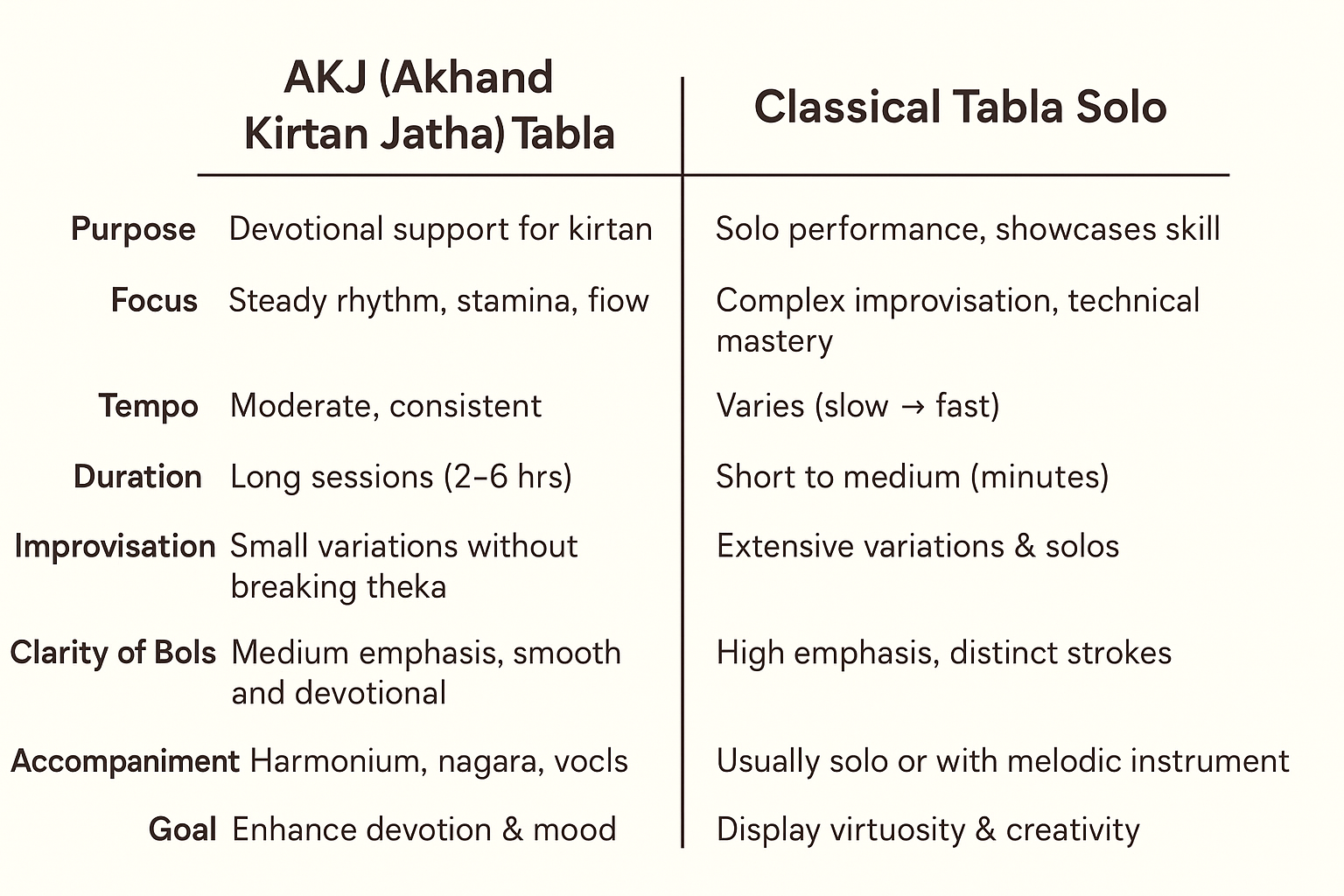
Tabla is an essential instrument in devotional music, especially in Akhand Kirtan Jatha (AKJ) sessions. The AKJ style of tabla is unique because it emphasizes continuous rhythm, supporting the kirtan singers, and maintaining energy for long hours. Unlike classical tabla solos, AKJ tabla focuses more on groove, clarity, and devotional feel rather than flashy improvisation.

Here’s a step-by-step guide on how to practice AKJ-style tabla:

1. Understand the Context

  • AKJ tabla is primarily used in devotional kirtan sessions, often alongside harmonium, nagara, and vocal singing.
  • The goal is to maintain a steady rhythm, enhancing the mood of the bhajan, without overpowering the singer.
  • Complexity is moderate, with an emphasis on stamina and smooth flow.

2. Learn Basic Thekas for Bhajan Talas

Some commonly used talas in AKJ kirtan include:

  • Keherwa (8 beats): Dha Ge Na Tin | Na Ka Dhin Na
  • Dadra (6 beats): Dha Dhi Na | Dha Tu Na
  • Teen Taal (16 beats): Occasionally for longer bhajans

Practice tip: Keep your playing steady, soft, and clear. Avoid overplaying.


3. Build Stamina

  • AKJ kirtans can last 2–6 hours, so stamina is key.
  • Start with 15–20 minutes of continuous playing and gradually increase to 1–2 hours.
  • Practice slow, medium, and fast tempos, but always maintain consistency and clarity.

4. Focus on Laya and Flow

  • Maintain a smooth and flowing rhythm throughout the kirtan.
  • Learn to gradually accelerate or decelerate without breaking the theka.
  • Subtle variations in bols (like Dha Dhin Na → Dha Ti Na) help keep the rhythm interesting and dynamic.

5. Improvisation Without Breaking Rhythm

  • AKJ tabla allows small improvisations during intros, outros, or pauses.
  • Simple variations include adding extra Dha/Na, swapping bols, or doing gentle rolls.
  • Always return to the main theka smoothly.

6. Listen and Play Along

  • Listen to live AKJ kirtan recordings to understand:
    • How tabla complements singers
    • How rhythm is maintained for long periods
    • How muted and resonant strokes highlight the mood
  • Play along to match energy, dynamics, and devotion.

7. Suggested Practice Routine

  1. Warm-up: 10 minutes of basic bols
  2. Theka Practice: 15–20 minutes in slow & medium tempo
  3. Continuous Play: 20–40 minutes focusing on stamina and flow
  4. Variations: 10–15 minutes of small improvisations
  5. Cool Down: Gentle play along recordings

Final Tips

  • Practice daily, even for short sessions, to build finger strength and endurance.
  • Keep your strokes resonant and clear, as clarity is the hallmark of AKJ tabla.
  • Enjoy the devotional process—playing tabla in kirtan is as much about spiritual connection as technical skill.
Categories
Blog Learning Tech

Latest GST Invoicing & Compliance for B2B and B2C in India (2025 Updates)

India’s GST system continues to evolve, bringing in new invoicing and compliance requirements for businesses. Whether you deal with Business-to-Business (B2B) or Business-to-Consumer (B2C) transactions, staying updated is essential to avoid penalties and ensure smooth operations.

This post covers everything you need to know about GST billing, invoicing, and filing under the latest rules effective from May 2025 — with facts, practical tips, and official references.


Understanding GST Invoicing: B2B vs. B2C

B2B Invoices: Mandatory E-Invoicing and Detailed Reporting

If your business has an annual turnover exceeding ₹5 crore, you are required to generate e-invoices for all B2B transactions. This means:

Uploading your invoice data to the Government’s Invoice Registration Portal (IRP).

Receiving an Invoice Reference Number (IRN) and QR code for each invoice.

Including important details such as buyer GSTIN, HSN codes (first 4 digits for large businesses), invoice number, taxable value, and tax amount.

This system ensures real-time invoice validation and enhances transparency across the GST network.
Fact: E-invoicing for B2B is mandatory for turnover > ₹5 crore since January 2023. (Sovos.com)

Also, only invoices properly reported and uploaded by the supplier allow buyers to claim Input Tax Credit (ITC).


B2C Invoices: Consolidated and Detailed Reporting

B2C transactions are treated differently based on invoice value:

For invoices up to ₹1 lakh, businesses report consolidated details in GSTR-1 returns (taxable value and tax amounts).

For invoices above ₹1 lakh, detailed invoice-wise reporting is mandatory.

Dynamic QR codes are required on B2C invoices from September 2024 onward, facilitating digital payments and improving transparency.

Businesses with turnover up to ₹5 crore must report only the first two digits of HSN codes on invoices.


GSTR-1 Return Filing Changes from May 2025

A significant update is the bifurcation of Table 12 in GSTR-1:

Table 12A: For B2B transactions.

Table 12B: For B2C transactions.

Both tables require HSN-wise summaries of supplies, helping the tax authorities analyze sales data more granularly and reducing reconciliation errors.

Timely filing of GSTR-1 remains crucial. Late or incorrect filing can delay ITC claims for buyers, which impacts cash flow and compliance.


Workflow for GST Compliance

  1. Invoice Generation:

E-invoices for B2B transactions through IRP.

Standard invoices with QR codes for B2C transactions.

  1. GSTR-1 Filing:

Report invoices accurately under the correct category (B2B or B2C).

Ensure inclusion of all mandatory details — GSTIN, HSN codes, invoice values, tax rates, etc.

  1. GSTR-3B Filing:

Cross-verify GSTR-1 data and declare tax liability.

Ensure ITC claims are supported by supplier invoice uploads.

  1. E-Way Bill Generation:

Mandatory for inter-state movement of goods exceeding ₹50,000 in value.


Key Compliance Checklist

Ensure accuracy of invoice data (GSTIN, HSN, tax rates).

Comply with e-invoicing mandates based on turnover.

Include dynamic QR codes on B2C invoices.

File GSTR-1 and GSTR-3B on time to avoid penalties.

Regularly reconcile returns to claim correct ITC.


Pro Tips to Stay Ahead

Use GST-compliant invoicing software that automatically generates e-invoices and helps with return filing.

Stay updated with notifications from the GST Council and the Government portal.

Periodically audit your GST returns for consistency between invoices and filings.


Conclusion

The GST landscape in India is advancing towards greater digitization and transparency, especially with the rise of e-invoicing and detailed return filings. Understanding the differences in billing requirements for B2B and B2C transactions — along with the new GSTR-1 structures — is critical for businesses to remain compliant and optimize their tax workflows.


References & Further Reading:

GST E-invoicing Mandate – Sovos

GST Return Filing Changes May 2025 – CaptainBiz

GST B2B vs B2C Invoice Reporting – EZTax

GST Updates – Economic Times